Author: Trace Rock

Meta’s new AI project turns doodles into animated figures

Meta’s intention in making Animated Drawings an open-source project is to enable other developers to innovate and provide users with more diverse and immersive experiences

Meta, the parent company of Facebook, has announced a new AI project that can turn simple doodles into animated figures. The project, called “Doodle to Life,” uses machine learning algorithms to analyze hand-drawn sketches and transform them into animated 3D characters.

The technology behind Doodle to Life is based on Meta’s existing machine learning models for understanding and processing natural language. By adapting these models to interpret doodles, the company hopes to create a new form of expression that is accessible to anyone.

“Everyone can draw a doodle, but not everyone can animate a character,” said Ficus Kirkpatrick, Head of AI at Meta. “With Doodle to Life, we’re making it easy for anyone to bring their ideas to life in a fun and creative way.”

Continue reading… “Meta’s new AI project turns doodles into animated figures”

Scientists create new biocompatible bio-ink to 3D print artificial organs

The new temperature method is based on a “poly(organophosphazene)-based temperature-sensitive hydrogel.”

A team of scientists has developed a new biocompatible bio-ink that can be used to 3D print artificial organs, such as livers and pancreases, that can be transplanted into humans. The researchers, led by Dr. Ali Khademhosseini, a professor of bioengineering at the University of California, Los Angeles, created the new ink by combining alginate, gelatin, and a glycoprotein called recombinant human collagen.

According to Khademhosseini, the new bio-ink has several advantages over previous formulations. “The new ink is biocompatible and can support cell growth and differentiation, which is essential for creating functioning tissues,” he explained. “Additionally, it has the necessary mechanical properties to be 3D printed into complex structures.”

To test the new bio-ink, the team 3D printed a liver-like structure and then seeded it with liver cells. After a week, the cells had grown and formed a functioning tissue that could perform some of the functions of a real liver.

Continue reading… “Scientists create new biocompatible bio-ink to 3D print artificial organs”

Microsoft Joins the Chip-munks, Will Make its Own AI Chips

One of the primary reasons for Microsoft’s foray into chip-making is to ​​reduce costs, which Athena could possibly slash by a third in comparison to Nvidia

Microsoft has announced its plan to develop its own AI chips, which will be used to power its Azure cloud platform and other products. This move will bring Microsoft into the growing club of tech companies that have started building their own custom chips to handle AI workloads.

According to Microsoft’s Chief Technology Officer, Kevin Scott, the company has already started to make progress in developing its own AI chips. He said, “We are going to build some of the world’s most advanced AI supercomputers, AI chips and infrastructure.”

Scott also mentioned that Microsoft is collaborating with researchers from several universities to develop these AI chips. He stated, “We’re working with a number of different academic institutions to do advanced research around these new types of chips.”

Continue reading… “Microsoft Joins the Chip-munks, Will Make its Own AI Chips”

Hyundai Building Wearable Robot for Patient Rehabilitation

The ‘X-ble MEX’ is a wearable medical robot Hyundai Robotics Lab developed to help with lower muscle reconstruction and joint mobility recovery.

Hyundai Motor Group has announced that it is developing a wearable robot for patient rehabilitation. The wearable robot, which is currently in the prototype stage, is designed to help patients who have suffered from strokes or other neurological disorders regain their mobility.

According to the company, the wearable robot consists of a waist belt and leg straps that can be worn by the patient. The robot is equipped with sensors that can detect the patient’s movements and provide feedback to help them improve their walking and balance.

“We are excited to be developing this innovative wearable robot technology, which has the potential to revolutionize the way patients recover from neurological disorders,” said Chung Eui-sun, executive vice chairman of Hyundai Motor Group. “Our goal is to help patients regain their mobility and independence, and improve their quality of life.”

Continue reading… “Hyundai Building Wearable Robot for Patient Rehabilitation”

Mitsubishi Motors to Launch World’s First Real-time Cinematic Vehicle Configurator

● Industry-first use of the latest cloud streaming video game technology allows customers to configure their ideal 2023 Outlander Plug-In Hybrid and see it in motion 
● Upon completion, customers receive personalized interactive microsite featuring images and videos of their vehicle 
● ZeroLight‘s cloud-based, plug-and-play visualization platform complements Mitsubishi Motors’ ClickShop digital showroom experience

Mitsubishi Motors has announced the launch of the world’s first real-time cinematic vehicle configurator, which will enable customers to configure and visualise their vehicles in a more immersive and interactive way. The configurator is set to be launched in the UK in May 2023, and will be available on the company’s website.

According to Mitsubishi Motors UK’s managing director, Rob Lindley, “We are excited to be launching this cutting-edge technology, which will provide our customers with a more engaging and interactive way to configure and visualise their vehicles. This is a game-changing technology that we believe will revolutionize the way people buy cars.”

Continue reading… “Mitsubishi Motors to Launch World’s First Real-time Cinematic Vehicle Configurator”

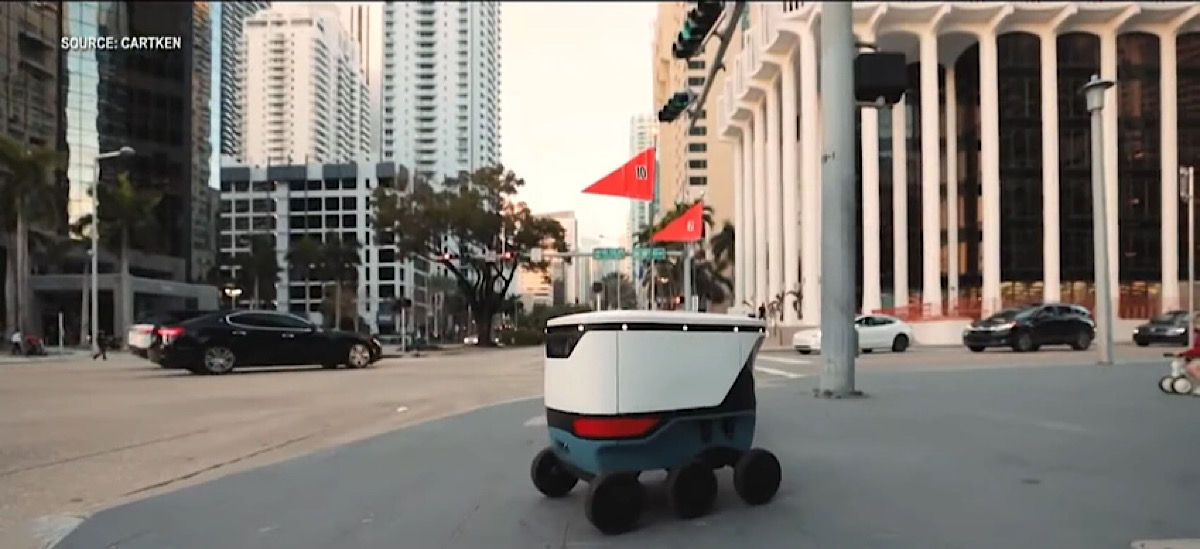
Uber Expands Robot Delivery Service to Virginia

The news follows the successful pilot of the service in Miami, Florida

Uber has expanded its robotic delivery service to Virginia, providing contactless delivery to customers through its autonomous delivery robots. This marks the fourth state in which Uber has launched its robotic delivery service, following its debut in California in 2019.

According to Luke Fischer, Head of Uber’s Autonomous Delivery business unit, “Our delivery robots are perfect for customers who are looking for an affordable and convenient way to receive their orders. With this expansion, we are excited to bring our service to more people in Virginia, and provide them with a safer, more efficient and cost-effective delivery option.”

The delivery robots are equipped with cameras and sensors that allow them to navigate sidewalks and traffic safely, and they can travel up to three miles per hour. Customers can track the delivery in real-time through the Uber app and receive a notification once the delivery has been made.

Continue reading… “Uber Expands Robot Delivery Service to Virginia”

Tiny Spacecraft Using Solar Sails Open Up a Solar System of Opportunity

A new generation of tiny spacecraft could be the key to unlocking the potential of solar sails, allowing us to explore the solar system in new and exciting ways. These spacecraft, which are no larger than a postage stamp, use the power of the sun to travel through space, and could help us to study asteroids, comets, and other celestial bodies in more detail than ever before.

Solar sails work by using the pressure of sunlight to propel the spacecraft forward. The sails are made from thin, reflective material that reflects the light and generates a small amount of thrust. Over time, this thrust can add up, allowing the spacecraft to reach high speeds and travel great distances.

According to Planetary Society CEO Bill Nye, solar sails have the potential to revolutionize space exploration. “Solar sails offer a new way of exploring the solar system,” he said. “They allow us to travel much faster and much farther than we ever have before.”

Continue reading… “Tiny Spacecraft Using Solar Sails Open Up a Solar System of Opportunity”

Super-thin ‘mirror membranes’ could lead the way to bigger space telescopes

Researchers at the University of Colorado Boulder have developed super-thin mirror membranes that could pave the way for larger space telescopes. The new technology could enable telescopes that are up to 100 times larger than current ones, allowing scientists to explore deeper into the universe than ever before.

The mirror membranes are made from silicon nitride, a strong and lightweight material that is just 100 nanometers thick, which is about 1,000 times thinner than a human hair. The membranes are coated with a layer of gold, which makes them highly reflective.

According to CU Boulder Professor Mihail Bora, the new technology has several advantages over current mirror systems. “The thinner the mirror, the less mass it has, which makes it easier to launch into space,” he said. “And because it’s so thin, it can be deformed using less force, which means we can control the shape of the mirror more precisely.”

Continue reading… “Super-thin ‘mirror membranes’ could lead the way to bigger space telescopes”

MIT uses liquid neural networks to teach drones navigation skills

MIT researchers have developed a new method of training drones to navigate by using a “liquid neural network” that can simulate human learning. The system is capable of learning from a small amount of data and can adapt to new environments quickly.

According to MIT postdoctoral associate William Gilpin, “The system is inspired by the way the human brain works. It’s designed to mimic the brain’s ability to learn from experience and adjust to new situations.”

The liquid neural network uses a “memristor-based neural network” that is trained to recognize patterns in visual data. The network is then used to control the drone’s flight path, allowing it to navigate through complex environments with ease.

Continue reading… “MIT uses liquid neural networks to teach drones navigation skills”

Space startup Bellatrix to test electric propulsion for satellites on-board PSLV

Hall-effect thruster (HET), on Polar Satellite Launch Vehicle-C55 that is set for launch 

Space startup Bellatrix Aerospace is set to test its innovative electric propulsion system for satellites onboard the Polar Satellite Launch Vehicle (PSLV) rocket. The test will take place as part of a satellite mission scheduled for later this year, marking a major milestone for the Bangalore-based startup.

Bellatrix Aerospace was founded in 2015 by Rohan M Ganapathy and Yashas Karanam, two young engineers from India’s prestigious Indian Institute of Technology (IIT) Bombay. The startup is focused on developing cost-effective propulsion systems for satellites and spacecraft, with a particular emphasis on electric propulsion.

Electric propulsion systems are seen as a game-changer for the satellite industry, as they offer several advantages over traditional chemical propulsion systems. They are more efficient, which means they can carry more payload while using less fuel, and they can operate for longer periods of time, which is particularly useful for deep-space missions.

Continue reading… “Space startup Bellatrix to test electric propulsion for satellites on-board PSLV”

AI is teaching the Ford Mustang Mach-E how to drive

Semi-autonomous BlueCruise feature improved with artificial intelligence

The Ford Motor Company has partnered with autonomous driving technology company Argo AI to use artificial intelligence (AI) to teach its new electric Mustang Mach-E how to drive. The collaboration between the two companies aims to develop the necessary technology to make the Mach-E a fully autonomous vehicle.

Argo AI, which is partially owned by Ford, has been working on autonomous vehicle technology since 2016. Their expertise in developing self-driving systems and Ford’s long-standing legacy in the automotive industry is expected to bring a new level of innovation to the market.

The goal is to teach the Mach-E how to drive in a variety of situations, including city and highway driving. The AI technology will also be used to develop the vehicle’s ability to recognize objects and pedestrians on the road, as well as its ability to navigate through traffic.

Continue reading… “AI is teaching the Ford Mustang Mach-E how to drive”

Bubbles Not Needles: MIT Scientists Create Ultrasonic Patch to Painlessly Deliver Drugs

The patch delivers drugs through ultrasonic waves.

A team of researchers from the Massachusetts Institute of Technology (MIT) has developed a novel way of delivering medication through the skin without causing any pain. This technology could revolutionize the way medicines are administered to patients, especially those who require injections.

The ultrasonic patch, as it is called, uses high-frequency sound waves to open up microscopic channels in the skin through which the medication can be delivered. According to the researchers, this method is much less painful than traditional injections, and it could be used to administer a wide range of drugs, including vaccines and insulin.

The team, led by Professor Giovanni Traverso and Dr. Carl Schoellhammer, tested the patch on pigs and found that it was able to deliver insulin into their bloodstream effectively. In addition, the researchers say that the patch can be easily customized to deliver different dosages of medication.

Continue reading… “Bubbles Not Needles: MIT Scientists Create Ultrasonic Patch to Painlessly Deliver Drugs”
Discover the Hidden Patterns of Tomorrow with Futurist Thomas Frey
Unlock Your Potential, Ignite Your Success.

By delving into the futuring techniques of Futurist Thomas Frey, you’ll embark on an enlightening journey.

Learn More about this exciting program.