
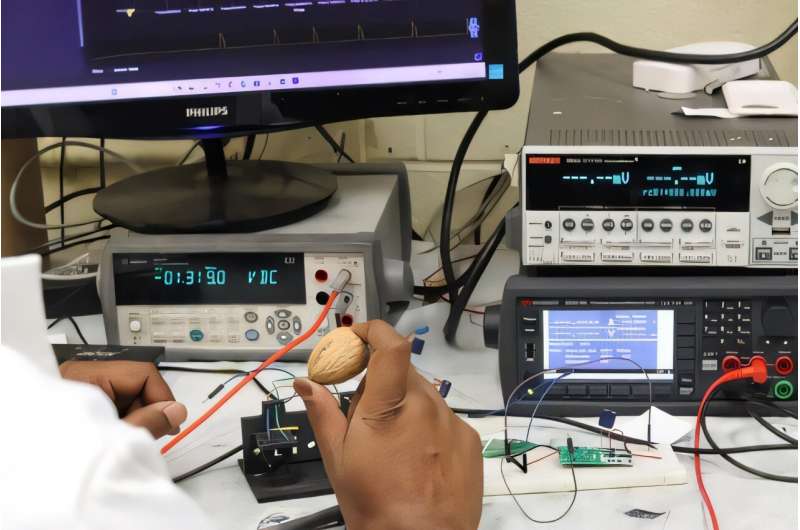
What if the next leap in energy didn’t come from billion-dollar reactors, sprawling power plants, or futuristic satellites, but from something as humble as a walnut shell? At the University of Waterloo, researchers have created a device no bigger than a coin that can generate electricity from waste shells and a few drops of water. This deceptively simple invention could one day power wearable sensors, remote monitors, and portable devices in places where batteries are too costly or fragile to be practical.
The device, known as a water-induced electric generator (WEG), is built on an insight hiding in plain sight: the natural structure of nut shells. Walnuts, it turns out, have a labyrinth of pores designed to transport water and nutrients as the nut grows. When water evaporates through those pores, it carries charged ions that rub against the shell’s surface, creating an electrical imbalance. The result is hydrovoltaic energy—electricity harvested from the simple act of water leaving a surface.
Graduate researcher Nazmul Hossain stumbled onto the idea after examining a hazelnut shell under an electron microscope. The intricate design, honed by evolution, looked like a ready-made system for energy harvesting. Testing showed that walnuts, in particular, offered the highest energy yield. With minimal treatment—cleaning, polishing, and shaping—these shells could be transformed into miniature power sources.
The results are modest but powerful in implication. By linking four walnut-based WEGs together, the Waterloo team produced enough electricity to run an LCD calculator. That may sound small, but it demonstrates a profound idea: discarded biological material, activated by nothing more than evaporating water, can become a reusable power source for electronics. Imagine environmental sensors scattered through forests, wearable health monitors, or disaster-relief gear powered continuously by droplets from rain, sweat, or ambient humidity.
The researchers are already thinking ahead. They are experimenting with wearable WEGs that can generate energy from human sweat and testing applications like leak-detection sensors that could run indefinitely without battery replacements. They’ve also tried using wood as an alternative material, suggesting the concept could extend far beyond nuts. In an age where electronics are shrinking faster than their batteries, this kind of innovation could provide the missing piece—energy harvesters that are as small, simple, and sustainable as the devices they power.
The future of energy isn’t just about scaling up. It’s also about scaling down—about creating solutions for the tiny, distributed, always-on devices that will define the Internet of Things, wearable healthcare, and remote sensing. WEGs suggest a path forward where every drop of water and every piece of organic material can become part of the energy ecosystem.
Walnut shells, long discarded as waste, could soon be powering the technologies that connect and protect us. The beauty of this vision lies not in grand infrastructure, but in the elegance of nature’s own architecture repurposed for human use. The next wave of innovation may not look like massive grids or towering turbines—it may look like a coin-sized device quietly pulling power from the air.
Read more on related breakthroughs:
