
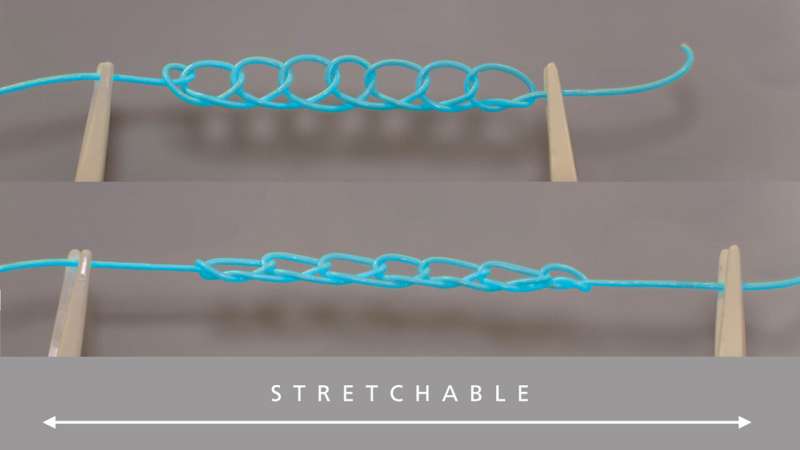
Researchers at the National University of Singapore (NUS) have developed a groundbreaking fiber technology that could transform the landscape of soft robotics, wearable electronics, and interactive displays. The innovative “SHINE” (hydrogel-clad ionotronic nickel-core electroluminescent) fiber represents a remarkable convergence of multiple cutting-edge technological capabilities.
The SHINE fiber emerges as an extraordinary technological achievement, simultaneously offering self-healing properties, bright light emission, magnetic manipulation, wireless powering, and extreme flexibility. Led by Associate Professor Benjamin Tee, the interdisciplinary research team from NUS’s Department of Materials Science and Engineering and Institute for Health Innovation & Technology has created a technological marvel that comprehensively addresses significant limitations in existing light-emitting fibers.
The fiber’s unique design ingeniously incorporates a nickel core for magnetic responsiveness, a zinc sulfide-based electroluminescent layer for light emission, and a transparent hydrogel electrode. Its performance is truly remarkable, achieving a record luminance of 1,068 cd/m², which substantially exceeds typical indoor visibility requirements. The researchers have successfully fabricated fibers extending up to 5.5 meters long, maintaining full functionality even after nearly a year of open-air storage.
Perhaps most impressive is the fiber’s self-healing mechanism. When damaged, it can restore chemical bonds under ambient conditions, recover structural integrity through heat-induced dipole interactions at 50 degrees Celsius, and remarkably regain over 98% of its original brightness after repair. This capability transforms how we conceptualize technological durability and resilience.
The potential applications for the SHINE fiber span an impressive range of technological domains. It could revolutionize smart textiles with dynamic lighting capabilities, enable soft robotic systems capable of navigating intricate spaces, create interactive displays with sophisticated optical signaling, and develop wearable technology with unprecedented durability.
Looking forward, the research team is focusing on refining magnetic actuation precision, exploring the integration of advanced sensing capabilities like temperature and humidity detection, and developing increasingly sophisticated light-emitting textile technologies. Published in Nature Communications on December 3, 2024, this research represents a significant leap forward in creating adaptable, multi-functional technological materials that could fundamentally reshape human-technology interactions.
By Impact Lab
