
By Futurist Thomas Frey
You slide into a Tesla Robotaxi at 11 PM with your golden retriever. Your spouse thinks you’re working late. You tell the destination—your colleague’s apartment across town. Your dog settles on the seat beside you. The doors close. No driver. No witnesses. Just you, your dog, and your secret rendezvous, right?
Wrong. Catastrophically, documentably, permanently wrong.
That driverless car isn’t a private space. It’s a rolling surveillance platform with cameras recording interior and exterior, microphones capturing audio (including your dog’s barking), sensors monitoring every movement—human and canine—GPS tracking precise routes, and AI analyzing passenger behavior for safety, liability, and—here’s the part nobody’s talking about—pet-related cleaning fees.
Tesla just announced their Robotaxi cleaning fee structure: $50 for moderate messes like food spills, $150 for severe issues like biowaste or smoking. But here’s what the fine print reveals: pet-related fees start at $75 for dog hair and dander requiring extra cleaning, escalate to $200 for pet accidents, and hit $350 for damage like scratched seats or chewed interior components. Every standard Robotaxi ride with pets is recorded, reviewed, and analyzed. Your dog’s behavior? Documented. Your affair? Recorded. Your pet’s anxiety episode that destroyed the seat fabric? Catalogued, timestamped, billed, and stored.
Welcome to the quirky reality of driverless cars: they’re public transportation masquerading as private space. But here’s the twist—privacy might still exist. You and your pet will just have to pay for it.
What “Public Transportation” Actually Means (For Most People and Their Pets)
Traditional taxis offered plausible deniability—for both passengers and their animals. Sure, there’s a driver, but drivers see hundreds of passengers weekly. Your specific ride and your dog’s behavior blur into anonymity. Cash payment leaves no digital trail. The driver might remember the passenger whose dog destroyed the upholstery, but most rides fade from memory.
Standard Robotaxis eliminate every shred of this anonymity for both humans and animals. Every ride links to your account—including notation that you brought a pet. Every route is logged. Every interior event is recorded “for safety and quality assurance.” The car doesn’t forget that your dog barked for fifteen minutes straight or that you let him sit on the seat without the required pet carrier. The car doesn’t overlook the muddy paw prints or the hair covering the interior.
Think about what this captures: You and your date getting physical in the backseat while your dog watches? Recorded. Your dog having an anxiety attack and damaging the door panel trying to escape? Documented with multiple camera angles. The treat you gave your pet that he subsequently regurgitated on the floor? AI-analyzed to determine cleaning fee tier. That conversation about your secret plans while absent-mindedly petting your dog? Stored.
But—and this is where it gets interesting—companies are already recognizing that some passengers will pay premium prices for privacy that extends to their pets.
The Form Factor Question: Cars or Vans?
Here’s the design question nobody’s definitively answered: will autonomous robotaxis be shaped like traditional cars or more like vans? The answer matters enormously for pet owners and privacy alike.
The car-shaped argument: Maintains familiarity, fits existing infrastructure, appeals to passengers accustomed to sedan-style vehicles. But car interiors are cramped for large dogs, difficult to clean thoroughly between rides, and offer minimal separation between passengers.
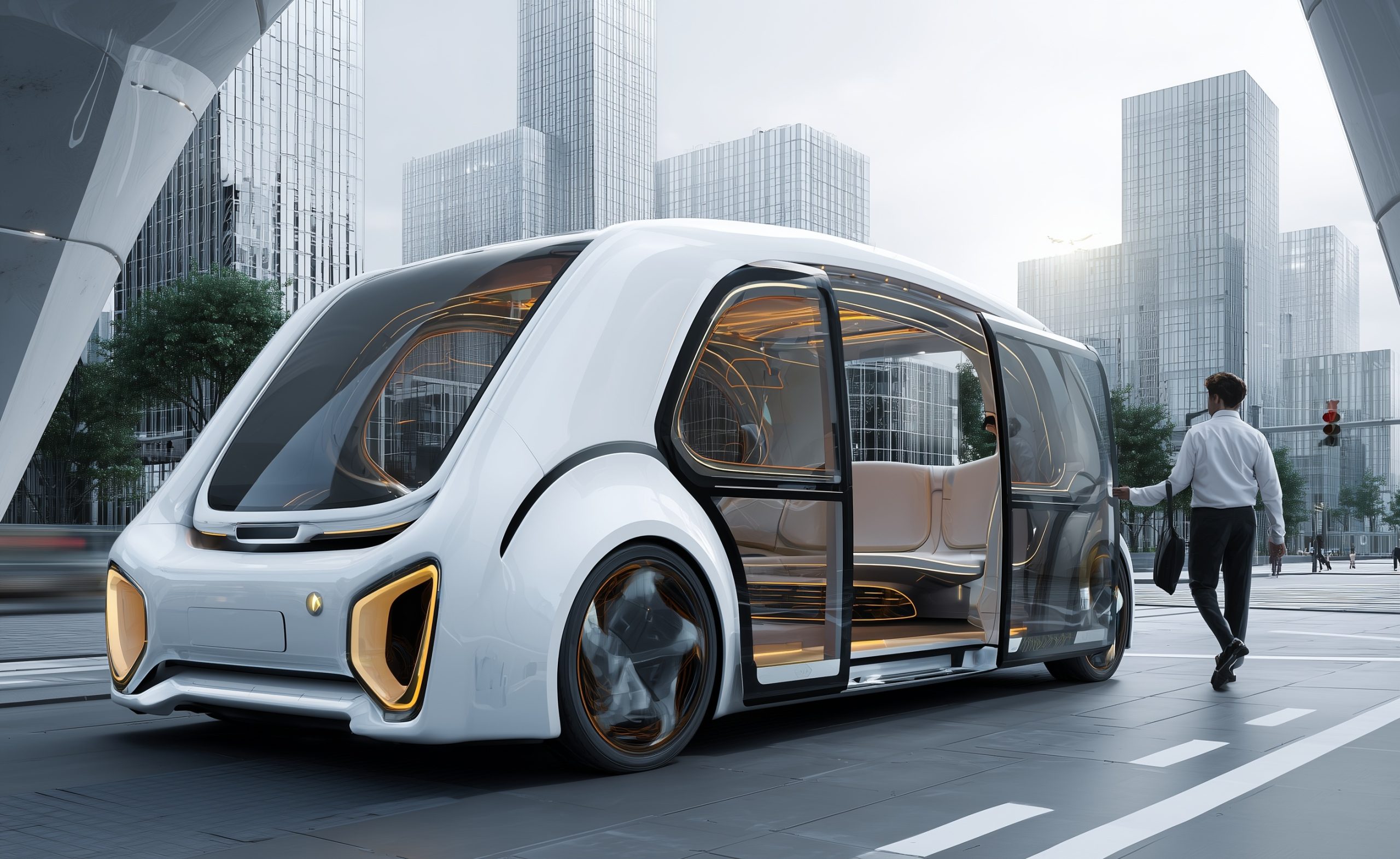
The van-shaped argument: Maximizes interior flexibility, allows configuration changes between rides, provides dedicated pet zones separate from seating areas, simplifies cleaning with flat floors and removable panels. Companies like Zoox and Cruise are already designing purpose-built autonomous vehicles that look more like rolling living rooms than traditional cars.
My assessment: the industry converges on van-like form factors within 5-7 years. Why? Because operational efficiency demands it. Van-shaped robotaxis can reconfigure interiors automatically: four-seat mode for families, two-seat-plus-cargo for deliveries, pet-friendly mode with washable surfaces and separation barriers, premium privacy mode with soundproofing and opaque partitions.
Pet transport specifically drives van adoption. A car-shaped robotaxi struggles to accommodate large dogs safely. Van interiors allow dedicated pet compartments with proper ventilation, containment, and easy cleaning—essential when the same vehicle transports pets one hour and executives the next.
The Privacy-Tier Emerging Market (For Humans and Their Animals)
Imagine a different service tier: “Discretion Mode” Robotaxis that cost 5-10x standard rates but come with contractual privacy guarantees for both passengers and pets. Cameras disabled except for external safety monitoring. No interior recording. No audio capture. Minimal data retention—just pickup, dropoff, payment, and a simple yes/no flag for “pet present,” purged after 48 hours.
Think autonomous limousines for executives conducting sensitive business calls while their emotional support dogs accompany them. Private vehicles for celebrities avoiding paparazzi—with their recognizable pets that would otherwise give them away. Discrete transport for people having affairs who can afford to keep both their infidelity and their distinctive Great Dane secret. Medical transport where patient privacy extends to service animals that might reveal health conditions.
The market already exists. Traditional limousine services charge premium rates partly for privacy—soundproof partitions, tinted windows, drivers who understand discretion extends to remembering which passengers travel with animals. Autonomous vehicles could replicate this model: standard surveillance-heavy Robotaxis where every pet hair is documented, versus premium privacy-protected vehicles where neither your presence nor your dog’s is recorded.
This creates a fascinating two-tier system: privacy becomes luxury good for both humans and pets. The wealthy travel incognito in vehicles that don’t record their German Shepherds. Everyone else accepts that their pet’s behavior becomes corporate data used for fee assessment and service optimization.
The Pet Scenarios Playing Out Differently by Price Point
The service dog scenario—budget version: Your standard Robotaxi records everything about your service animal—behavior, commands you give, tasks it performs. That data reveals your disability. Your health insurance company subpoenas records showing you required a psychiatric service dog, adjusting your premiums accordingly.
The service dog scenario—premium version: Privacy-tier vehicles record only that a service animal was present, no behavioral details. Your medical information remains protected because the vehicle never documented what type of assistance the dog provided.
The pet damage scenario—budget version: Your anxious rescue dog panics during the ride, scratching seats and chewing a door handle. Interior cameras capture every moment. You’re billed $450 for damage plus $200 “pet behavioral incident fee.” The footage becomes evidence when you dispute the charge. Your account gets flagged: “high-risk pet owner.”
The pet damage scenario—premium version: Your dog’s anxiety episode still causes damage, but no recording exists showing which passenger’s pet caused it. You’re billed based on condition inspection, not surveillance footage. No behavioral flag on your account because the system never documented what happened.
The allergy scenario—budget version: You travel with your cat in a standard Robotaxi. The next passenger has severe allergies and has an reaction despite cleaning protocols. They sue. Vehicle logs prove your cat shed extensively (documented by sensors detecting dander levels). You’re liable.
The allergy scenario—premium version: Premium pet-transport vehicles use dedicated pet compartments with HEPA filtration and deep-cleaning cycles between pet and non-pet passengers. No cross-contamination, no liability, no documentation of which specific pet caused what level of shedding.
The Cleaning Fee Tells You Everything
Those Tesla pet-related cleaning fees reveal the baseline reality: standard autonomous vehicles monitor everything to protect operational interests—including pet behavior. AI vision systems detect dog hair patterns on seats, analyze stain composition to determine if that spot is water or urine, count scratch marks on door panels, and assess whether the smell requires ozone treatment or just vacuuming.
You can’t argue your dog didn’t shed when fiber analysis shows Great Pyrenees hair throughout the interior. You can’t claim the damage was pre-existing when time-stamped video shows your dog scratching the window. You can’t dispute that your cat urinated on the seat when chemical sensors detected it and cameras caught the act.
Premium pet-friendly vehicles might handle this differently: dedicated pet compartments with washable surfaces, inspection protocols between rides that assess damage without identifying which specific pet caused it, and cleaning fees that are higher baseline rates rather than passenger-specific punishments. You pay more upfront for pet transport, but your pet’s behavior remains undocumented.
The Form Factor Drives Everything
This is why form factor matters so much for the privacy question: van-shaped robotaxis enable physical separation that car-shaped vehicles can’t match. Build a robotaxi with modular interior and you can offer:
Standard pet mode: Pet area separated from passenger seating by barrier, cameras monitoring both spaces, all data recorded and stored for liability and fee assessment.
Premium pet mode: Same physical separation, but privacy partition blocks visibility between zones, minimal recording, data purged rapidly.
Privacy suite mode: Enclosed passenger compartment with soundproofing, no internal cameras, space for pet carrier that travels with passenger in private zone.
Car-shaped vehicles can’t offer this flexibility. You’re in one shared space with your pet, cameras covering everything, no privacy possible regardless of how much you pay. Van interiors enable tiered privacy by compartmentalizing space—something impossible in sedan-style configurations.
The Uncomfortable Truth We’re Not Discussing
We’re heading toward a future where privacy in transportation becomes tiered commodity for both humans and animals. Standard service includes comprehensive surveillance that documents everything about you and your pet. Premium service offers privacy protections—for a price that might include separate fees for human privacy and pet privacy.
This creates profound equity concerns beyond just human surveillance. When only the wealthy can afford to transport pets privately, we’re building infrastructure that documents the animals of working-class and middle-class owners while letting elite pets travel unmonitored. Your everyday Robotaxi ride with your Labrador becomes documented behavioral analysis while celebrities’ designer dogs travel in privacy-protected vehicles.
But it also creates market opportunity. The first autonomous vehicle company that successfully markets pet-friendly privacy tiers to affluent animal lovers taps massive revenue potential. Imagine “Paw Phantom”—autonomous pet transport where discretion extends to your animals, priced accordingly.
The Future Taking Shape
Standard Robotaxis will be cleaner, safer, more efficient, and more affordable than human-driven alternatives. They’ll also be surveillance platforms that document everything about passengers and their pets. Most will evolve toward van-like form factors because operational efficiency demands flexible interiors that can handle pet transport one hour and executive meetings the next.
Premium autonomous vehicles will offer privacy—for both you and your animals—for a price. They’ll cost significantly more but provide what used to be standard: the ability to travel with your pet without creating permanent records of their behavior, your relationship with them, or problems that arise during transport.
We’re not just trading autonomy for automation. We’re creating a tiered system where privacy becomes luxury rather than baseline expectation, form factors shift toward van-like configurations that enable compartmentalization, and even our relationships with our pets become documented unless we can afford to keep them private.
The quirky part isn’t that this is happening. It’s that we’re enthusiastically adopting technology that makes privacy expensive—for both humans and animals—while assuming it should remain universal. We’re climbing into rolling evidence collectors that document everything about us and our pets unless we can afford rolling privacy zones.
Your standard driverless van knows everything about you and your dog. The premium version knows nothing—if you can afford it. The question is whether privacy as luxury good, form factors optimized for surveillance and cleaning, and documented pet behavior are acceptable futures or dystopian warnings we should heed before it’s too late.
Related Articles:
The Road That Feeds Your Car: Why Florida’s Charging Highway Is Just the Beginning https://www.impactlab.com/2025/12/28/floridas-charging-highway-autonomous-future/
The World’s First Flying Car Race Just Happened (And Changed Everything) https://jetson.com/news/jetson-UP.Summit-2025
CES 2026: The Year Robots Finally Leave the Lab and Enter Your Kitchen https://www.impactlab.com/2026/01/ces-2026-standout-technology/
