
By Futurist Thomas Frey
The Question Desertification Forces Us to Answer
Deserts are expanding. Climate patterns shift, rainfall decreases, vegetation dies, and sand reclaims land that once supported agriculture and communities. Traditional approaches—planting trees, building barriers, pumping water—struggle against the fundamental problem: shifting sand won’t stay put long enough for anything to take root.
This forces an uncomfortable question: what if we’re fighting desertification wrong? What if instead of trying to grow plants in sand, we first turn the sand into something that can support plant life? What if we literally glue the desert floor together using organisms that have survived in extreme conditions for eons?
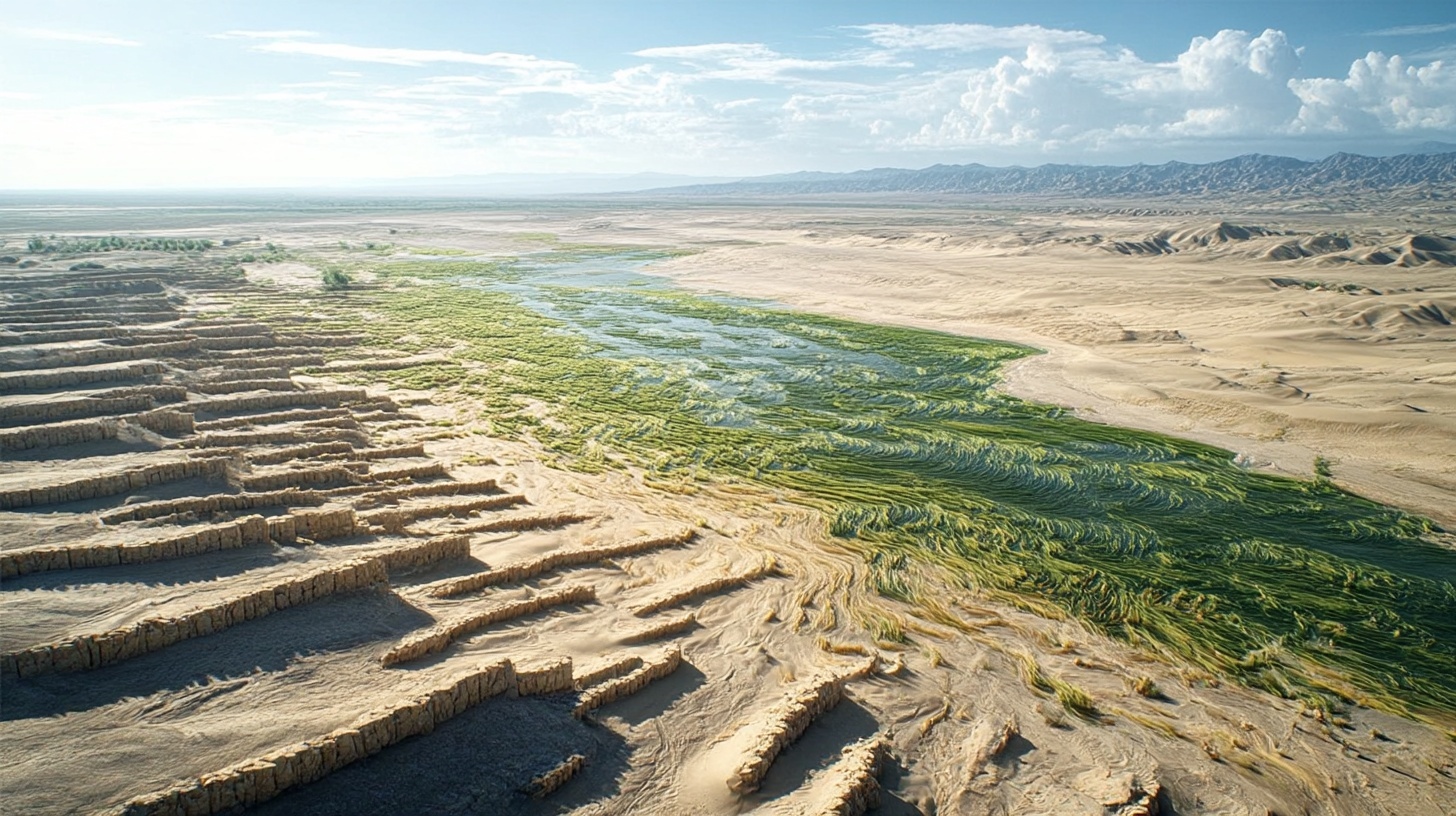
Chinese researchers at the Shapotou Desert Experimental Research Station have answered this question with a solution that sounds like science fiction: deploy massive quantities of blue-green algae to create an “ecological skin” that binds shifting dunes into stable substrate. Not in decades—in one year. Not as small-scale experiment—across 6,667 hectares in Ningxia province over the next five years, with plans to scale globally.
Let me walk you through why this blue-green algae approach represents a fundamental shift in how we reclaim deserts, what it means for global desertification battles, and why microbial geoengineering might be humanity’s best tool for reversing landscape degradation.
The Problem Traditional Desert Reclamation Can’t Solve
Deserts are notoriously difficult to reclaim for one simple reason: most plants cannot survive the abrasive, shifting nature of sand. Before anything can grow, the ground must stabilize. In natural systems, this happens through biological soil crust formation—a process where microorganisms, lichens, and mosses gradually bind sand particles together over 5-10 years.
That timeline is too slow when desertification accelerates. By the time natural crusts form, more land has turned to desert than was reclaimed. Traditional intervention methods face similar constraints:
Tree planting: Trees need stable soil to establish roots. In shifting sand, they get buried, exposed, or blown over before maturing. Survival rates in active dunes are abysmal.
Physical barriers: Grass grids and windbreaks slow sand movement but don’t fundamentally stabilize it. They require constant maintenance and eventually get overwhelmed.
Irrigation: Pumping water into deserts can support limited vegetation, but it’s expensive, unsustainable where water is scarce, and doesn’t address the underlying instability of the substrate.
The fundamental challenge: you can’t plant in quicksand. You need solid ground first. And creating solid ground from shifting sand has historically been prohibitively slow and expensive.
How Blue-Green Algae Solves the Fundamental Problem
Enter cyanobacteria—blue-green algae that have existed for billions of years and thrive in conditions that would kill virtually any other organism. These photosynthetic microbes can endure extreme heat, survive bone-dry conditions for years, and spring back to life the moment they encounter moisture.
The Chinese research team’s innovation isn’t discovering cyanobacteria—it’s engineering them into a deployable desert reclamation technology. Here’s how it works:
Step 1: Strain selection. After screening over 300 species, researchers identified seven key cyanobacterial strains optimized for desert conditions—heat tolerance, drought resistance, rapid proliferation, and aggressive biomass production that binds sand particles.
Step 2: Solid seed production. These strains get blended with organic matter into nutrient-rich paste and cast into hexagonal molds, creating portable “solid seeds”—engineered blocks designed to survive transport into deep desert and burst into growth upon encountering rain.
Step 3: Deployment. These blocks are dispersed across barren dunes where they lie dormant until moisture arrives. The moment it rains, the cyanobacteria activate, proliferating rapidly and secreting a biomass-rich matrix that literally glues sand particles together.
Step 4: Crust formation. Within one year—not five to ten—a stable biological soil crust forms. This crust can withstand winds of 36 km/h (22 mph), immobilizes shifting dunes, and establishes nutrient-rich substrate that supports successional plant development.
The breakthrough isn’t just speed. It’s scalability. This isn’t labor-intensive tree planting requiring constant maintenance. It’s deploying dormant microbes that activate automatically when conditions permit and require zero human intervention once in place.
Why This Approach Changes Global Desertification Strategy
Traditional desert reclamation operates incrementally—plant by plant, barrier by barrier, slowly working against sand’s natural tendency to shift. Blue-green algae reclamation operates at scale—transforming entire landscapes simultaneously by addressing the root cause rather than symptoms.
Cost efficiency: Once strains are selected and solid seeds manufactured, deployment costs are minimal compared to labor-intensive planting and irrigation infrastructure. The microbes do the work autonomously.
Climate resilience: Unlike plants that die when water disappears, cyanobacteria simply go dormant. They survive extended droughts and reactivate when moisture returns, making them far more resilient to unpredictable rainfall patterns.
Foundation for ecosystem succession: Biological soil crusts don’t just stabilize sand—they create conditions supporting plant growth. They fix nitrogen, accumulate organic matter, improve water retention, and provide substrate for seeds to germinate. The crust enables natural ecosystem recovery rather than requiring artificial maintenance.
Transferable technology: The approach isn’t geographically limited. Cyanobacteria exist globally. Strain selection and solid seed production can be adapted to different desert conditions. What works in Ningxia can be modified for Africa, Mongolia, Middle East, or American Southwest deserts.
The Scale China Is Planning
Ningxia province is preparing to apply this technology across 6,667 hectares over the next five years. That’s not experimental pilot—that’s operational deployment at landscape scale. And Ningxia is just the beginning.
This effort is part of China’s ambitious “Great Green Wall” project aimed at halting desertification and restoring degraded landscapes. With the recent completion of a massive 1,856 km (1,153-mile) sand control belt in Inner Mongolia, China is demonstrating commitment to desert reclamation as core national strategy, not marginal environmental initiative.
The technology is already being adapted for export. African nations facing severe desertification are piloting similar approaches. Mongolia is exploring deployment. The methodology is being positioned as blueprint for global desert restoration.
This matters because desertification isn’t localized problem—it’s global crisis. Approximately one-third of land surface faces desertification risk. Hundreds of millions of people depend on land currently threatened by degradation. Food security, water resources, and climate stability all depend on reversing—or at least halting—desert expansion.
What This Means for Terraforming and Geoengineering
The broader implication goes beyond desertification. This project represents successful deployment of microbial geoengineering—deliberately using microorganisms to reshape natural landscapes at scale. That’s a significant milestone.
We’ve modified ecosystems with plants and animals for millennia. We’ve used microbes in industrial processes for decades. But deliberately deploying microbes to transform terrain at regional scale represents new capability. And it works.
This opens conceptual doors for other applications:
Ocean dead zone remediation: Could engineered microbes restore oxygen levels in hypoxic zones?
Mine tailings stabilization: Could microbial crusts prevent toxic dust storms from abandoned mining sites?
Coastal erosion control: Could algae-based binding prevent beach loss more effectively than physical barriers?
Polar region preservation: Could cold-adapted microbes help stabilize permafrost or slow ice loss?
The Ningxia project demonstrates that microbial geoengineering isn’t theoretical—it’s operational, scalable, and potentially applicable to multiple landscape restoration challenges.
The Timeline We’re Looking At
Based on China’s current trajectory and expanding deployment:
2026-2030: Ningxia completes initial 6,667 hectare deployment. Other Chinese regions begin similar projects. African pilot programs demonstrate feasibility in different desert types. Global research community studies methodology for adaptation to local conditions.
2030-2035: Technology spreads to multiple continents. Costs drop as production scales. Strain libraries expand to cover diverse desert ecosystems. International desert reclamation increasingly incorporates microbial crusting as standard first-phase intervention.
2035-2045: Blue-green algae desert reclamation becomes dominant approach for stabilizing active dunes globally. Combined with traditional tree planting and vegetation restoration for areas with established crusts. Millions of hectares reclaimed from desertification.
This isn’t speculative future—it’s happening now. The solid seeds exist. The deployment is underway. The only question is how quickly the approach spreads beyond China to global desertification challenges.
Final Thoughts
China’s blue-green algae desert reclamation project isn’t just about environmental restoration—it’s proof of concept for microbial geoengineering as practical, scalable, and effective intervention for landscape-scale problems.
The fundamental insight is elegant: work with organisms that already thrive in extreme conditions rather than trying to force conditions to support organisms designed for temperate climates. Deploy systems that function autonomously rather than requiring constant human intervention. Address root causes—unstable substrate—rather than symptoms.
This approach won’t reverse all desertification. Some degradation results from factors biological crusts can’t fix. But for active sand dunes threatening to engulf productive land, it offers solution that’s faster, cheaper, and more resilient than alternatives.
The broader lesson: when facing landscape-scale environmental challenges, our best tools might not be engineered machines or massive infrastructure projects. They might be ancient microorganisms that have survived every environmental catastrophe for billions of years, deployed strategically through clever human engineering.
We’re not just planting trees in deserts anymore. We’re gluing the desert floor together with the same organisms that helped terraform the planet in the first place. And it’s working.
Related Articles:
Great Green Wall: Drought-resilient algae to help reclaim 6,667 hectares of desert https://interestingengineering.com/science/great-green-wall-drought-resilient-algae-to-help-reclaim-6667-hectares-of-desert
Earth’s Invisible Shield: The Magnetosphere Opportunity Nobody Sees Coming https://www.impactlab.com/2025/12/20/earths-invisible-shield-the-magnetosphere-opportunity-nobody-sees-coming/
How is China turning deserts into arable lands? https://interestingengineering.com/innovation/how-is-china-turning-deserts-into-arable-lands
