
By Futurist Thomas Frey
The Transformation Nobody’s Fully Grasping Yet
Walk through any major airport today and you’re witnessing an institution in the early stages of existential transformation. The massive parking structures generating 40-50% of non-aeronautical revenue? They’ll be largely empty by 2035. The carefully designed terminal flows optimized for passengers arriving by personal vehicle? Obsolete. The clear separation between ground transportation and air operations? Dissolved.
Future airports won’t just look different—they’ll operate on fundamentally different economic models, serve radically different transportation modes, and integrate technologies that blur the distinction between ground and air travel in ways that make today’s airports seem as quaint as train stations from the 1950s.
I’ve written about future airports several times over the past few years, covering everything from air taxis to pilotless travel to robot food delivery. But I’ve never quite grasped the full scope of the transition we’re living through right now—the uncomfortable period where old revenue models collapse before new ones fully materialize, where infrastructure designed for one transportation paradigm must adapt to serve another, and where the very definition of “airport” expands to include facilities that look nothing like what we recognize today.
Let me walk you through what airports actually become by 2035, why the transition is more disruptive than anyone’s admitting, and what replaces the business models that have sustained airports for decades.
The Parking Lot Crisis: First Sign of Disruption
Here’s the crisis airports aren’t publicly discussing: parking revenue is collapsing faster than replacement revenue streams are emerging.
Today’s economics: Major airports generate $4-8 billion annually from parking—roughly 40-50% of non-aeronautical revenue. Denver International Airport makes over $100 million yearly from parking. O’Hare generates similar amounts. These aren’t luxuries—they’re essential to airport operations budgets.
2035’s reality: Autonomous vehicles don’t park. They drop passengers and leave. Air taxis don’t use parking lots—they use vertically-oriented landing pads. Rideshare services already reduced parking revenue 15-20% at major airports. The autonomous wave will eliminate another 50-60% by 2035.
The multi-story parking structures dominating airport peripheries become expensive monuments to obsolete transportation patterns. Some airports are already recognizing this—new construction plans eliminate or dramatically reduce parking capacity. But most existing airports have billions invested in parking infrastructure that generates nothing once autonomous transportation dominates.
What replaces parking revenue? That’s the question keeping airport executives awake at night. The obvious answers—congestion pricing for autonomous drop-offs, fees for air taxi landings, charging infrastructure for electric ground transport—won’t generate comparable revenue. The economics don’t work. You can’t charge autonomous vehicles $30/day to briefly stop. You can’t impose parking-equivalent fees on air taxis without driving them to competing droneports.
Airports face fundamental rethinking of revenue models while maintaining operations dependent on income streams that are vanishing. This is happening now, not in some distant future. The transition period—roughly 2026-2035—will be financially brutal for airports that don’t aggressively develop alternative revenue sources.
The Three-Dimensional Airport: When Ground and Air Merge
By 2035, the term “airport” becomes inadequate. These facilities operate simultaneously as:
Traditional airports serving conventional commercial aircraft—but with pilotless options increasingly common for cargo and eventually passengers.
Droneports managing constant launches and landings of autonomous air taxis, passenger drones, and delivery drones operating on entirely different infrastructure than traditional runways.
Autonomous ground transportation hubs coordinating fleets of self-driving vehicles, managing pickup/dropoff zones, and integrating with regional autonomous transit networks.
The operational challenge isn’t just managing these simultaneously—it’s that they require completely different infrastructure, operate on different time scales, serve different customer types, and generate revenue through different mechanisms.
Air Taxis and Passenger Drones: The Integration Nobody’s Ready For
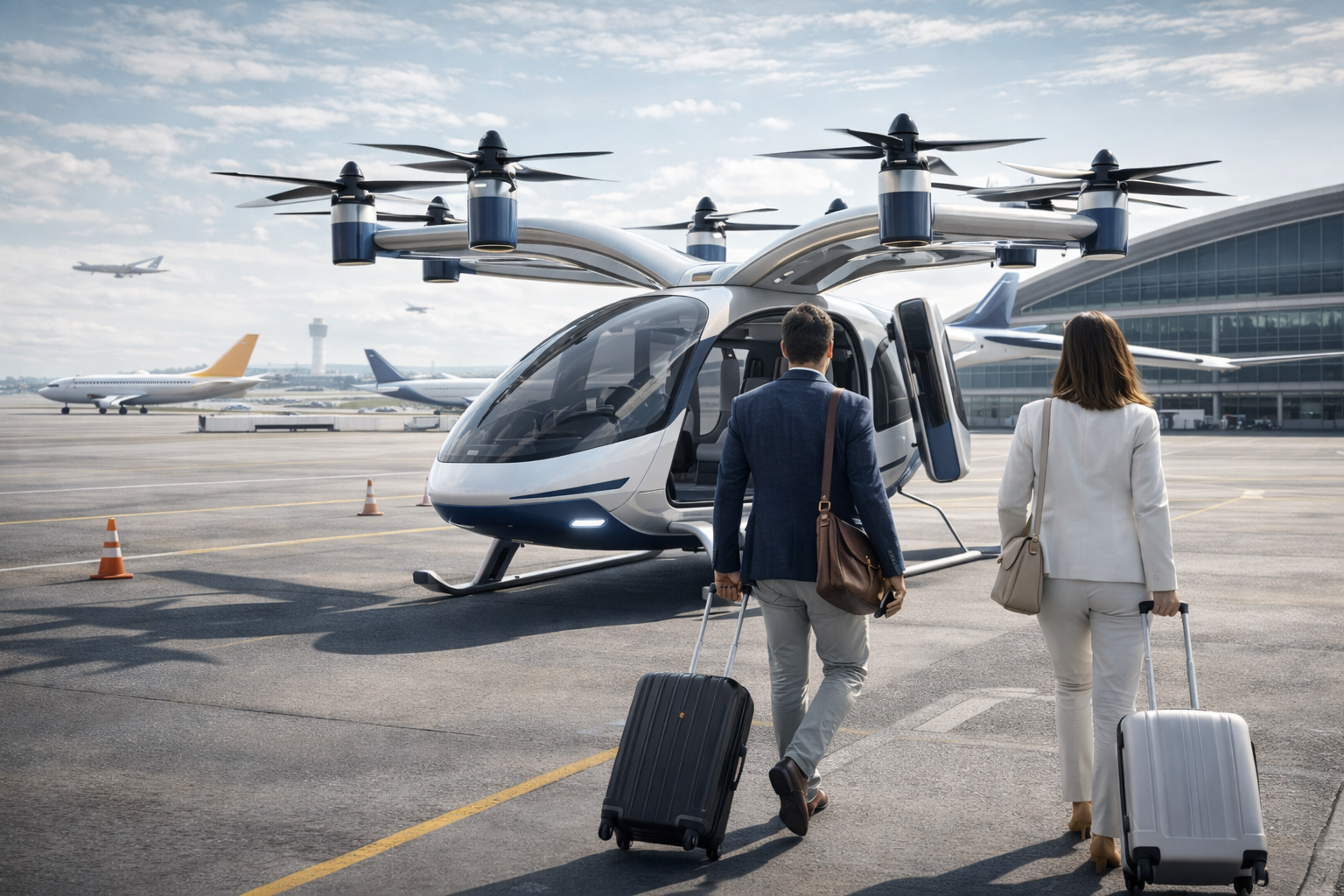
United Airlines ordered 200 air taxis from Archer Aviation—$1 billion commitment for aircraft that take off and land vertically, carry 4-6 passengers, travel 60-150 miles on electric power, and operate point-to-point rather than through traditional hub-and-spoke patterns.
American Airlines backed Vertical Aerospace. Boeing partnered with Larry Page on autonomous flying taxis. These aren’t experiments—they’re commercial bets by major airlines that air taxis become essential to their operations by 2028-2032.
What this means for airports:
Vertical infrastructure becomes critical. Rooftop landing pads, elevated platforms, multi-level launch zones. Airports designed for horizontal movement suddenly need vertical integration. Existing terminals weren’t built for this—they’ll require massive retrofitting or replacement.
Airspace management transforms completely. Traditional air traffic control manages dozens of aircraft per hour with miles of separation. Air taxi operations require managing hundreds of vertical takeoffs/landings per hour with minimal separation. This isn’t just more of the same work—it’s fundamentally different operational paradigm requiring AI-powered coordination that doesn’t exist in traditional aviation.
Customer flows change entirely. Traditional passengers arrive 1-3 hours early, move through security, wait at gates, board large aircraft on predictable schedules. Air taxi passengers arrive 10-15 minutes before departure, bypass traditional security (different threat model for small aircraft), and board from elevated platforms or rooftop facilities. The terminal designs serving one don’t serve the other.
The regulatory complexity multiplies. The FAA struggles to certify autonomous systems for traditional aviation. Now add pilotless air taxis operating in dense urban airspace, mixed with drones, conventional aircraft, and emergency vehicles. Nobody has figured out comprehensive regulatory framework for this yet—but operations are rolling out regardless, creating compliance chaos that won’t fully resolve until mid-2030s at earliest.

Pilotless Everything: When Humans Become Optional
The bigger shift: commercial aviation going pilotless. Not immediately for passengers—trust barriers remain substantial—but for cargo first, regional commuter flights second, and eventually long-haul passenger service.
Current state: Autopilot handles most flight time already. Pilots mainly manage exceptions, emergencies, and passenger psychology. The technology for pilotless flight exists. The regulatory and trust barriers are what remain.
2030-2035 trajectory: Cargo operations go fully autonomous first—FedEx and UPS already testing pilotless flights. Regional routes under 500 miles transition to optional pilot or remote supervision. Long-haul remains conventionally crewed but with increasing automation reducing crew from two to one to remote oversight.
What this means for airports: The entire infrastructure around pilot facilities—crew rooms, briefing areas, rest facilities, certification centers—shrinks dramatically. Meanwhile, new infrastructure emerges: remote operation centers where single operators oversee multiple autonomous flights, maintenance facilities handling aircraft with different automation levels, and testing/certification areas for pilotless systems.
The airport of 2035 employs fewer pilots and more AI systems operators, fewer air traffic controllers and more airspace management specialists overseeing algorithmic coordination, fewer parking attendants and more autonomous vehicle dispatch coordinators.
AI as Airport Operating System
The transformation isn’t just about new vehicle types—it’s about AI becoming the nervous system coordinating everything.
Today’s airports use AI for optimization: predicting passenger flows, allocating gates, routing baggage, scheduling maintenance. Humans make decisions; AI provides recommendations.
2035’s airports operate on AI platforms where algorithms make thousands of real-time decisions: dynamically adjusting air taxi landing sequences based on weather and traffic, coordinating autonomous ground vehicle pickups with flight arrivals, optimizing energy distribution across charging infrastructure, predicting and preventing congestion before it occurs.
Digital twins virtualize entire airport operations—simulating every aircraft movement, every passenger flow, every system interaction in real-time. This allows predictive control: the system sees problems developing and adjusts operations before they manifest.
The human role shifts from operational control to oversight and exception handling. You don’t direct traffic—you monitor AI systems directing traffic and intervene when they encounter situations outside their training. You don’t schedule gates—you verify AI scheduling makes sense and adjust parameters when needed.
Airports become algorithmic environments where AI orchestrates the dance of autonomous vehicles, pilotless aircraft, passenger flows, and logistics operations with microsecond precision impossible for human coordination.
The Robot Takeover: More Than Food Delivery
I previously wrote about airport robots delivering food to gates—Gita robots following human runners, mobile ordering systems eliminating lines, contactless delivery for convenience and safety.
By 2035, this expands exponentially. Robots don’t just deliver food—they handle baggage movement, cleaning operations, security patrols, passenger assistance, and maintenance inspections. The airport becomes partially automated environment where humans and robots share space, with robots handling predictable, repetitive tasks and humans managing exceptions and customer service.
The infrastructure implications: Charging stations everywhere. Robot-friendly pathways and elevators. Storage and maintenance facilities for robot fleets. Communications infrastructure supporting thousands of autonomous systems operating simultaneously. Digital twin systems virtualizing entire airport operations for real-time optimization.
Airports become living data centers managing physical flows through algorithmic coordination rather than human direction.
The Droneport Explosion: Airports Outside Airports
Here’s the truly disruptive part: by 2035, traditional airports no longer monopolize air transport infrastructure.
Droneports emerge throughout metro areas—rooftop facilities atop office buildings, standalone structures in business districts, integrated platforms in transportation hubs. These handle air taxi operations, drone deliveries, and point-to-point passenger transport that never touches traditional airports.
The economic threat: Traditional airports invested billions in runway capacity, terminal space, and parking infrastructure. Droneports require minimal space—rooftop pads, vertical landing zones, automated charging stations. Capital costs are orders of magnitude lower. Operating costs are minimal—fully automated with remote oversight.
A single downtown droneport handling 200 air taxi movements daily serves comparable passenger volume to small regional airport but costs $10-20 million to build versus hundreds of millions for traditional airport infrastructure.
The competitive dynamic: Traditional airports can’t compete on cost for short-range point-to-point travel. Their economics depend on large aircraft, hub operations, and passenger volumes that justify massive infrastructure. Droneports unbundle this, serving direct routes that bypass traditional hubs entirely.
Airports respond by building their own droneport facilities—but they’re fundamentally adding competing infrastructure that cannabalizes their core operations while operating at lower margins.
What 2035 Actually Looks Like
For passengers: You summon autonomous vehicle that picks you up at home, coordinates with airport systems for optimal arrival timing, drops you at terminal level corresponding to your flight type (traditional gate, air taxi platform, or droneport). Security is differentiated by risk—full screening for international commercial flights, streamlined for domestic, biometric-only for air taxis where threat models differ.
Food ordering is entirely mobile with robot or human delivery to wherever you’re waiting. Flight information is pushed to your devices rather than displayed on boards. Boarding is continuous rather than grouped calls—you arrive when ready, systems coordinate your movement.
If taking air taxi to another city, you might never enter traditional terminal—direct to rooftop platform, automated check-in through biometrics, aboard within minutes of arrival. The two-hour early arrival buffer becomes relic of aviation’s less efficient past.
For airports: Revenue comes from facilitation fees, data services, automated system coordination charges, real estate development (converting parking structures to mixed-use), and premium services rather than parking, retail, and concessions. The business model resembles digital platform more than transportation facility.
Staffing shifts heavily toward technology operations, remote systems management, customer service for exceptions, and security. The operational workforce shrinks by 40-50% through automation while technical workforce grows.
Physical infrastructure fragments into specialized zones: traditional gates serving conventional aircraft, air taxi platforms handling high-frequency vertical operations, autonomous vehicle coordination centers managing ground transport, drone logistics areas handling cargo and delivery operations.
The Convergence Creates Entirely New Possibilities
When AI, droneports, air taxis, and autonomous vehicles converge in single facility, possibilities emerge that none enabled individually:
Seamless intermodal journeys: Autonomous vehicle picks you up, drops you at droneport, air taxi flies you to regional airport, traditional flight takes you across country, another air taxi to destination city, autonomous vehicle to final address. One booking, one payment, AI coordinates every transition.
Dynamic routing: Weather closes regional airport? AI instantly reroutes you through alternative droneport, adjusts ground transport pickup, notifies all parties. No human coordination needed—the system adapts in real-time.
Predictive personalization: AI knows your patterns, preferences, constraints. It books optimal routing before you ask, adjusts for delays you haven’t noticed yet, reserves services you typically use, and handles exceptions automatically.
Just-in-time everything: Arrive at airport exactly when optimal—not hours early. Food delivered exactly when you want it. Boarding precisely when you’re ready. No waiting because AI coordinated your journey with flight operations.
The airport becomes invisible infrastructure. You don’t navigate it—AI navigates it for you, making thousands of micro-optimizations that add up to frictionless travel experience.
The Uncomfortable Transition We’re Living Through
None of this arrives smoothly. We’re in the awkward middle phase where:
- Parking revenue declines but replacement revenue hasn’t fully materialized
- Air taxis and drones are certified but infrastructure to support them at scale doesn’t exist
- Pilotless technology works but regulatory approval and public trust lag years behind capability
- Autonomous ground transport reduces parking demand but airports can’t eliminate parking because some passengers still drive
- Traditional airlines invest in air taxis that compete with their own hub-and-spoke operations
- AI systems are capable but integration with legacy airport infrastructure is incomplete
- Droneports are proliferating but regulatory frameworks for their operation remain unclear
Airports are simultaneously trying to maintain legacy operations generating declining revenue while investing billions in infrastructure for transportation modes that might not fully materialize for another decade and might cannibalize their core business.
This transition period—roughly 2026-2040—will see airport bankruptcies, consolidation, and dramatic restructuring. Not every airport survives. Those that do will look radically different than today’s facilities.
Final Thoughts
The airport of 2035 isn’t really an “airport” anymore—it’s a multi-modal transportation nexus integrating autonomous ground vehicles, pilotless aircraft, air taxis, passenger drones, cargo drones, and conventional aviation in coordinated ecosystem managed more by algorithms than humans.
The convergence of AI, droneports, air taxis, and autonomous vehicles doesn’t just change how airports operate—it changes what airports are. They transform from static facilities processing passengers into dynamic platforms orchestrating transportation across ground and air, conventional and autonomous, human-crewed and pilotless.
The parking lots are repurposed or demolished. The terminals are retrofitted with vertical infrastructure. The workforce is smaller but more technically sophisticated. The revenue model depends on facilitation and coordination rather than captive passengers and monopolistic services.
And nobody’s quite figured out how to get from here to there without financial crisis, because the old revenue streams are collapsing faster than new ones are emerging, and the infrastructure investments required are massive while the payoff remains uncertain.
We’re not waiting for future airports—we’re living through the painful transition where today’s airports either transform or become obsolete. The technology exists. The operational models are emerging. The regulatory frameworks are slowly catching up.
The revolution isn’t coming—it’s here. The question isn’t what airports will look like in 2035. It’s which airports make it to 2035 intact, and what replaces those that don’t survive the transformation.
Related Articles:
United Airlines’ $1 Billion Bet on Electric Air Taxis Signals Aviation’s Urban Future https://www.cnbc.com/united-airlines-archer-aviation-air-taxi-deal/
Smart Airports: How AI and Digital Twins Are Transforming Aviation Infrastructure https://www.mckinsey.com/industries/travel/our-insights/smart-airports-clearing-the-runway-for-digital-takeoff
The Orbital Economy Ramp-Up: How Space Industry Evolves in Waves, Not All at Once https://www.impactlab.com/2026/01/12/the-orbital-economy-ramp-up-how-space-industry-evolves-in-waves-not-all-at-once/
