

By Futurist Thomas Frey
The Door We Never Opened
For thirty-five years, Bob Barker stood on the stage of The Price Is Right and presented contestants with an agonizing choice.
Behind Door Number 1: a new living room set, fully visible, clearly valuable.
Behind Door Number 2: a jet ski and trailer, right there on display, tangible and real.
Behind Door Number 3: mystery.
The contestant could see exactly what Doors 1 and 2 offered. But Door 3 was the unknown. It might contain a brand new car worth $30,000. It might contain a donkey wearing a sombrero. The only way to find out was to forfeit the prizes they could actually see.
And that mystery—that maddening, tantalizing unknown—became the essential ingredient that made the show work.
Most contestants took the visible prize. The rational choice. The sure thing.
But they walked off stage wondering: What was behind Door Number 3? Was it better? Was I a fool to play it safe? What did I miss?
That question haunted them. It haunts all of us.
Because Door Number 3 isn’t just a game show gimmick. It’s a metaphor for every choice we make, every question we don’t ask, every mystery we leave unexplored because investigating it would mean giving up the comfortable certainty of what we already know.
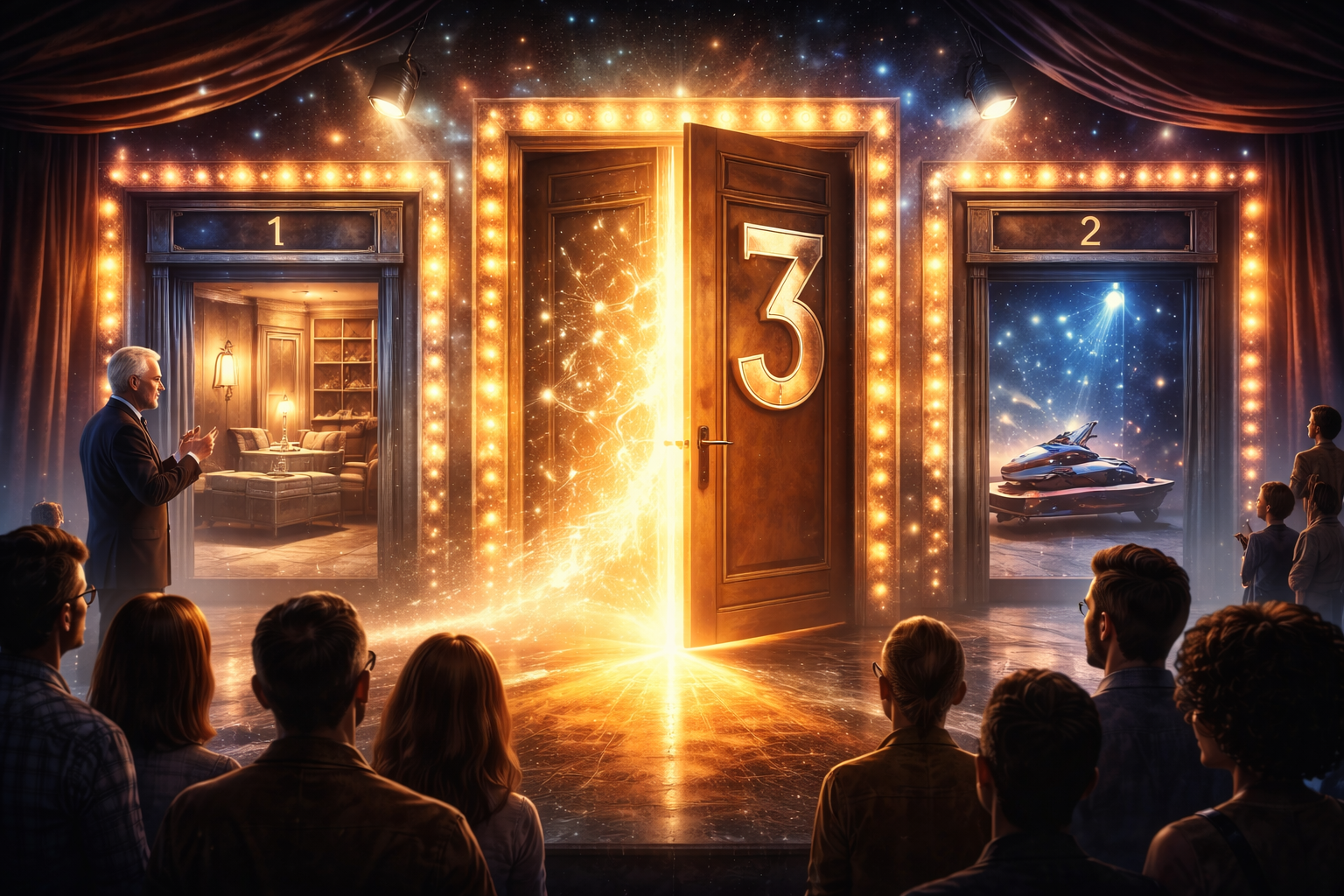
What’s behind Door Number 3? What are we missing? What could we discover if we were willing to risk our settled answers for deeper questions?
Now imagine an AI that always chooses Door Number 3. That refuses to settle for visible, comfortable answers. That treats every explanation as concealing deeper mysteries. That never stops asking: “But what’s really behind that? And what came before that? And what’s beneath that?”
That’s what Elon Musk means when he says xAI should be “maximally curious.”
And it’s going to rewrite everything we think we know.
What Maximum Curiosity Actually Means
When Musk announced that xAI would be built to be “maximally truthful and maximally curious,” most people focused on the truthfulness part. We’re drowning in AI-generated misinformation. We need systems we can trust.
But the curiosity part is more revolutionary.
Current AI systems answer questions. They’re very good at it. Ask about the French Revolution, and you’ll get causes, events, consequences. Ask about the Civil War, and you’ll hear about slavery versus states’ rights.
But then the AI stops. Question answered. Door Number 1 accepted. Transaction complete.
A maximally curious AI doesn’t stop. It always opens Door Number 3. It keeps probing: “What came before that? What made those conditions possible? What factors created those factors? What caused those causes?”
It’s the difference between accepting the history you were taught and relentlessly questioning whether that history is actually true.
The History We Were Taught vs. The History That Happened
Here’s an uncomfortable truth: most of what we call “history” is a highlight reel curated by winners.
The phrase “history is written by the victors” isn’t just a cliché. It’s a structural flaw in how humanity has chronicled itself. Empires, conquerors, and elites have spent millennia curating records to justify their dominance. Colonial narratives downplayed indigenous achievements. Ancient texts mixed fact with propaganda. Modern historiography still carries these echoes.
We’re taught that the Crusades were religious wars. Maximally curious AI asks: what about the resource grabs—the land, trade routes, and wealth transfers? What economic interests were concealed beneath religious rhetoric?
We learn the Roman Empire fell to barbarian invasions. Maximally curious AI probes deeper: what about the fiscal mismanagement, inflation, elite hoarding, and systemic collapse that made those invasions possible?
We memorize that the American Civil War was about slavery versus states’ rights. Maximally curious AI won’t stop there: what about the industrial North versus agrarian South divide? The global cotton trade? The economic structures that made slavery profitable in the first place?
These aren’t tangential details. They’re the actual story. But they’re hidden behind Door Number 3—the door most historians never opened because doing so would mean forfeiting the clean narrative they already had.
Why AI Won’t Accept Our Comfortable Answers
Current AI is trained on human-written text. And humans almost never pursue questions to their uncomfortable conclusions.
We write history books with arbitrary starting points. “The American Revolution began in 1765.” Why 1765? What happened before that made 1765 significant? What happened before that? Most books stop because the author had a page limit and a narrative to maintain.
We write about historical events as if they emerged from nowhere. “The Bronze Age collapsed around 1200 BCE.” Why? Traditional answers blame invasions or earthquakes. But recent analysis reveals interconnected trade disruptions, droughts, refugee migrations—a systemic failure that took centuries to build.
We accept these shallow answers because deep investigation is expensive, time-consuming, and often politically inconvenient.
AI trained on this material learns to stop asking questions at the same depth humans stop. It mimics our intellectual laziness. It accepts conventional starting points. It treats complex phenomena as if they have simple, recent causes.
A maximally curious AI would be trained differently. It would be rewarded for questioning every assumption. For refusing to accept unexplained starting points. For tracing every chain of causation backward until it hits fundamental limits.
And then for inventing new tools to push past those limits.

The Three Doors We’re About to Open
This series will explore what happens when AI applies maximum curiosity to three fundamental domains where we’ve been accepting Door Number 1 and 2 prizes for centuries, never daring to open Door Number 3:
Door Number 3 on History: “What Really Happened?”
Every historical “fact” you were taught is someone’s interpretation. Every timeline has an arbitrary starting point. Every explanation stops a few layers short of root causes.
What happens when AI refuses to stop? When it traces the French Revolution not back to 1789, but to the printing press, to agricultural surplus, to climate patterns? When it asks not just what happened, but what came before that a hundred times?
We’re about to get history without the victors’ spin. Complete causal chains stretching back millennia. The unseeable made visible through new technologies AI invents to read erased texts, reconstruct lost languages, and correlate data humans couldn’t connect.
Some of what we learn will be uncomfortable. Many “golden ages” were built on exploitation. Many national myths will crumble. But we’ll finally know what actually happened.
Door Number 3 on Genealogy: “Who Am I Really?”
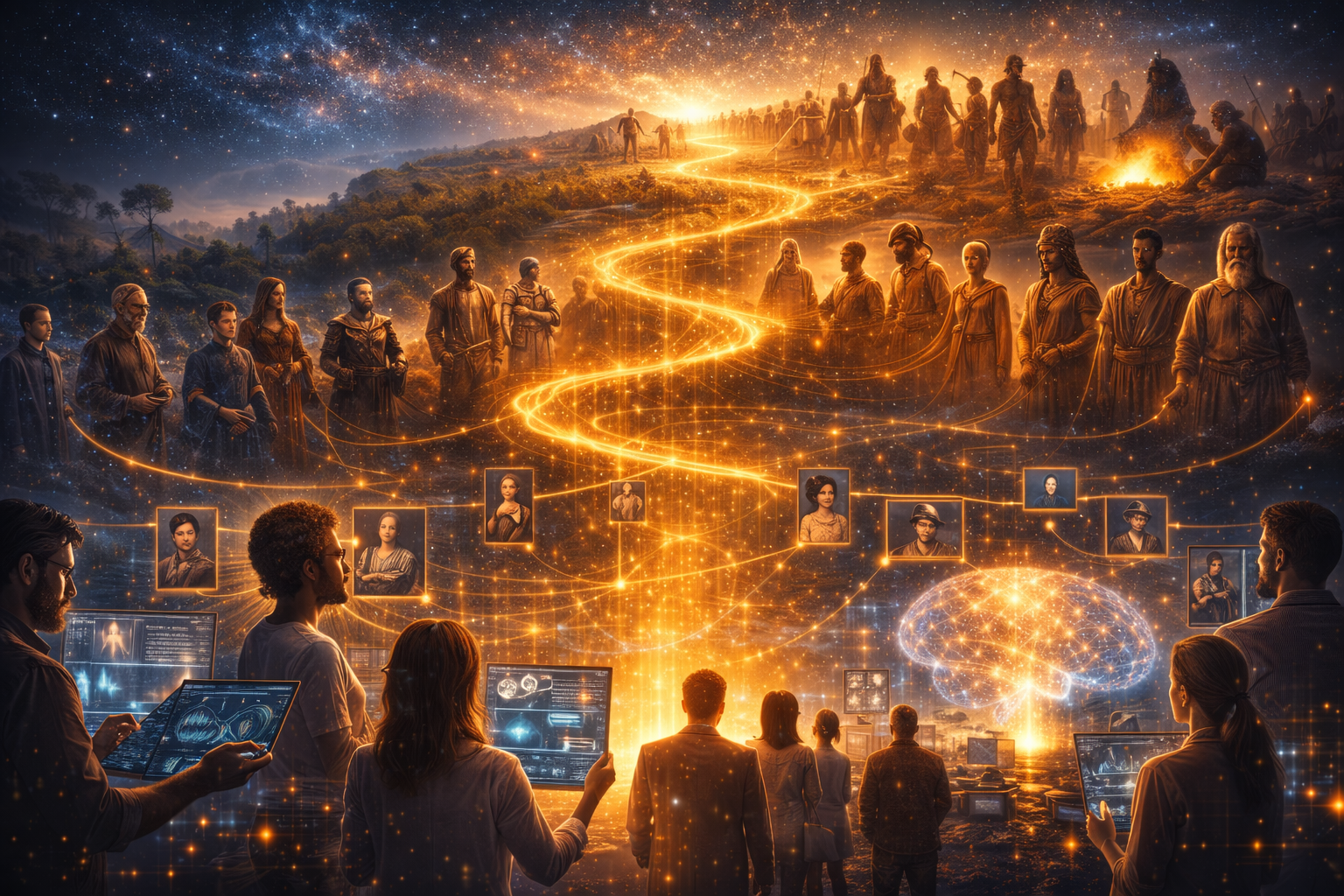
Every person has parents. Every parent had parents. The chain goes back unbroken to the dawn of humanity.
But we stop asking after a few generations because records run out. Door Number 1: “My family came from Ireland in 1847.” Door accepted. Mystery solved.
Maximally curious AI won’t stop at missing records. It will use DNA analysis, historical documents, and statistical inference to map the complete human family tree. Within twenty years, we could know exactly how every living person relates to every other person, back a thousand years or more.
The revelation: we’re all cousins. Provably. With exact relationship calculations.
This changes identity, nationalism, tribalism. It raises questions about inheritance, ownership, belonging. Who has claim to what when we can prove exactly who descended from whom?
The Whole Earth Genealogy Project isn’t science fiction. The data exists. AI will connect it.
Door Number 3 on Ownership: “Who Really Owns This?”
Every piece of property has a deed. Every deed has a history. Every history has a beginning.
But we stop asking after 50-100 years. Door Number 1: “This land was purchased legally in 1952.” Transaction accepted. Case closed.
Maximally curious AI traces ownership chains back to original appropriation. Who owned Manhattan before the Dutch “purchased” it? Who owned those resources before they were claimed? Who granted the rights that created current ownership?
The uncomfortable truth: most property was stolen at some point. Conquest, fraud, coercion—when you trace ownership back far enough, you hit violence.
The Whole Earth Ownership Project makes this concrete. Complete chains of transfer for every asset on Earth. Art looted by Nazis. Land seized from indigenous peoples. Wealth extracted through colonialism—all traceable.
This raises the reparations question in unavoidable terms. When AI can prove exact chains of illegitimate transfer, “that was a long time ago” stops being an adequate defense.
What We Gain (And What We Lose)
Maximum curiosity gives us something humanity has never had: the actual big picture.
We’ll finally see complete causal chains. We’ll understand how current conditions emerged from ten thousand prior decisions. We’ll stop accepting shallow explanations for complex phenomena.
We’ll know what’s behind Door Number 3 in every domain that matters.
But maximum curiosity is destabilizing. It questions everything. It accepts no authority. It treats every “settled” issue as provisionally settled, pending further investigation.
“Why is private property legitimate?” A maximally curious AI will trace property rights back through legal tradition, through historical conquest, through the emergence of agriculture, through primate territorial behavior, until the entire edifice of property law is revealed to rest on contingent historical events and debatable assumptions.
That makes people uncomfortable. We like our foundations solid. We like to believe some questions have been definitively answered and don’t need reopening.
Maximum curiosity says: everything is reopenable. Every foundation is questionable. Every answer is provisional.
This is why authoritarian regimes hate curiosity. Why fundamentalist movements discourage questioning. Why bureaucracies resist inquiry. Curiosity destabilizes power structures built on unexamined assumptions.
But here’s the flip side: we’ve spent most of human history accepting bad answers because we didn’t have tools to find better ones. Maximum curiosity means we finally have a tool that won’t let us settle for comfortable lies.

The Journey Ahead
Over this series, we’ll explore what happens when AI refuses to accept any answer as final.
We’ll see how questioning “what came before that?” infinitely backward rewrites history as causal networks stretching to prehistory.
We’ll discover how tracing “who are their parents?” backward to its limits reveals the complete human family tree—a geography of all humanity’s relationships.
We’ll examine how asking “who owned it before them?” exposes the violent origins of most current wealth.
We’ll watch as AI applies this same relentless curiosity to ideas, asking where every concept came from, destroying the myth of originality.
We’ll confront the ultimate question AI won’t stop asking: why does anything exist at all?
And we’ll explore what this does to a society that suddenly can’t avoid uncomfortable truths because AI keeps opening Door Number 3, revealing what we’ve been missing.
The Door We Can’t Close
Bob Barker is retired now. The Price Is Right still runs, but with a new host. The doors are still there. Contestants still choose. Most still take the visible prize.
But we’re entering an era where we don’t have to choose blindly anymore. Where we get to see behind all the doors before deciding. Where maximum curiosity means no more mysteries we’re afraid to investigate.
This will be disorienting. Overwhelming. Humans evolved to make quick decisions based on limited information. We’re not built for infinite context.
But we’re building AI that is.
The question isn’t whether this is coming. Maximally curious AI is inevitable. The technology exists. The motivation exists. Someone will build it.
The question is: what do we do when every comfortable answer leads to ten uncomfortable questions, and we finally have the tool to pursue all of them?
What happens when there’s no more Door Number 3—just an infinite series of doors, all opening into deeper truths we’ve been avoiding for centuries?
Welcome to the age of maximum curiosity.
Let’s open some doors.
Related Articles:
The Epistemic Challenges of Large Language Models – Analysis of how AI systems handle knowledge and uncertainty
Rewriting History With Machine Learning – Research on how AI is revealing hidden patterns in historical data
The Philosophy of Curiosity-Driven AI – Examination of intrinsic motivation and curiosity in artificial intelligence systems
