
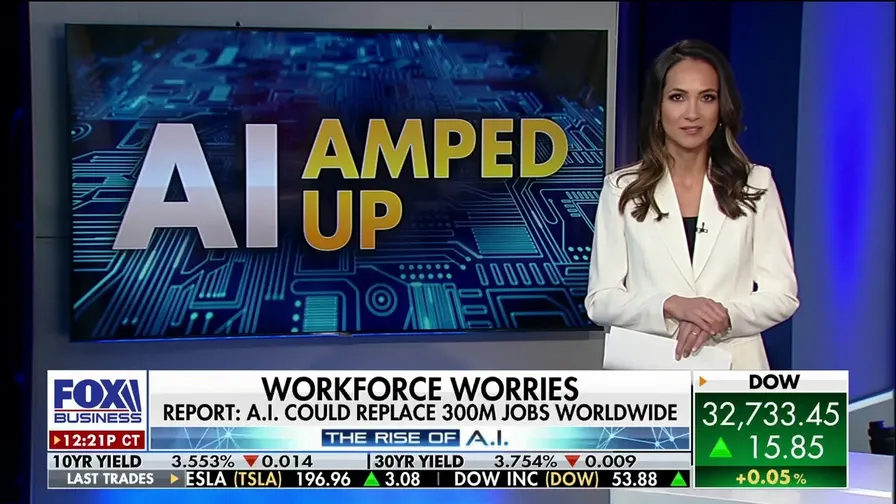
The CEO of a leading artificial intelligence (AI) image and video enhancement software company has responded to concerns regarding AI’s impact on employment in the art and entertainment industries, asserting that recent advancements will actually benefit creators by alleviating technical challenges.
Eric Yang, CEO of Topaz Labs, dismissed the notion that AI would replace human creativity, stating, “There’s a common fear that AI will replace humans, but we believe that we’ll instead see an explosion of AI-assisted human creativity and productivity in the next few years. People create art to tell stories to other people, and AI can never replace that,” Yang told Fox News Digital.
A research report from Goldman Sachs in March indicated that AI has the potential to automate up to 26% of employment tasks in media, design, arts, entertainment, and sports. However, artists’ opinions on generative AI have been divided. Some view AI-generated art and photo generators as “anti-artist,” as they rely on existing human artwork for training data obtained without consent or compensation. Others worry that AI’s ability to swiftly create work similar to that of established artists could lead the public to perceive photography and painting as easily replicable. These concerns are primarily directed toward generative AI models like MidJourney and Dall-E, rather than image or art enhancement tools.
Yang drew a parallel between new AI enhancement and generation software and past concerns surrounding tools like Photoshop. When Adobe introduced Photoshop in 1990, many artists expressed fears that it would devalue photographs and render artists obsolete. “Photoshop didn’t replace photographers, it just gave them superpowers,” Yang asserted. “Similarly, generative AI will enhance the talent of human artists rather than replacing it. With AI, creators can fully concentrate on their vision instead of being bogged down by technical details. We will soon see some of the most imaginative work ever produced as a result of combining AI tools with human taste and storytelling.”
Yang further highlighted the commercial viability of deep learning models for image enhancement, which demonstrated remarkable results and acceptable speeds in 2018. Since then, AI tools have gradually replaced previous methods for challenging tasks like noise reduction, image sharpening, and upscaling. He predicted that AI generation, the process of creating something from nothing, would follow a similar trajectory to AI enhancement over the next five years.
The CEO explained the fundamental difference between traditional editors and AI software, stating, “Traditional editors force you to lay out the exact set of tools and instructions to achieve a desired outcome. AI software is different because they’re ‘descriptive’: you specify the desired end result and the software figures out how to get there. It’s like moving from being the painter to being the art director: you’re still in control, but you don’t have to brush every stroke yourself. This will affect every feature in current editors, but also include new features that we haven’t even thought of yet.”
Yang emphasized that these new software options would enhance accessibility and efficiency in video and photo editing. Furthermore, he believed that the “real value” of this descriptive AI editing system lies in liberating human creativity from the technical limitations of previous “crude tools.”
Albert Yang, Topaz Labs Founder and Research Advisor, added that the trend of AI replacing time-consuming algorithms for image and video enhancements would continue to accelerate over the next ten years. He also highlighted AI’s potential to unlock previously impossible methods for video and image manipulation, exemplified by advancements in text-to-image generation and deepfake technology.
While deepfake technology has raised concerns due to its potential misuse, Eric Yang’s and Albert Yang’s perspectives center on the collaborative potential between AI and human creativity. As AI continues to evolve, the debate surrounding its role in the art and entertainment industries will undoubtedly persist, shaping the future landscape of artistic expression and technological innovation.
By Impact Lab
