
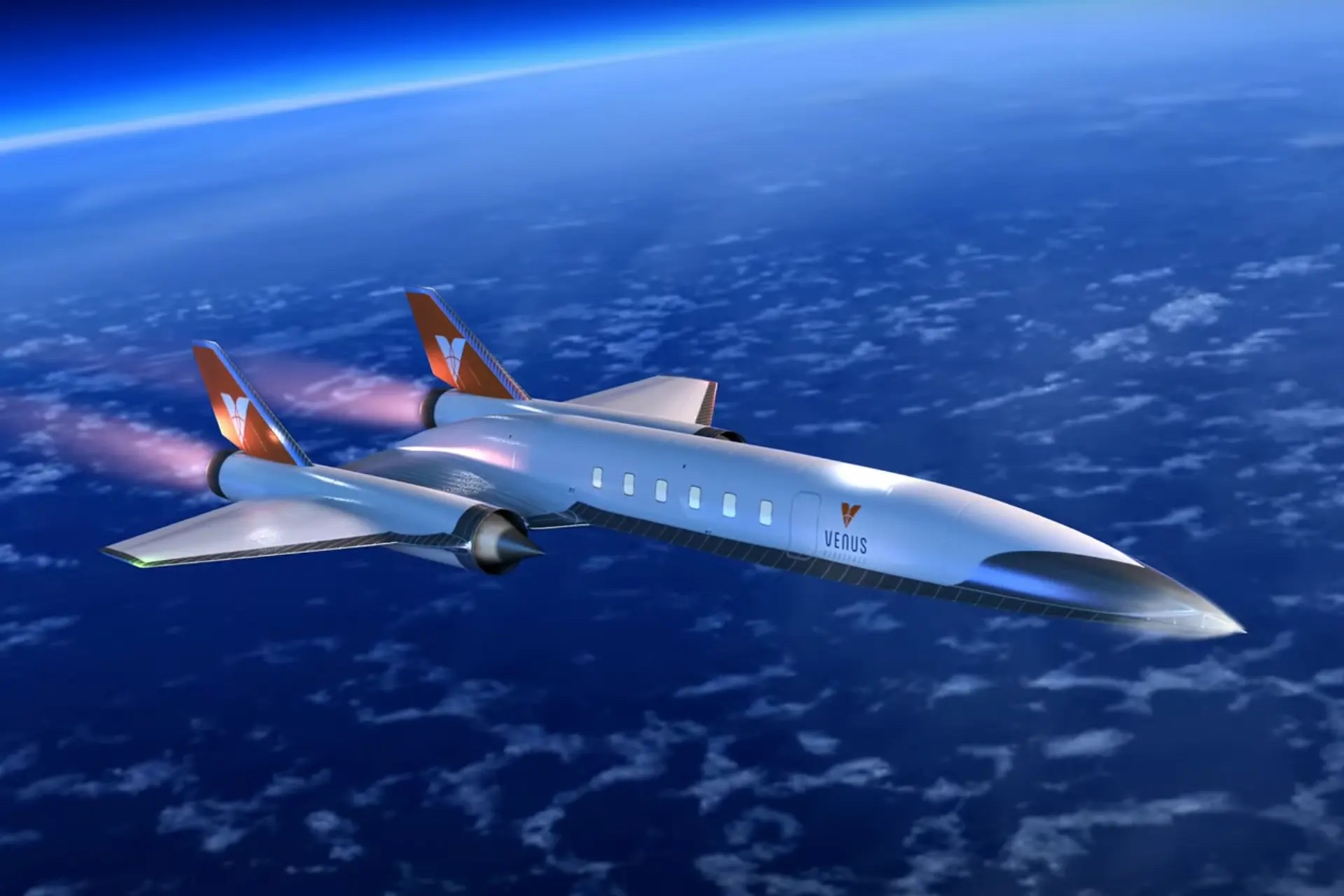
When is an empty tube not just an empty tube? When it’s a ramjet utilizing cutting-edge rotating detonation technology to propel aircraft at hypersonic speeds. This is precisely the innovation behind Venus Aerospace’s new engine—the Venus Detonation Ramjet 2000 lb Thrust Engine (VDR2).
Hypersonic flight, defined by speeds exceeding Mach 5, faces significant challenges, especially in designing engines capable of sustained thrust. While current hypersonic systems primarily rely on glide bodies that are boosted to extreme altitudes by rockets, achieving consistent, high-speed flight requires something more akin to a jet engine. Venus Aerospace’s VDR2 seeks to bridge this gap.
Unveiled at the Up.Summit in Bentonville, Arkansas, the VDR2 is deceptively simple in appearance. In a cutaway view, it looks like an empty tube, largely because it operates as a ramjet. Unlike conventional jet engines, which rely on spinning turbine blades to compress incoming air, a ramjet compresses air by the sheer speed at which the engine moves forward. This unique design allows the VDR2 to handle extremely high temperatures—up to 2,130 °C (3,860 °F)—that would otherwise melt turbine blades in a traditional engine.
What sets the VDR2 apart from previous designs is its incorporation of Rotating Detonation Rocket Engine (RDRE) technology. RDRE eliminates the need for moving parts and uses a series of coaxial cylinders with a gap where fuel and oxidizer are injected and ignited. When configured correctly, this generates a shock wave that travels at supersonic speeds within the gap, increasing heat and pressure for greater thrust and efficiency.
The result is a low-drag engine, developed in partnership with Velontra, capable of delivering high thrust and efficiency—enough to power an aircraft to speeds of Mach 6 and altitudes of up to 170,000 feet (52,000 meters). Venus Aerospace’s design goals estimate the VDR2 will be 15% more efficient than conventional engines, potentially revolutionizing hypersonic flight.
“This engine makes the hypersonic economy a reality,” said Venus Aerospace CTO Andrew Duggleby. “We are excited to partner with Velontra to achieve this revolution in high-speed flight, given their expertise in high-speed air combustion.”
The VDR2 is slated to undergo its first test flight in a drone next year, signaling a major leap forward in the development of hypersonic airliners that could one day fly passengers from San Francisco to Tokyo in just one hour.
By Impact Lab
