
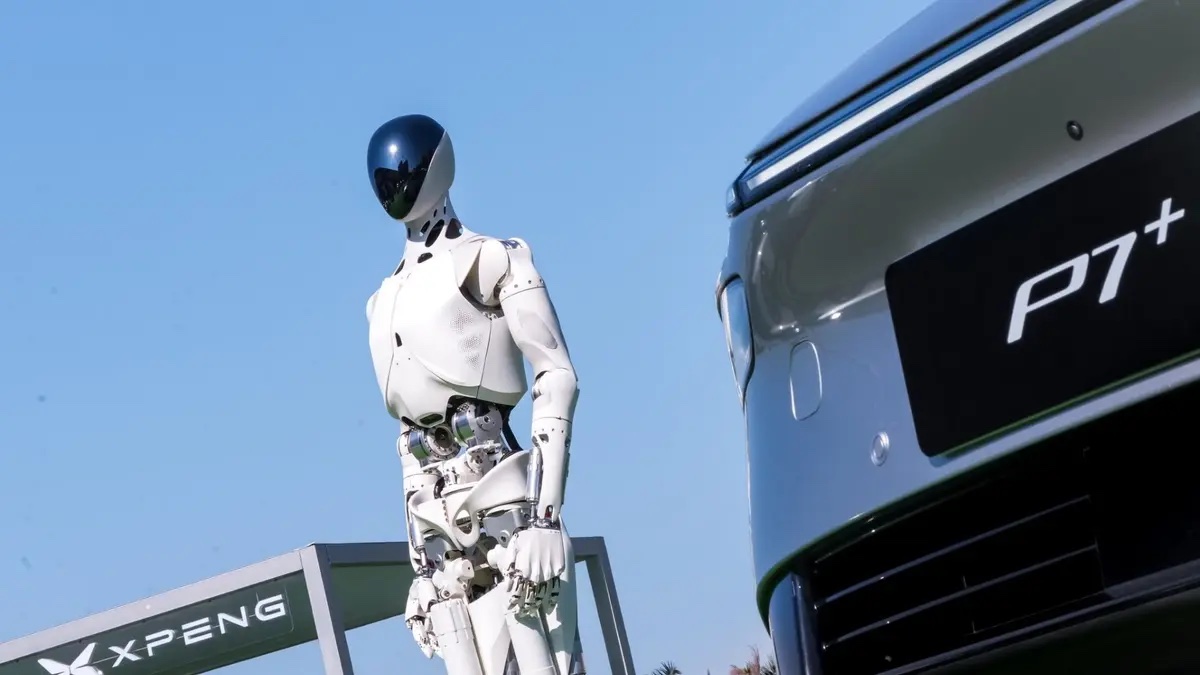
At its 2024 AI Day event, Chinese electric vehicle (EV) manufacturer Xpeng took a bold step into the world of robotics by unveiling its first humanoid robot, named Iron. This move echoes Tesla’s strategy of integrating AI and robotics into its broader vision, positioning Xpeng as a key player in the emerging robotics sector.
Iron stands at 5’8″ tall and weighs 154 pounds (70 kg), designed with over 60 joints and an impressive 200 degrees of freedom, allowing it to perform a range of tasks with remarkable flexibility. Built on the same AI technologies powering Xpeng’s electric vehicles, the robot is already operational on the company’s production lines, where it is assisting in the assembly of the upcoming P7+ electric car.
Xpeng’s new humanoid robot isn’t just a showcase piece—it has practical applications in the company’s manufacturing operations. According to Xpeng, Iron has been seamlessly integrated into the daily workings of the company, focusing on internal operations such as assembly lines and retail settings.
The robot’s intelligence is powered by Xpeng’s proprietary Turing AI chip, which features a 40-core CPU designed specifically for AI-intensive tasks. This chip, which has the capacity to process AI models with 30 billion parameters, is already enabling Iron to perform complex tasks, including delicate assembly work and walking, with impressive precision.
In addition to its work in manufacturing, Iron has the potential to be deployed in a wide range of industries. Xpeng envisions the robot taking on roles such as personal assistant, performing administrative duties, assisting in customer service, and even supporting tasks in retail environments, offices, and homes. This broad outlook on Iron’s potential places Xpeng in direct competition with other tech giants like Tesla, which has developed its own humanoid robot, Optimus, also using AI and autonomous driving technologies.
Xpeng’s Turing AI chip is a critical component in Iron’s ability to adapt and respond to a variety of tasks. The chip has undergone extensive testing, completing more than 2,700 functional verifications in just 40 days—three times the industry standard for development efficiency. This advanced chip allows Iron to adjust to new tasks with human-like decision-making capabilities, making it a versatile tool in both manufacturing and customer-facing applications.
In addition to Iron, Xpeng also introduced its Kunang super-electric system, an advanced powertrain that maximizes energy conversion for enhanced EV efficiency. The system, built on an 800V high-voltage silicon carbide platform, integrates a 5C ultra-charging AI battery that significantly boosts both energy efficiency and vehicle range. With the ability to add around 0.62 miles (1 km) of range per second, the system is capable of achieving an 80% charge in just 12 minutes. Xpeng’s new ultra-fast charging station, the S5 liquid-cooled station, can charge at a rate of over 0.6 miles (1 km) per second, further advancing the company’s goal of pushing the limits of electric vehicle technology.
Xpeng’s ambition extends beyond electric cars. The company is also venturing into the field of flying cars, with hybrid models set to launch in 2026. This commitment to AI, robotics, and autonomous driving technology positions Xpeng as a forward-thinking tech leader.
Xpeng’s expansion into robotics is just one part of the company’s broader strategy to become a global leader in AI, EVs, and autonomous technology. With plans to enter 60 international markets by next year, Xpeng is poised to rapidly expand its footprint across industries, positioning itself as a serious competitor in the tech and automotive sectors. As the company continues to innovate, Iron could be just the beginning of a new era for Xpeng as it strives to redefine the intersection of technology, mobility, and artificial intelligence.
By Impact Lab
