
By Futurist Thomas Frey
When Childhood Becomes Unrecognizable
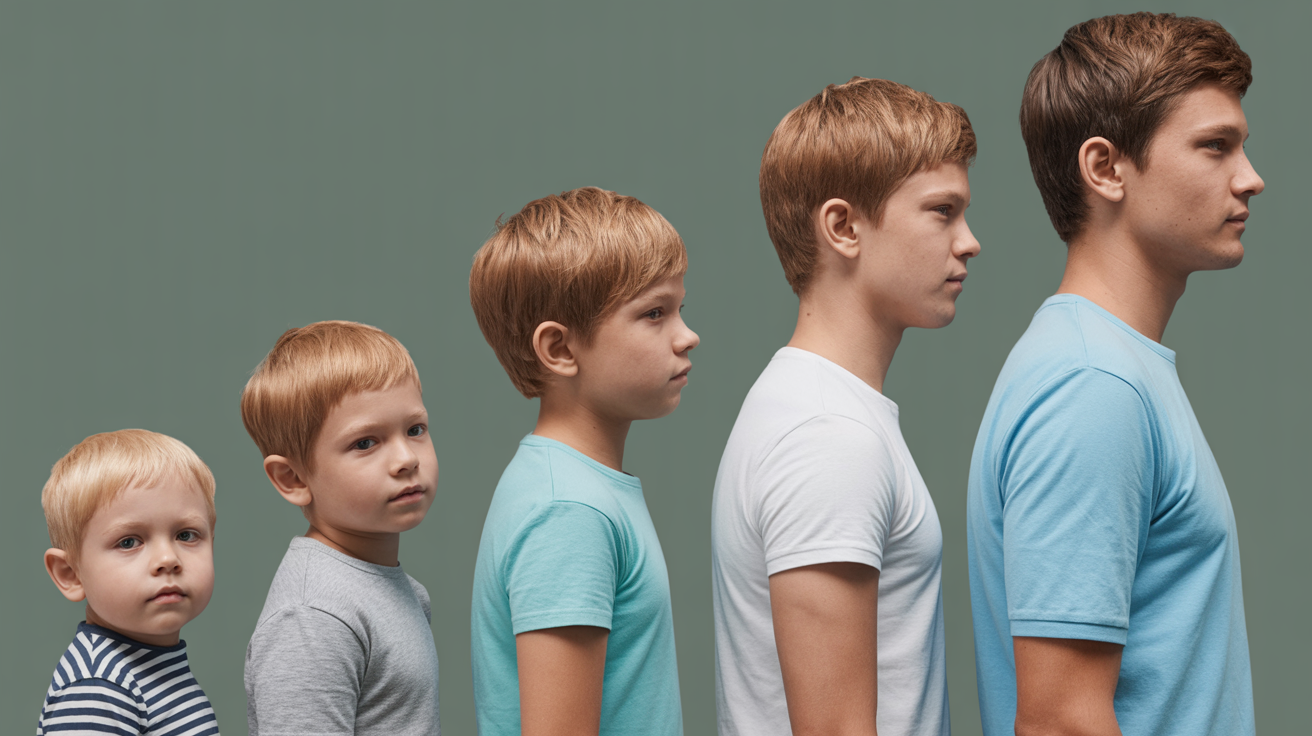
Meet Ethan, born in 2020. He’s five years old in 2025, growing up during the most disruptive technological transition in human history. Let me walk you through his life in five-year increments, showing how radically different childhood becomes when AI, robotics, and automation reshape society faster than institutions can adapt.
Age 5 (2025): The Last “Normal” Childhood
Ethan attends traditional kindergarten. His parents both work full-time office jobs. He learns to read from books and tablets. His home has Alexa and a Roomba, but mostly operates like houses did in 2015.
His teachers worry about screen time. His parents limit YouTube and video games. The family takes vacations planned through traditional travel websites. Life feels familiar—recognizably similar to his parents’ childhoods, just with more technology.
This is the last generation to experience “traditional” childhood before everything changes.
Age 10 (2030): The Transition Begins
Ethan’s school adopts AI-powered personalized learning. He no longer follows the same curriculum as classmates—his AI tutor (powered by Cogniate) customizes lessons to his learning style, pace, and interests. He completes “5th grade math” in seven months and moves directly into advanced topics.
His father loses his marketing job to AI automation. The family experiences six months of income volatility before his dad finds contract work as an “AI oversight specialist” earning 60% of his previous salary. His mother becomes primary breadwinner.
Ethan’s home now has a cleaning robot and meal prep unit. His family gets an autonomous vehicle subscription—no one in the household drives anymore. He video chats with his grandmother through a social robot that moves around her house, making her feel less isolated.
School feels less like school and more like individualized tutoring with occasional group projects. Traditional grades disappear, replaced by competency demonstrations.
Age 15 (2035): Native to a Different World
Ethan doesn’t attend physical school regularly—maybe twice weekly for labs and social activities. His education is entirely AI-guided and project-based. He’s completed what used to be “high school” requirements and is working on advanced specializations in bioengineering and AI ethics.
His competency ledger (living credential showing everything he can actually do) is more important than any transcript. Universities are already recruiting him based on demonstrated capabilities, not grades or test scores.
His parents’ income comes from managing small fleets of AI agents and service robots. Neither has a traditional job. Their income fluctuates monthly but averages higher than 2025 through portfolio work.
Ethan’s home is fully autonomous—robots handle cooking, cleaning, maintenance, and basic repairs. The house monitors family health through bathroom sensors, kitchen scanners, and bedroom tracking. His parents were alerted to his grandmother’s heart irregularity three days before she would have had symptoms.
He has a brain-computer interface headband for enhanced learning and gaming. His social life is split evenly between physical friends and digital relationships in immersive VR environments. The distinction between “online” and “offline” friends is meaningless to his generation.
Age 20 (2040): Architect of His Own Path
Ethan has never applied for a traditional job. At 16, he launched an AI-assisted biotech research consultancy. At 18, he created synthetic organisms for environmental cleanup (his third income stream). At 20, he manages AI systems that generate most of his income while he focuses on research and creative projects.
He’s never written a resume. His competency ledger shows everything he’s learned, every project completed, every skill demonstrated. Employers and collaborators evaluate him based on actual capabilities, not credentials.
His income is entirely project-based and fluctuates dramatically—some months $4,000, others $40,000. He’s learned to manage finances around six-month averages rather than monthly budgets, like most of his generation.
He lives in a micro-housing unit with full automation—cooking, cleaning, maintenance handled by robots and AI. He owns no car (autonomous vehicles on-demand), rarely shops in physical stores (everything delivered by drones and robots), and spends 30% of his waking hours in immersive VR for work, socializing, and entertainment.
His grandmother, now 75, lives independently with 24/7 robotic care assistance and AI health monitoring. She’s never alone because social robots provide constant companionship and immediate help if needed.
The Transformation Complete
Ethan’s childhood spans the complete transformation from industrial-age institutions to AI-native society. He experienced traditional school, the transition to personalized learning, and fully autonomous education. He watched his parents’ career disruption and adapted his own path accordingly.
By 20, concepts his parents took for granted—traditional jobs, fixed careers, physical workplaces, educational credentials, human-only relationships—are as foreign to him as rotary phones and typewriters.
He’s not struggling to adapt to change. He’s native to a world where change is the only constant, AI is ubiquitous, and human purpose is about creating meaning rather than performing tasks machines handle better.
This is what growing up in the AI age actually looks like. And Ethan’s generation will build a world we can barely imagine.
Related Articles:
2035 Predictions: When Humans Stop Operating and Start Designing Purpose
The Turbulent Middle: What 2026 Looks Like for People Caught Between Economies
Who Invented the Four-Year Degree? And Why It’s About to Become Obsolete
