
By Futurist Thomas Frey
The Question Ukraine Forces Us to Ask
Ukraine is running out of soldiers. After nearly three years of brutal attrition warfare, mobilization becomes increasingly difficult, casualties mount, and the demographic crisis deepens. Meanwhile, both sides deploy thousands of drones daily—kamikaze FPV drones, reconnaissance quadcopters, loitering munitions, autonomous swarms.
This forces an uncomfortable question: could you fight a war today with zero soldiers? Not someday with advanced AI—now, with existing drone technology, autonomous systems, and remote operation. What would an all-drone army look like? How long to gear up? How would battlefields change? And most importantly: is this better or worse for humanity in the long run?
Let me walk you through what soldierless warfare actually looks like and why we might be closer to it than anyone’s comfortable admitting.
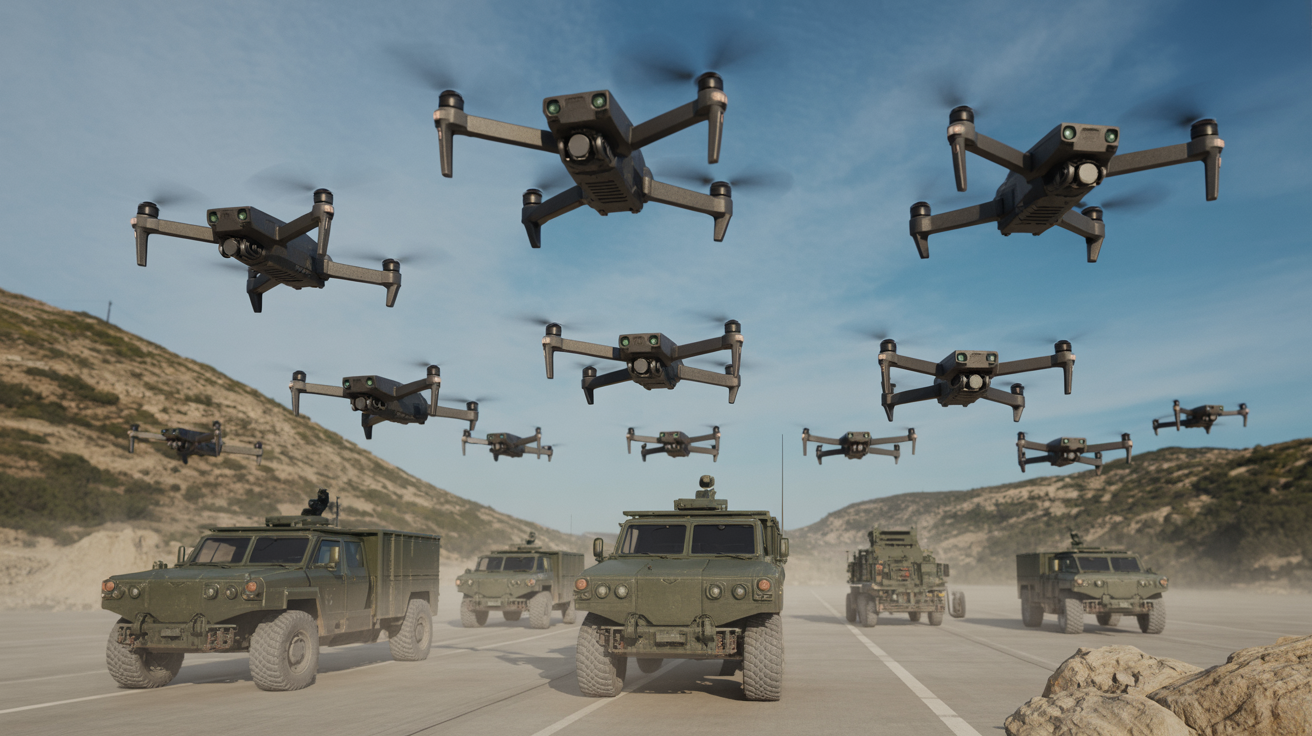
What an All-Drone Army Looks Like
Ground Layer: Thousands of small autonomous ground vehicles—modified ATVs, robotic platforms, unmanned ground vehicles (UGVs)—equipped with weapons, sensors, and communications. These aren’t tanks; they’re mobile weapons platforms controlled remotely or operating autonomously within defined parameters.
Think Boston Dynamics robot dogs equipped with rifles, autonomous turrets on wheeled platforms, and remote-controlled vehicles carrying anti-tank missiles. Ukraine and Russia are already deploying early versions of these.
Air Layer: Swarms of drones operating at multiple altitudes:
- High altitude: Reconnaissance drones providing persistent surveillance and targeting data
- Medium altitude: Loitering munitions waiting for targets of opportunity
- Low altitude: FPV kamikaze drones, small quadcopters dropping grenades, autonomous attack drones
The density would be staggering: tens of thousands of drones per square kilometer, controlled by hundreds of operators miles behind lines or operating autonomously with pre-programmed objectives.
Command Layer: Human operators managing autonomous systems through tablets and laptops in hardened facilities far from combat. AI systems coordinate drone swarms, identify targets, manage logistics, and optimize tactics in real-time.
This isn’t science fiction—Ukraine fields FPV drone teams controlling dozens of drones per operator right now. Scaling to fully autonomous armies is engineering and production, not fundamental breakthroughs.
How Long to Gear Up an All-Drone Force
Current production capacity: Ukraine produces roughly 4 million drones annually. China produces components for tens of millions of small drones. The bottleneck isn’t manufacturing capability—it’s software integration, training operators, and developing autonomous systems.
Timeline for viable drone-only force:
- 6 months: Proof of concept with existing technology—10,000 drones coordinated by 500 operators holding specific territory against conventional forces
- 18 months: Operational capability—100,000+ drones with autonomous coordination defending or attacking specific objectives
- 3 years: Full replacement of infantry—500,000+ autonomous and semi-autonomous systems controlled by 10,000-50,000 operators and AI coordination
The technology exists today. The challenge is coordination software, logistics for maintenance and recharging, and developing tactics for drone-heavy warfare. But a determined nation could field a credible all-drone army within 18-24 months using existing commercial technology.
How the Battlefield Changes
No front lines: Traditional fronts dissolve. Drones operate 360 degrees around positions, making “behind enemy lines” meaningless. Every position is simultaneously under observation and potential attack from any direction.
Constant lethality: Battlefields become continuously lethal rather than concentrated around attacks. Autonomous systems patrol 24/7 without fatigue, maintaining persistent threat across entire theaters.
Attrition becomes production: Winning isn’t destroying enemy armies—it’s out-producing them. Wars become industrial capacity competitions: who manufactures more drones faster and maintains supply chains under attack.
Electronic warfare dominance: The critical capability becomes jamming enemy drones while protecting your own communications. EW becomes more important than artillery or armor.
Speed increases dramatically: Without human sleep requirements or morale concerns, operations occur continuously at machine tempo. Attacks happen simultaneously across hundreds of kilometers with thousands of coordinated systems.
Civilian infrastructure becomes military target: Drone production facilities, charging infrastructure, communications networks—all become primary targets. The distinction between civilian and military infrastructure collapses.
How Many Drones Are Needed
For comparison: Ukraine currently fields approximately 500,000 soldiers. An equivalent drone force replacing infantry would require:
Frontline combat: 200,000+ small attack drones (FPV kamikaze, armed quadcopters, loitering munitions)
Reconnaissance: 50,000+ surveillance drones providing persistent coverage
Ground vehicles: 20,000+ autonomous ground vehicles for holding territory and supply transport
Logistics: 100,000+ delivery drones for ammunition, batteries, and equipment
Reserve/rotation: 200,000+ drones in maintenance, charging, or reserve
Total: 500,000-750,000 drones replacing conventional infantry force
Cost comparison: $500-5,000 per small military drone versus $50,000+ annual cost per soldier (including training, equipment, healthcare, pensions). Even expensive military-grade drones cost less than human soldiers over time.
Is This Better or Worse in the Long Run?
Arguments this is BETTER:
Reduced casualties: No soldiers die. Wars stop creating widows, orphans, and generational trauma from combat deaths. This is the strongest humanitarian argument for drone warfare.
Faster wars: Without need to preserve soldier lives, conflicts resolve faster through overwhelming force rather than protracted attrition.
Democratic advantage: Democracies struggle with casualties undermining public support. Drone warfare removes this constraint, potentially strengthening democratic nations versus authoritarian ones willing to sacrifice populations.
Economic efficiency: Drones cost less than trained soldiers, reducing military budgets while maintaining or increasing capability.
Arguments this is WORSE:
Lower threshold for war: When wars don’t cost lives, political leaders face fewer constraints on military action. Wars become more frequent because consequences decrease.
Endless conflicts: Without casualty pressure forcing resolution, wars drag on indefinitely as both sides continuously produce replacement drones.
Civilian casualties increase: Autonomous systems make mistakes. When thousands of drones operate with imperfect targeting, civilian deaths from misidentification could exceed conventional warfare.
Authoritarians gain advantage: Dictatorships with industrial capacity can wage wars without popular support constraints. They can’t draft unwilling populations, but they can manufacture drones regardless of public opinion.
Dehumanization of warfare: When killing becomes video-game-like remote operation, psychological barriers against violence erode. War becomes normalized as low-consequence activity.
Proliferation to non-state actors: Terrorist organizations, cartels, and insurgent groups can build drone armies for thousands of dollars. Military capability becomes democratized to any group with modest funding.
The Winners and Losers
Winners:
- Industrial powers: Countries with manufacturing capacity and supply chain resilience (China, potentially U.S. if reindustrialized)
- Small, tech-savvy nations: Israel, Taiwan, South Korea—nations with advanced technology but limited populations benefit enormously from force multiplication
- Defense contractors: Companies producing drones, sensors, AI systems, and electronic warfare equipment see explosive growth
- Authoritarian regimes: Ability to wage war without popular support or casualty concerns
- Populations avoiding conscription: Young people in democracies never face draft
Losers:
- Traditional military powers: Nations with large standing armies but limited industrial capacity (Russia long-term, most European nations)
- Countries with weak industrial bases: Cannot compete in production wars regardless of population size
- Conventional defense industries: Tank manufacturers, traditional aircraft producers become obsolete
- International stability: Lower barriers to conflict mean more frequent wars
- Civilians in conflict zones: Increased automation means increased misidentification and collateral damage
- Global poor: Warfare becomes affordable for any faction, spreading conflicts to regions previously too poor for sustained military operations
The Uncomfortable Reality
We’re not asking whether soldierless warfare is possible—Ukraine and Russia demonstrate it’s happening now in hybrid form. The question is whether nations will fully commit to drone-only forces or maintain human armies alongside autonomous systems.
My assessment: within a decade, at least one nation will field a predominantly drone-based military out of necessity (likely a smaller nation facing larger adversary) or capability demonstration (likely China or U.S. proving the concept).
The technology works. The economics favor it. The military advantages are overwhelming for nations willing to embrace it. The ethical arguments against it—that war should remain costly in human terms to discourage casual conflict—won’t overcome the competitive pressure when adversaries deploy drone armies and you haven’t.
Final Thoughts
Soldierless warfare isn’t a distant future—it’s a near-term inevitability driven by Ukraine’s desperate innovation under existential threat. The nation running out of soldiers is pioneering the warfare model that makes soldiers optional.
This is simultaneously humanity’s greatest achievement in reducing combat deaths and our most dangerous step toward making war so consequence-free for governments that conflicts become perpetual background noise rather than society-shaking events demanding resolution.
The question isn’t whether we can fight wars without soldiers. We can, and we will. The question is whether we should, and whether we’re prepared for a world where starting wars becomes as simple as ramping up factory production rather than convincing young people to risk their lives.
Ukraine is writing the playbook. The rest of the world is just deciding how quickly to adopt it.
Related Articles:
AI Drones and Active Shooters: When Technology Becomes First Responder
The Norman Matrix: How Directional Air Layers Will Control the Drone Revolution
12 Provocative Predictions for 2026: The Year Reality Becomes Science Fiction
