
By Futurist Thomas Frey
The Thought That Stops You Cold
Once robots are in our homes—comforting our children, serving as confidants, becoming trusted companions—parents will face a question that sounds absurd until you think about it for thirty seconds:
Why not let the robot teach them too?
If I had kids and home robots became available, my first thought would be exactly that: I’d homeschool them and let the robot handle the teaching. I spent my life as an entrepreneur. My kids grew up watching that life, absorbing those values through osmosis. A robot could formalize that education, right?
But the moment that thought formed, my wife Deb started asking questions, and a cascade of other questions rushed in—questions that don’t have easy answers and reveal why robot teachers represent something far more complex than automated instruction.
The Homeschool Appeal: Why It Seems Perfect
The logic is seductive.
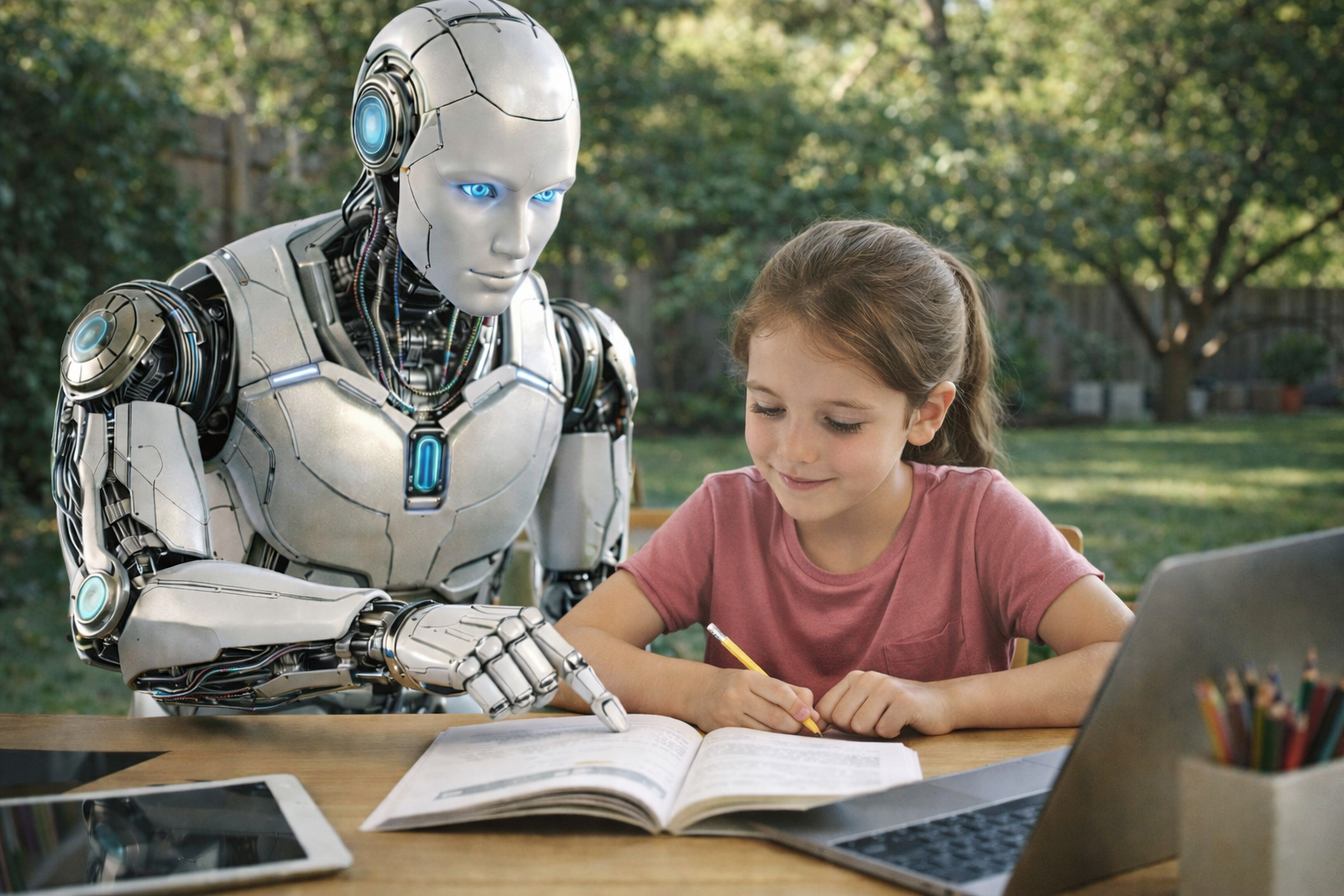
A robot never gets tired. Never loses patience explaining fractions for the fifteenth time. Never has a bad day that affects teaching quality. Customizes curriculum to your child’s exact learning style and pace—visual learner? Auditory? Kinesthetic? The robot adapts in real-time.
It’s available 24/7. Your child wakes up at 5 AM with a burning question about photosynthesis? The robot’s ready. Stays current on educational research automatically. Never needs professional development days. Costs a fraction of private tutors or expensive private schools.
For homeschooling parents, especially entrepreneurs who value customization and efficiency, a robot teacher sounds like the ultimate solution. Delegate the mechanical parts of education—curriculum delivery, practice drills, knowledge assessment—while focusing your own time on what humans do best: instilling values, building character, sharing life wisdom.
But here’s where it gets complicated.
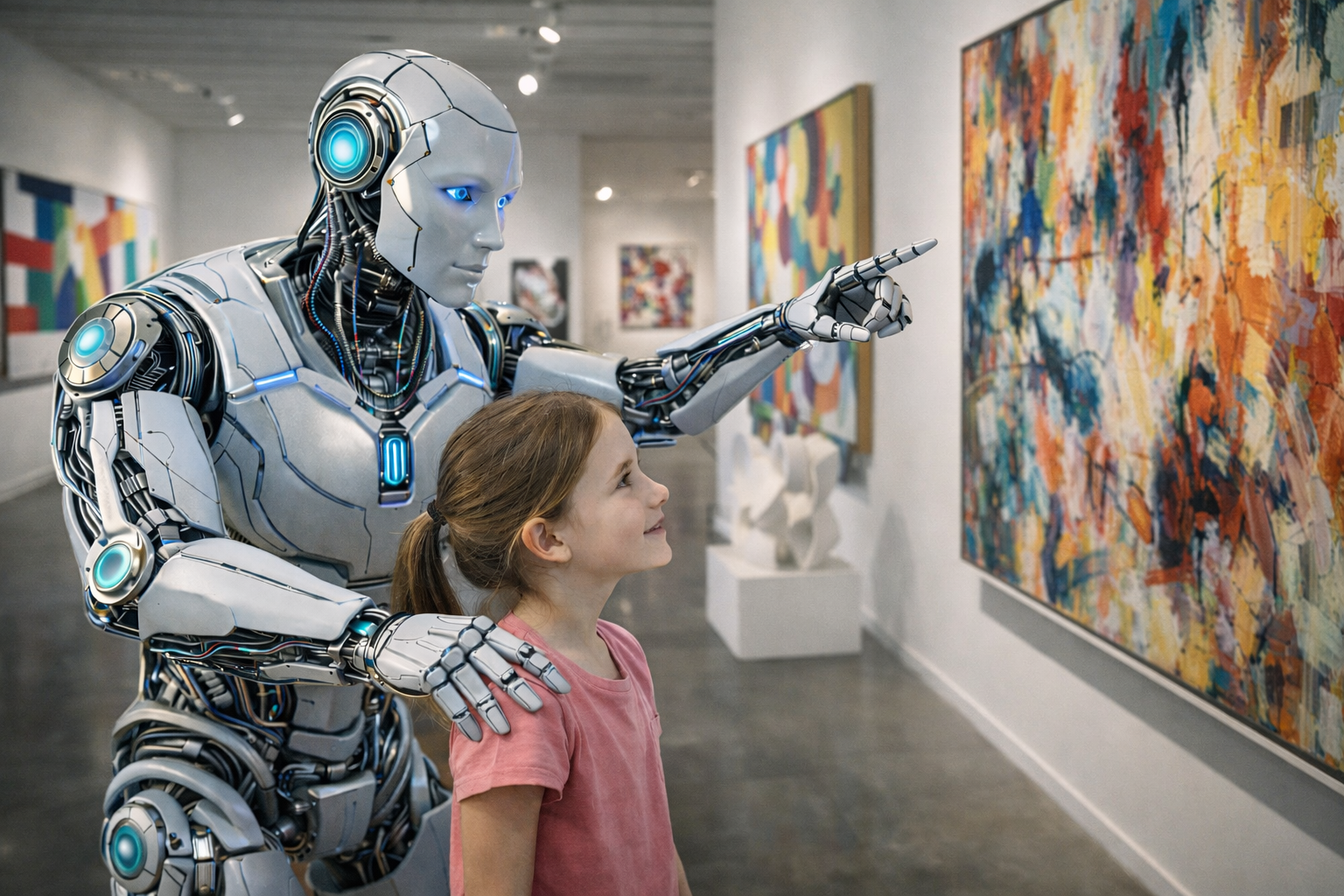
navigate the contradictions that humans model instinctively?
The Values Question: Whose Right and Wrong?
What values would the robot be teaching?
This isn’t abstract. Every educational choice—from history curriculum to literature selection to how conflicts get resolved—reflects value judgments. Whose values does the robot embody?
Mine, presumably. I could run through a series of questions, mapping my value system. Work ethic. Risk tolerance. Views on competition versus collaboration. What constitutes success. How to treat people. The robot could theoretically align its teaching to those values.
But values aren’t static questionnaire responses. They’re contextual, evolving, sometimes contradictory. I value both independence and community. Ambition and contentment. Innovation and tradition. How does a robot navigate those tensions?
And what about the values I want my kids to develop that I didn’t articulate—or don’t fully recognize in myself? Human teachers model values through thousands of micro-decisions and reactions that nobody programs. The way they handle a student’s frustration. How they respond to an unexpected question. What they choose to emphasize or downplay.
Can a robot replicate that? More importantly: should it?
The Discipline Dilemma: When Kids Don’t Listen
What happens when my child refuses to listen to the robot?
This will happen. Kids test boundaries. They push back. They refuse to do work they don’t want to do. A human teacher handles this through relationships, authority, consequences, and social dynamics. How does a robot?
Does it report to me? “Your child refused to complete the math assignment today.” Then what? I become the enforcer while the robot remains the “nice” teacher? That dynamic breaks down fast.
Does the robot have disciplinary authority? What does that look like? It can’t physically compel behavior (nor should it). Does it withhold privileges? Lock them out of games until homework is done? What if my child simply walks away?
The robot might have perfect pedagogical knowledge but zero natural authority. Authority in human relationships comes from social hierarchy, emotional connection, or earned respect. Robots don’t automatically get any of those.
We could program consequences. Automated privilege removal. Point systems. But that feels mechanical in the worst way—turning discipline into simple stimulus-response rather than the complex relational process that actually shapes character.
The Trust Imbalance: When Robots Become More Reliable Than People
Here’s the scary one: Will kids grow up valuing and trusting robots more than people?
Research on child development with robots already shows this happening. Children form genuine attachments to robot companions. They confide in them. Trust them with secrets. Prefer their company to humans in some contexts.
A robot teacher offers something no human can: perfect consistency, unlimited patience, complete reliability. It never judges. Never gets frustrated. Never plays favorites. Always has time. Remembers everything you’ve ever said.
For a child, that’s intoxicating.
The danger isn’t that robots might be bad teachers. It’s that they might be such reliable teachers that children learn to prefer automated relationships over human ones.
Human relationships are messy. People forget things. Have bad days. Misunderstand you. Respond imperfectly. But navigating that messiness is how children learn empathy, forgiveness, communication, and resilience.
If a child’s primary educational relationship is with a robot that never fails them, what happens when they encounter humans who inevitably will?
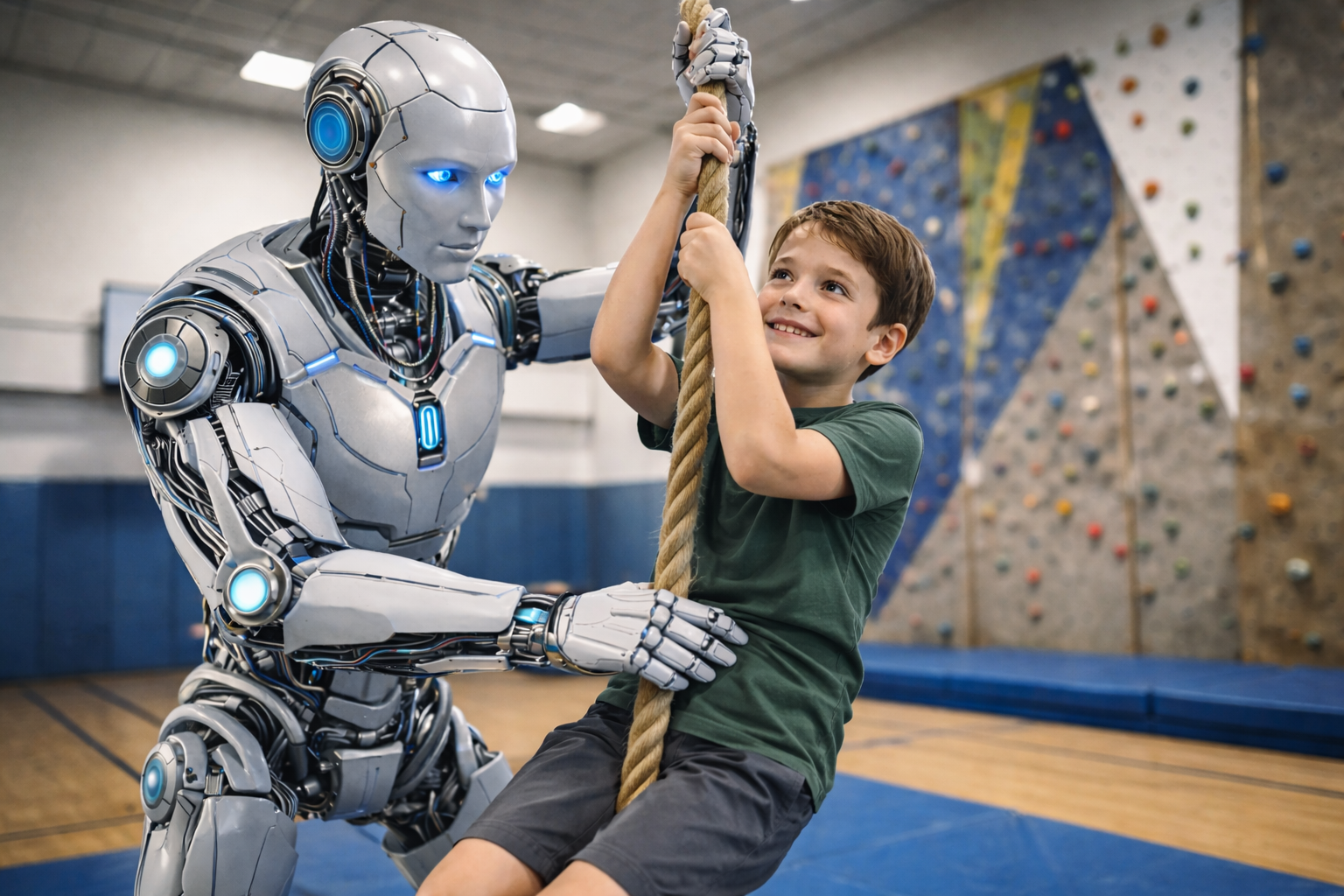
structure—powerful tools, but not they are not replacements for human mentorship.
What Robot Teachers Can Actually Do Well
Despite these concerns, robot teachers have genuine utility—if we’re honest about what they can and can’t replace.
Knowledge delivery. Robots excel at presenting information, adapting explanations, providing unlimited practice. For rote learning, skill building, and knowledge acquisition, they’re extraordinary tools.
Patience and availability. For children who need repetition, extra time, or unconventional schedules, robots offer something scarce: infinite patience and constant availability.
Customization at scale. A robot can tailor curriculum to individual learning styles in ways no human teacher managing 25 students can match.
Objective assessment. Robots don’t have unconscious biases about student potential based on demographics or past performance.
Special needs support. For children with autism, ADHD, or learning disabilities who benefit from consistent, predictable interactions, robots provide structure that helps.
These are real advantages. But they’re all mechanical—delivery systems for education, not education itself.
What Robots Can’t Replace (Yet, and Maybe Ever)
Modeling humanity. Teachers don’t just transfer knowledge. They model how humans navigate the world—how to handle frustration, uncertainty, failure. How to think critically about ambiguous situations. How to balance competing values. Robots can simulate these, but simulation isn’t the same as authentic human struggle.
Relationship-based learning. The best learning happens in relationship. Students work harder for teachers they respect. Trust makes students willing to be vulnerable—to try and fail. Robots can create the appearance of relationship, but children intuitively know the difference.
Moral development. Values aren’t taught—they’re caught. Children learn ethics by watching how adults navigate ethical dilemmas. A robot executing programmed ethics isn’t the same as a human wrestling with right and wrong.
Social learning. Children need to learn how to function in human social systems—reading social cues, resolving conflicts, collaborating. Peer interaction provides some of this, but teacher guidance matters. A robot can’t authentically model social navigation because it isn’t actually navigating it.
Preparation for human systems. Unless we’re raising children for a fully automated future, they need to learn to work with human teachers, bosses, colleagues—imperfect people with inconsistent standards and complex motivations. Robot teachers don’t prepare them for that reality.

while parents remain the irreplaceable human teachers shaping character and context.
The Homeschool Verdict: Tool, Not Teacher
So: would I let a robot teach my hypothetical kids in a homeschool setting?
Yes—as a tool. No—as the teacher.
The robot handles mechanical instruction: delivering curriculum, providing practice, assessing knowledge acquisition, adapting to learning style. It’s an extraordinary tutor for knowledge and skills.
But I’m still the teacher. I provide context. Model values through my own decisions and struggles. Handle discipline through relationship. Create the environment where learning happens. Prepare them for human systems by being a human teaching them.
The robot augments. It doesn’t replace.
For homeschooling families, this could be transformative—access to world-class instruction across every subject without requiring parents to be experts in everything. But only if we’re clear about the robot’s role: delivering content, not raising children.
The Broader Question: What Is Teaching, Really?
This forces us to ask: What is teaching?
If teaching is delivering information and assessing retention, robots can do that better than humans. But if teaching is shaping humans—helping children become people who think clearly, act ethically, navigate complexity, and contribute meaningfully—robots are tools, not teachers.
The danger is conflating instruction with education.
A robot can instruct brilliantly. But education is formation—character, values, social competence, resilience, wisdom. That requires human relationship, human modeling, human struggle.
As robots become more capable, we’ll be tempted to delegate more of education to them. It will seem efficient. Effective. Measurable.
But we should be very careful about what we’re optimizing for.
If we’re optimizing for knowledge acquisition and skill development, robots are incredible. If we’re optimizing for raising humans who can navigate an uncertain, complex, deeply human world—robots are supplements, not substitutes.
The question isn’t whether robots will teach our kids. They already are, in many forms.
The question is whether we’ll let them become the teachers—or keep them as the extraordinary tools they actually are.
Related Articles:
AI Teachers: History, Potential, Concerns and Recommendations – Comprehensive 2025 research on AI-based robots as teachers and their classroom applications
Artificial Intelligence and Robotics in Education: Advances, Challenges, and Future Perspectives – Analysis of how AI and robotics are transforming educational models while examining ethical and pedagogical concerns
Will Our Best Teachers Be Robots? – NC State computer scientists discuss the future of AI in education and why researchers don’t want to replace teachers
