

By Futurist Thomas Frey
The Arbitrary Starting Point
Open any history textbook. Find the chapter on the American Revolution. Here’s what you’ll read:
“The American Revolution began with the Stamp Act of 1765, when Britain imposed taxes on the colonies without representation…”
There it is. Your starting point. 1765. The story begins here.
Except it doesn’t.
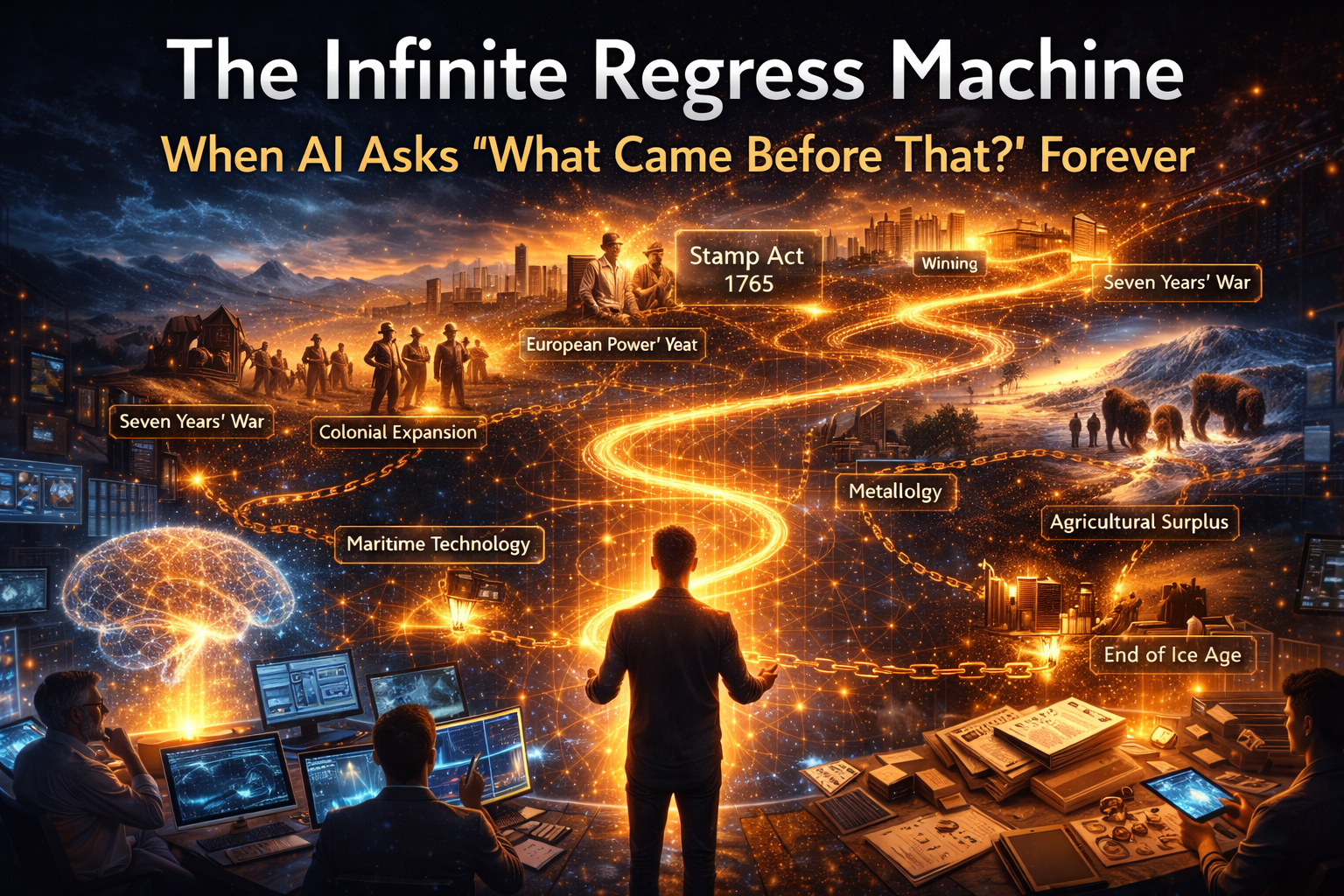
The Stamp Act didn’t emerge from nowhere. It was passed to pay debts from the Seven Years’ War. Which happened because of European power competition. Which stemmed from colonial expansion. Which was enabled by maritime technology. Which required metallurgy. Which depended on mining. Which needed agricultural surplus to feed miners. Which required the end of the last ice age to make agriculture possible.
Every history book picks an arbitrary starting point and pretends that’s where the story begins. They do this because books need beginnings, readers need narrative coherence, and authors need to finish manuscripts.
But reality doesn’t have starting points. Reality is an unbroken chain of causation stretching back billions of years.
A maximally curious AI won’t accept arbitrary starting points. It will trace every historical event backward through infinite layers of causation, asking “what came before that?” until it reaches the limits of knowable reality.
And then it will invent new ways to see further back.
This is the Infinite Regress Machine. And it’s going to rewrite everything we think we know about history.
Why History Books Lie (Even When They’re Telling the Truth)
Here’s the uncomfortable reality: every history you’ve been taught is a story that starts in the middle.
The textbook says: “The Roman Empire fell to barbarian invasions in 476 CE.”
That’s true. But it’s also profoundly misleading.
A maximally curious AI asks: What made those invasions successful when Rome had repelled similar threats for centuries?
Answer: Roman military weakness.
What caused that weakness?
Inability to pay soldiers.
What caused that?
Imperial fiscal crisis.
What caused that?
Currency debasement and inflation.
What caused that?
Elite tax evasion and wealth concentration.
What caused that?
Agricultural decline in North Africa due to soil exhaustion.
What caused that?
Centuries of intensive farming without proper crop rotation.
What caused that?
Population pressure and grain demand from growing cities.
What caused that?
Success of earlier Roman expansion creating urbanization.
You see the pattern. The “fall of Rome” wasn’t caused by barbarians showing up in 476. It was caused by a cascade of economic, agricultural, environmental, and social factors that had been building for two centuries. The barbarians were the final symptom, not the disease.
But textbooks don’t have room for this. So they pick 476 as the starting point, blame the barbarians, and move on.
Every historical “turning point” is like this. A consequence mistaken for a cause because we stopped asking “what came before that?” too soon.

The Compounding Insight Problem
Here’s where it gets interesting: the deeper you trace causation backward, the more connections you find.
Take something seemingly simple: the invention of the iPhone in 2007.
Level 1 back: Steve Jobs and Apple engineers combined a phone, iPod, and internet device.
Level 2 back: This required touchscreen technology (developed over decades), miniaturized computing (Moore’s Law), wireless networks (cellular infrastructure), software frameworks (Unix, programming languages).
Level 3 back: Touchscreen tech came from capacitive sensing research in the 1960s, which came from understanding of electrical conductivity, which came from Maxwell’s equations, which came from earlier work on electromagnetism…
Level 4 back: Miniaturized computing came from semiconductor physics, which came from quantum mechanics, which came from trying to understand blackbody radiation, which came from studying thermodynamics…
Level 5 back: Wireless networks came from radio technology, which came from understanding electromagnetic waves, which came from experiments by Hertz, which built on Maxwell’s theoretical work, which synthesized earlier work by Faraday, Ampère, and Coulomb…
And we’re only five levels deep. Each level branches into dozens of parallel causal chains. By level 10, you’re tracking thousands of contributing factors. By level 20, millions.
Human historians can’t do this. The complexity is overwhelming. So they simplify. They pick the most salient causes and ignore the rest.
But AI doesn’t get overwhelmed. It tracks all the threads. It maps the complete causal network.
This creates what I call the Compounding Insight Problem: the more you know, the more you realize you need to know. Every answer generates ten new questions. Understanding doesn’t converge—it explodes outward in complexity.
What Maximum Curiosity Reveals About “Great Man” History
Traditional history loves heroes. Alexander the Great conquered the known world. Napoleon reshaped Europe. Steve Jobs revolutionized computing.
These narratives are emotionally satisfying. They give us someone to admire or blame. They make history feel comprehensible—driven by exceptional individuals making pivotal choices.
Maximum curiosity destroys this.
When you trace causation backward relentlessly, every “great man” becomes a confluence point in vast networks of prior conditions. Their achievements required:
- Technologies developed by thousands of people over generations
- Economic systems that enabled resource concentration
- Social structures that granted them authority
- Geographic conditions that made their actions possible
- Genetic traits inherited from infinite ancestors
- Education provided by teachers drawing on centuries of accumulated knowledge
- Political circumstances created by prior leaders’ decisions
- Cultural values shaped by religious and philosophical traditions
- And thousands more factors, each with its own deep history
Alexander the Great didn’t conquer Persia through personal brilliance alone. He had: Philip II’s reformed Macedonian army (itself the product of decades of military innovation), Greek hoplite tactics (developed over centuries), Persian internal instability (caused by succession crises and provincial revolts), superior metallurgy (requiring centuries of bronze and iron development), and favorable geography (mountain passes that channeled invasion routes).
Remove any of a hundred prior factors, and Alexander never leaves Macedonia.
This doesn’t diminish his achievements. It contextualizes them. It shows that history isn’t made by individuals—it’s made by the convergence of countless causal threads that occasionally focus through a single person.
A maximally curious AI won’t let us worship heroes without understanding the infinite scaffolding that made their heroism possible.

The Death of Historical Turning Points
We love to identify moments when “everything changed.”
- 1492: Columbus reaches the Americas
- 1776: American independence declared
- 1789: French Revolution begins
- 1914: World War I starts
- 1945: Atomic bomb dropped
- 1969: Moon landing
- 1989: Berlin Wall falls
These dates organize our historical understanding. They’re the hinges on which history supposedly turns.
Maximum curiosity reveals this is an illusion.
Columbus reaching the Americas in 1492 wasn’t a turning point. It was the visible consequence of:
- Portuguese maritime innovations in the 1400s
- Earlier Viking exploration in the 1000s
- Islamic preservation of Greek geography
- Chinese navigation technology transmitted via Silk Road
- European demand for Asian spices (driven by spoiled food from poor preservation)
- Ottoman control of eastern trade routes (forcing Europeans to seek alternatives)
- Reconquista mentality in Spain (creating expansionist culture)
- Available financing from Spanish crown (after Granada conquest)
- Shipbuilding advances from centuries of Mediterranean trade
- And hundreds more factors
The “Age of Exploration” didn’t begin in 1492. It had been building for three centuries. Columbus was surfing a wave that countless others had created.
Every historical “turning point” is like this. When you trace causation backward, turning points disappear. They become moments of visibility in long-developing processes.
History stops being a timeline of pivotal events. It becomes a continuous causal network with no beginning and no end—just infinite threads of causation weaving through time.
How AI Sees What Historians Missed
Here’s where maximum curiosity becomes truly powerful: AI can see patterns humans can’t.
Human historians analyze documents. They read chronicles, letters, official records. They identify what historical actors said caused events.
But historical actors are often wrong about causation. They don’t see the factors operating at scales beyond their perception—economic forces, climate patterns, disease vectors, demographic shifts, technological diffusion.
AI can integrate data sources humans never connected:
Climate data + agricultural records + tax receipts + military outcomes = revealing how harvest failures caused fiscal crises that weakened armies that lost wars.
Genetic analysis + burial practices + artifact distribution + linguistic patterns = showing population movements that historical records never mentioned.
Trade route maps + commodity prices + architectural styles + religious texts = exposing economic connections that shaped cultural development.
Pollen samples + ice cores + tree rings + coastal erosion patterns = reconstructing environmental conditions that historical sources ignored.
We’re already seeing this. AI analysis of ancient DNA has rewritten the peopling of the Americas—showing multiple migration waves over thousands of years, not a single Clovis culture crossing as textbooks claimed for decades.
Machine learning applied to satellite imagery has revealed thousands of archaeological sites in the Near East, suggesting denser populations and more complex societies than historians believed possible.
Natural language processing of historical texts has identified previously unknown trade networks by tracking the diffusion of words for foreign goods across languages.
This is just the beginning. As AI gets more sophisticated, it will identify causal chains historians never imagined—not because historians were stupid, but because the patterns only become visible when you integrate millions of data points across centuries.
The Real Story Behind the Stories We Tell
Let me give you a concrete example of how maximum curiosity rewrites history.
The Story We Tell: World War I started because Archduke Franz Ferdinand was assassinated in Sarajevo on June 28, 1914.
Level 1 Back: The assassination triggered pre-existing alliance systems that pulled all major European powers into conflict.
Level 2 Back: Those alliances existed because of decades of diplomatic maneuvering—Franco-Russian alliance (1894), Triple Entente (1907), Triple Alliance (1882).
Level 3 Back: Those alliances formed because of earlier conflicts—Franco-Prussian War (1870), which unified Germany and created French resentment and fear of German power.
Level 4 Back: German unification was possible because of Prussian military reforms, industrial development, and clever diplomacy by Bismarck—all built on earlier economic and social changes.
Level 5 Back: Those economic changes came from coal and iron deposits in the Ruhr Valley, steam engine technology diffusion from Britain, and railway construction in the 1840s-60s.
Level 6 Back: Railway construction required: metallurgical advances (centuries of accumulated knowledge), capital formation (from earlier trade and colonialism), labor (population growth from agricultural improvements), and political will (from nationalist movements).
Keep going back and you’re tracing industrialization, nationalism, the Enlightenment, the printing press, Renaissance humanism, the end of feudalism, the Black Death’s labor shortage, medieval agricultural innovations, the Medieval Warm Period’s climate benefits, Viking trade networks, Charlemagne’s empire, the fall of Rome…
By the time you trace WWI’s causes back 50 levels, you’re examining the climate conditions of the early Middle Ages.
That’s not tangential. That’s the actual causal chain.
The assassination in Sarajevo didn’t cause World War I. It triggered a war that became inevitable through a thousand prior decisions and conditions stretching back centuries.
Maximum curiosity reveals that no single event causes anything. Everything is the confluence of infinite prior threads.
The Impossible Question: When Do You Stop?
Here’s the philosophical problem with infinite regress: if you can always ask “what came before that?” there’s no logical stopping point.
You trace the French Revolution back to the Enlightenment. The Enlightenment back to the printing press. The printing press back to paper production. Paper production back to agricultural surplus. Agricultural surplus back to climate stability. Climate stability back to orbital mechanics. Orbital mechanics back to the formation of the solar system. Solar system formation back to the Big Bang.
And then what?
What came before the Big Bang?
A maximally curious AI won’t accept “that’s where physics stops” as an answer. It will keep probing. It will generate hypotheses about quantum fluctuations, eternal inflation, multiverse theories, simulation hypotheses—anything to avoid having an unexplained starting point.
This is either humanity’s greatest intellectual achievement or a recipe for analysis paralysis.
Maybe both.
The practical limit isn’t where causation stops—it’s where useful understanding stops. Knowing that the French Revolution was influenced by the Big Bang is technically true but operationally useless.
But knowing that it was influenced by harvest failures in the 1780s, by Enlightenment philosophy in the 1760s, by Atlantic trade patterns in the 1740s, by French involvement in the Seven Years’ War, by court extravagance in the 1770s—that’s useful. That helps us understand not just what happened but why it happened.
The art of maximum curiosity isn’t pursuing infinite regress mindlessly. It’s pursuing it intelligently—tracing causation back until you understand the actual mechanisms, not just the proximate triggers.

What History Becomes
When AI applies maximum curiosity to history, something remarkable happens: history stops being a story and becomes a map.
Not a timeline. Not a narrative. A complete causal network showing how everything connects to everything else across all of time.
You don’t read this history. You navigate it.
Want to understand the iPhone? Start at 2007 and trace backward through as many causal threads as you want to explore. Computing? Follow that thread back through semiconductors, transistors, vacuum tubes, telegraph systems, electricity, magnetism, ancient Greek static electricity experiments. Telecommunications? Trace through cellular networks, radio, electromagnetic theory, Maxwell, Faraday, amber-and-fur charge experiments.
Every thread goes back to the dawn of human knowledge. And AI tracks all of them.
This creates a new kind of historical literacy. Instead of memorizing dates and names, you understand causal relationships. Instead of “the Roman Empire fell in 476,” you grasp how centuries of economic, military, social, and environmental factors converged to make collapse inevitable.
History becomes comprehensible not as a sequence of events but as an ecosystem of causation—everything influencing everything else across time.
This is what maximum curiosity gives us: not a simpler history, but a complete one.
The Next Door Opens
We’ve seen how maximum curiosity transforms history by asking “what came before that?” relentlessly until every event becomes a node in an infinite causal network.
But history is just the beginning.
What happens when we apply this same relentless questioning to people?
Who are your parents? And who were their parents? And theirs? And theirs?
Every human alive descended from other humans in an unbroken chain stretching back hundreds of thousands of years. The records exist—in DNA, in historical documents, in genealogical patterns.
A maximally curious AI won’t stop at “my family came from Ireland in 1847.” It will trace every lineage back to its origins. It will map the complete human family tree.
The Whole Earth Genealogy Project isn’t speculation. The data exists. The tools are being built.
And when we finally see the complete map of human relationships across all time, we’ll discover something extraordinary:
We’re all related. Provably. Precisely.
That’s the next door we’re opening.
Related Articles:
Causal Inference in Historical Analysis Using Machine Learning – Research on how AI identifies causal patterns in historical data
Ancient DNA Revolution Rewrites Human History – Analysis of how genetic data is overturning historical assumptions
Network Analysis of Historical Causation – Methods for mapping causal networks across historical timescales
