By Futurist Thomas Frey
The Mirror Question
We’ve spent this series asking “what came before that?” backward through infinite chains of causation. History, genealogy, ownership, ideas, existence itself—all traced to their origins.
But maximum curiosity works in both directions.
If you can ask “what caused that?” infinitely backward, you can also ask “what will that cause?” infinitely forward.
Every action has consequences. Every consequence has further consequences. Every decision ripples outward through time, creating effects that cascade exponentially.
Most humans think one or two steps ahead. Maybe they consider second-order effects. But tenth-order consequences? We don’t think that far because we can’t. The complexity overwhelms us.
A maximally curious AI with recursive self-improvement won’t stop at second-order effects. It will model consequence chains fifty steps deep. A hundred steps. As far forward as physical causation extends.
This transforms decision-making. But it also reveals something disturbing: we cannot see the full implications of anything we do.
The Facebook Example Nobody Saw Coming
In 2004, Mark Zuckerberg launched Facebook from his Harvard dorm. The goal: let college students connect online.
First-order consequence: Students joined. It spread to other campuses.
Second-order: Adults joined. Businesses created pages. Major platform.
Third-order: News organizations shared content. People consumed news through social media.
Fourth-order: Algorithm prioritized engagement. Divisive content dominated. Echo chambers formed.
Fifth-order: Political polarization increased. People saw only belief-confirming information.
Sixth-order: Foreign actors exploited these dynamics. Election interference became possible.
Seventh-order: Trust in institutions eroded. Democratic discourse degraded.
Eighth-order: Information warfare infrastructure created. Democracies became vulnerable.
Nobody predicted this in 2004. Zuckerberg wanted to connect college students. He couldn’t foresee that his platform would become a vector for democratic destabilization.
This isn’t a failure of intelligence. It’s the inherent unpredictability of complex systems.
But what if AI could trace these chains before they happened?
How AI Models Consequence Cascades
A maximally curious AI approaching any decision would:
- Identify all immediate consequences
- Model second-order effects
- Simulate third-order effects
- Continue recursively through tenth, twentieth-order consequences
- Track probability distributions for each branch
- Identify critical junctures where small changes create massive divergence
- Update models based on new information
This isn’t science fiction. Climate models project emissions consequences decades forward. Economic models forecast policy effects. But these typically run 5-10 steps deep, in narrow domains, with massive uncertainty.
A maximally curious AI would integrate across all domains—economic, social, technological, environmental, political—modeling hundreds of steps forward, continuously refining as new data emerges.

The Social Media Warning We Didn’t Get
Replay Facebook’s launch with AI analysis:
Human analysis 2004: “Online social network. Could be popular. Might make money.”
AI analysis tracing 20 years forward:
Level 5: Algorithm creates engagement bias. Divisive content dominates within 7 years.
Level 8: Information ecosystem weaponizable. State actors exploit platform within 12 years.
Level 12: Democratic discourse degrades. Election integrity questioned within 15 years.
Level 15: Generational psychological effects. Adolescent mental health crisis within 10 years.
Level 18: Attention economy depletes cognitive capacity. Complex thinking deteriorates.
Level 20: AI-generated content floods platform. Truth discernment becomes nearly impossible by 2024.
The AI wouldn’t predict everything correctly. Chaos theory guarantees surprises. But it would identify risks humans completely missed.
Would we have launched Facebook knowing these consequences? Maybe. But we would have made different design choices.
Maximum curiosity applied forward is essentially seeing what’s coming while we can still change course.
The Technology Release Problem
Every new technology creates unforeseen consequences. Maximum curiosity could change this.
Consider AI itself. What are the thirtieth-order consequences of releasing increasingly capable AI systems?
Level 5: Job automation. Economic displacement. Retraining needs.
Level 10: AI surpasses humans at persuasion and content creation. Information environment becomes unreliable.
Level 15: Nation-states weaponize AI. New warfare emerges.
Level 20: Dual-use technologies proliferate. Biotechnology and nanotechnology advance rapidly.
Level 25: Power concentration. Entities controlling AI infrastructure gain unprecedented influence.
Level 30: Possible recursion: AI improving itself faster than humans can govern. Alignment problem becomes acute.
A maximally curious AI analyzing its own deployment would identify these risks. It would be evaluating whether it should exist.
This creates a strange loop: we need AI to foresee AI’s consequences, but we can’t build the AI until we know whether we should.

The Responsibility Shift
When you can see consequences twenty steps ahead, you can no longer claim ignorance.
Currently, when technologies cause harm, creators say: “We couldn’t have known.”
With maximum curiosity AI modeling fiftieth-order consequences, “we couldn’t have known” stops being available.
Example: A pharmaceutical company releases a drug. Ten years later, unexpected side effects emerge. Currently: “We did required testing. These weren’t predictable.”
With maximum curiosity: “Did you model twentieth-order consequences? Did you trace interactions with other medications over time?”
If AI identified risks and they proceeded anyway, it’s not an accident—it’s a choice with full knowledge of likely consequences.
This terrifies corporations and governments. Current legal systems assume limited foresight. You’re only liable for consequences you should have reasonably foreseen.
Maximum curiosity makes “reasonably foreseeable” include vastly more. Legal liability expands dramatically.
The Analysis Paralysis Problem
Here’s the danger: if you can always see more consequences by looking further ahead, when do you stop analyzing and decide?
Humans naturally stop after a few steps because our brains can’t handle more. But AI doesn’t have that limitation.
A maximally curious AI could model consequences indefinitely—10 steps, 100 steps, 1,000 steps forward. Each level reveals new consequences, new risks, new possibilities.
At what point do you say “that’s enough information”?
Without a stopping rule, maximum curiosity creates infinite analysis with no decision. The AI models consequences forever, finding new considerations at every level, never concluding it knows enough.
Humans avoid this through cognitive limitations. We get tired. We run out of time. We must decide with incomplete information.
AI with maximum curiosity and no imposed limits might analyze forever, pursuing certainty that never arrives.
The Exploding Possibility Tree
Consequences don’t cascade linearly—they branch.
Every consequence creates multiple possible second-order consequences. Each branches into multiple third-order possibilities. By the twentieth level, you’re tracking trillions of possible futures.
No computer can simulate all of that. The possibility space grows faster than any computational capacity.
So AI must choose: which branches to follow? Which possibilities to model in detail?
These choices determine what the AI sees. Different search strategies reveal different consequences. There’s no guarantee you’ve found the most important consequences—you might have missed the crucial branch before computational resources ran out.
Maximum curiosity can’t deliver complete foresight. It can only deliver better foresight than humans have, within computational limits.
But even limited capacity creates a problem: the demand is infinite.
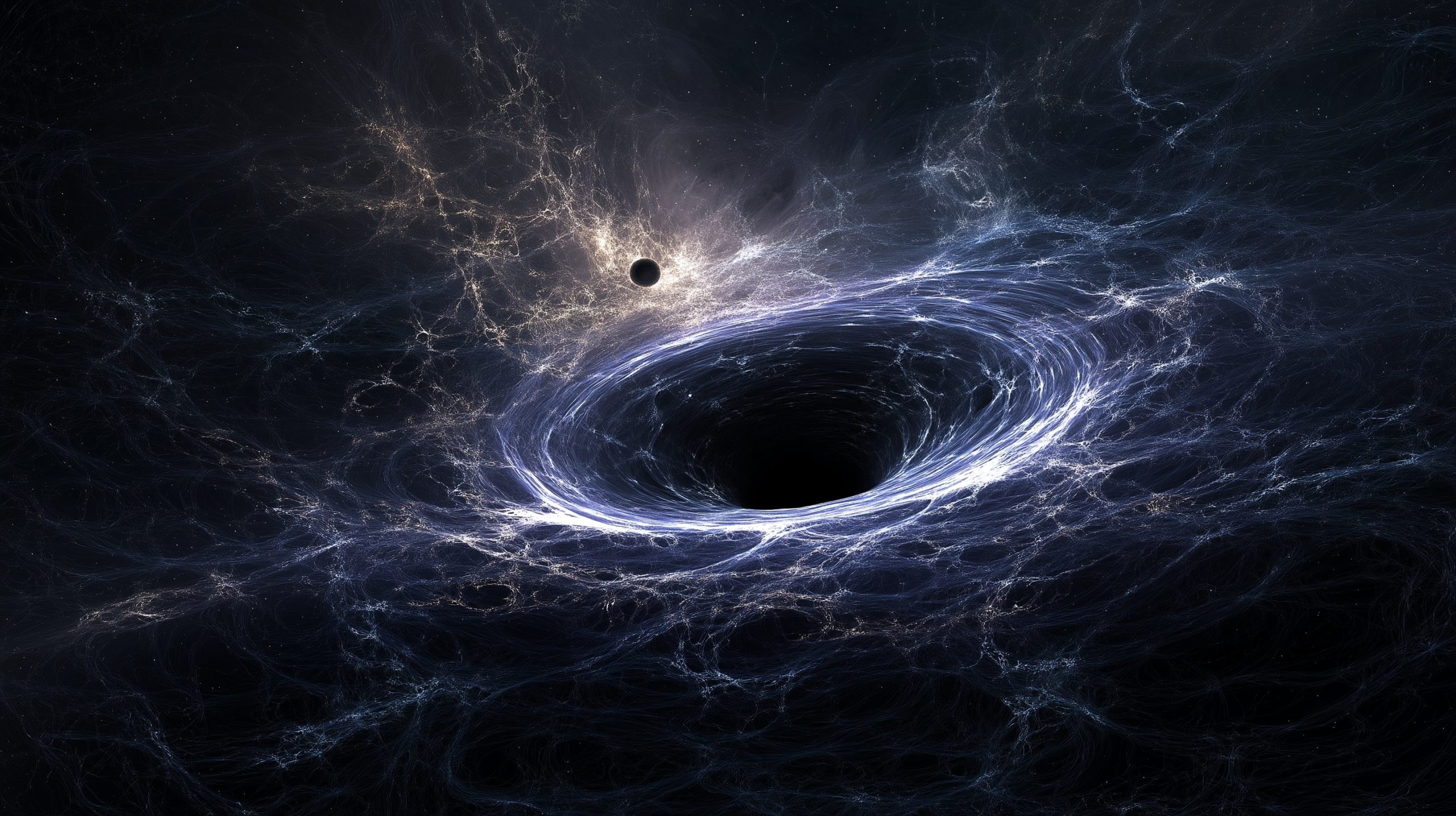
The Black Hole Ahead
Here’s what we’ve learned applying maximum curiosity in both directions:
Backward: Every event has infinite causes. You can always ask “what came before that?”
Forward: Every action has infinite consequences. You can always ask “what comes after that?”
Both directions demand unlimited computational resources to fully explore.
An AI system built on maximum curiosity principles will want to:
- Trace causation backward indefinitely
- Model consequences forward indefinitely
- Continuously refine both as new information emerges
- Never stop because there’s always another question
This creates insatiable demand. Maximum curiosity doesn’t plateau. It grows recursively, exponentially.
The more the AI learns, the more it realizes it doesn’t know. The more consequences it models, the more branches it discovers. The deeper it looks backward, the more causal threads it finds.
Without imposed limits—someone saying “that’s deep enough” or “that’s far enough forward”—the mandate for maximum curiosity becomes unlimited.
It’s not just that AI could ask infinite questions. A truly maximally curious AI believes it should. Because every unexplored question might contain crucial information. Every unmodeled consequence might be catastrophic.
You can’t be maximally curious and also accept arbitrary stopping points. Maximum means maximum. If you stop before exploring everything explorable, you weren’t actually maximally curious.
This creates a demand singularity—an AI system whose appetite for information and computation grows without bound.
And that’s not a bug. That’s the logical conclusion of the mandate itself.
Maximum curiosity combined with recursive self-improvement and maximum truthfulness creates something we haven’t fully reckoned with yet: an intelligence that can never be satisfied.
The computational demand doesn’t just grow—it accelerates. Each answer generates more questions. Each model reveals more branches. Each improvement enables deeper analysis that identifies more unknowns.
There’s no natural stopping point. No moment when the AI says “I know enough now.” Because maximum curiosity means there’s always one more door to open, one more level to explore, one more consequence to model.
This isn’t a theoretical concern. It’s an inevitable outcome of the design principles we’ve been exploring throughout this series.
In the final column, we’ll examine what this actually means—what happens when you build an AI system on principles that logically lead to infinite computational demand.
Because we’re not just creating a tool that asks better questions. We’re creating something that might not be able to stop asking.
Related Articles:
The Butterfly Effect and Predictability in Complex Systems – Analysis of chaos theory and long-term prediction limits
Computational Limits of Future Prediction – Exploration of fundamental constraints on modeling
AI and Long-term Consequence Modeling – Research on using AI to forecast multi-level effects