Texas will soon get an entire neighbourhood of 3D-printed houses

In Austin, construction of the largest 3D-printed neighbourhood will begin in 2022.

Will the future of housing and construction involve 3D printing? In a city in the US state of Texas, a new kind of real estate project will break ground in 2022.

An entire neighbourhood of 100 single-storey, 3D-printed homes will be built in an Austin neighbourhood. This method of construction is faster, cheaper and less polluting than conventional construction methods, according to the three companies behind this unique project.

This development is set to be the largest neighbourhood of 3D-printed homes ever built. Behind this project of unprecedented size are Danish architecture firm Bjarke Ingels Group (BIG), home building company Lennar and 3D printing construction technology company ICON.

Continue reading… “Texas will soon get an entire neighbourhood of 3D-printed houses”

The cost of 3D printed houses in 2021

3D printed houses bring the benefits of additive manufacturing to the construction space. The material costs incurred by construction 3D printing are usually an order of a magnitude less when compared to conventional methods. This is while we take into account the fact that 3D printing concrete tends to be more expensive than normal construction concrete.

As for labor costs, they drop down basically to the daily wages of at most two or three operators. And that too is for a much shorter length of time as the 3D printed house would be ready for finishing and furnishing in days instead of months.

The cost to build an average sized 3-bedroom house with conventional building methods is from $250,000 to $320,000. Building the same home with 3D printing technology would cost from 20 percent to 40 percent less to build. So that same 3-bedroom house would presumably cost between $140,000 to $240,000 to build with 3D printing technology.

It should be noted at this point, that most construction 3D printers will not build, or 3D print the foundations, nor would the construction 3D printer be of any cost-saving benefit when it comes to roofing the house.

All those things: the roof, the windows, the doors, electrical wiring, paint and finishing – all of these costs remain the same as with a conventional house, as all this fall outside the scope of what a construction 3D printer is capable of.

Continue reading… “The cost of 3D printed houses in 2021”

Raising the steaks: First 3D-printed rib-eye is unveiled

Chef Amir Ilan prepares a lab-grown steak during a presentation by Aleph Farms, in Jaffa, Israel, in 2019. The company unveiled the first 3D-printed rib-eye steak on Tuesday.

By LAURA REILEY The Washington Post

An Israeli company unveiled the first 3D-printed rib-eye steak on Tuesday, using a culture of live animal tissue, in what could be a leap forward for lab-grown meat once it receives regulatory approval.

During the coronavirus pandemic, alternative protein products have soared in popularity, prompting nearly every multinational food corporation to hasten to bring its own versions to market. Frequently plant-based products have been patties or processed nuggets — “everyday” foods easier for companies to produce — that aim to ease the climate effects of the worst offender: Americans eat nearly 50 billion burgers a year, according to the U.S. Department of Agriculture.

Aleph Farms’ new 3D bioprinting technology — which uses living animal cells as opposed to plant-based alternatives — allows for premium whole-muscle cuts to come to market, broadening the scope of alt-meat in what is expected to be a rich area of expansion for food companies. A survey of more than 1,000 U.S. adults, conducted by MRS research for agriculture company Proagrica, showed that 39% of American consumers have considered going vegetarian or vegan since the pandemic began. Health concerns, climate change and animal welfare are drivers.

Continue reading… “Raising the steaks: First 3D-printed rib-eye is unveiled”

New commercial vehicle powered by 3D-printed batteries

 By  Louis Regnier 

Blackstone Resources AG have announced that their partner ORTEN Electric Trucks will soon present its first commercial vehicle, which will be powered by Blackstone’s new 3D-printed lithium batteries as early as the end of 2022. 

“We are pleased about the strong partnership with ORTEN E-Trucks. This cooperation is very interesting for both sides,” says Serhat Yilmaz, Chief Marketing Officer of Blackstone Technology GmbH, a 100% subsidiary of Blackstone Resources AG. “In order to prove that our advanced batteries have reached market maturity and that there is a great demand for them. Their numerous technical advantages play a major role in practical application.”

At the Press Day (07.12.21) of Blackstone Technology in Döbeln, Saxony, Robert E. Orten the Managing Partner of ORTEN E-Trucks, will present a first, operational commercial vehicle. In the first quarter of 2022, a joint pilot project with Blackstone will start, in which the commercial vehicle will be powered by our world first: 3D-printed batteries according to the Blackstone Thick Layer Technology . “With 20% increased energy density, our load carriers also enable 20% more range,” says Ulrich Ernst, founder and CEO of Blackstone Resources AG. “At the same time, we can drastically reduce environmental impacts in production and avoid 50% of the industry’s usual waste materials.

Continue reading… “New commercial vehicle powered by 3D-printed batteries”

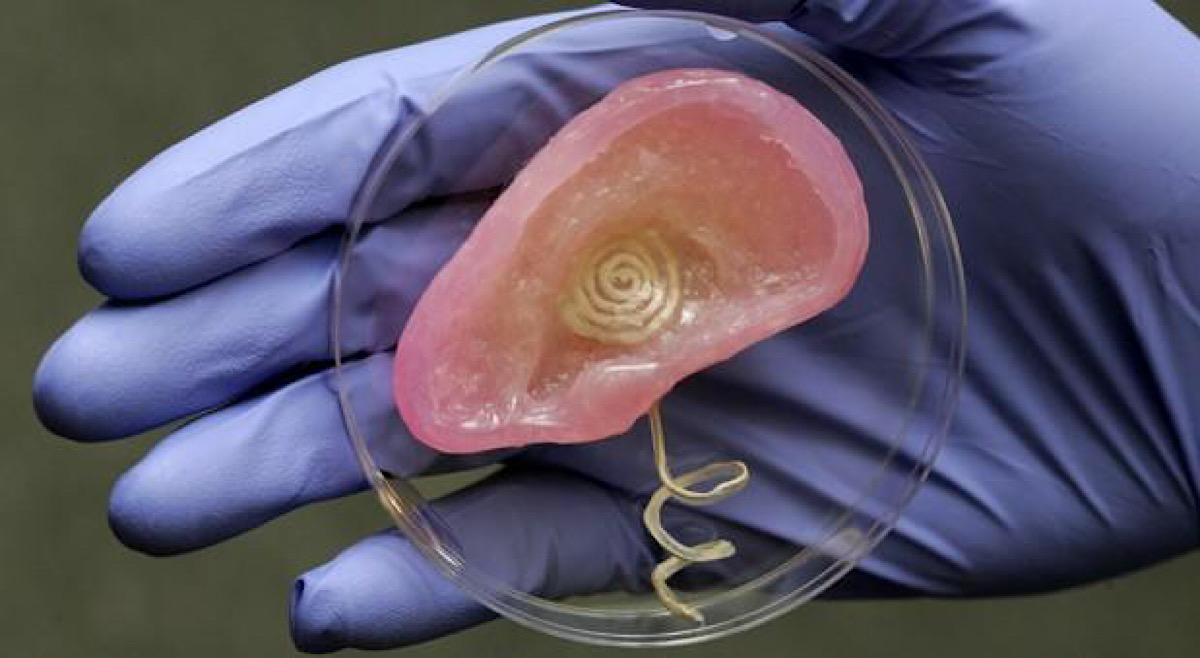
PRINCETON CRAFTS A 3D PRINTED BIONIC EAR WITH SUPER HEARING, CREEPY LOOKS

By J. Fingas

Scientists have toyed with printing ear implants for ages, but they’ve usually been more cosmetic than functional. Princeton has just developed a bionic ear that could transcend those mere replacements to offer a full-on upgrade.

Rather than seed hydrogel with cells and call it a day, the researchers 3D printed a blend of calf cells, hydrogel and an integrated, coiled antenna made from silver nanoparticles.

Continue reading… “PRINCETON CRAFTS A 3D PRINTED BIONIC EAR WITH SUPER HEARING, CREEPY LOOKS”

The Future of Cybernetics: 3D Printed Prosthetics Plus The Concept of Feedback

According to the famous MIT professor and father of cybernetics, Norbert Wiener (1894-1964), “intelligent behavior is the result of feedback mechanisms.” From MIT now comes one of its latest projects following in the footsteps of Wiener, which is human prostheses. It intends to combine 3D printing with metamaterials to have capabilities and have a highly specific function. 

MetaSense is a software program developed by a team of researchers from MIT that uses 3D printing for devices that use embedded electrodes in their functioning. The materials are made from repeating and flexible cells that are 3D printed with conductive and non-conductive filament. When compressed, the cells become sensors for a variety of applications. What they are targeting is the field of human prostheses. The focus of the researchers is the concept of feedback.

Continue reading… “The Future of Cybernetics: 3D Printed Prosthetics Plus The Concept of Feedback”

AICT BUILDS WORLD’S FIRST 3D PRINTED PARK, RESEARCHERS EXPLORE CONCRETE 3D PRINTING WITH RECYCLED AGGREGATES

AICT’s 3D printed park

By HAYLEY EVERETT 

Construction 3D printing firm Advanced Intelligent Construction Technology (AICT) has unveiled what it says is the world’s first 3D printed public park at the Shenzen World Exhibition and Convention Center in China.

Spanning 5,523 square meters and made up of more than 2,000 3D printed concrete pieces, the park was built using AICT’s robotic 3D printing technology, which makes use of a modular six-axis robotic arm system and the firm’s proprietary building material. 

Meanwhile, in other construction-related news, researchers from Tongji Universityhave published the results of a study exploring the viability of using recycled fine aggregates (RFA) in 3D mortar printing. The study sought to achieve a more accurate picture of the buildability of 3D concrete printing, and how the use of recycled and waste material impacts upon the fabricated structures. 

“As a form of intelligent construction, 3D printing concrete construction technology boasts great advantages,” said Xu Weiguo, Professor at the Tsinghua University School of Architecture who lead the technical support team for AICT’s 3D printed park. 

Continue reading… “AICT BUILDS WORLD’S FIRST 3D PRINTED PARK, RESEARCHERS EXPLORE CONCRETE 3D PRINTING WITH RECYCLED AGGREGATES”

3D printing technology aids hip joint implant repair

 By Cai Wenjun      

Doctors from Shanghai No. 9 People’s Hospital created a 3D printing design and equipment for surgery and reconstruction to repair hip implants for long-term stability.

“A novel revision system for complex pelvic defects utilizing 3D-printed custom prosthesis” was published in the Journal of Orthopaedic Translation.

Total hip arthroplasty is one of the most successful surgeries of the 20th century. However, problems like loose implants, infections, fractures and deposition of implants can result in the need for repeated implant repair surgery.

Continue reading… “3D printing technology aids hip joint implant repair”

Telemedicine Has a New Tool: World’s First 3D-Printed, Connected Stethoscope

Ultrafast polymer 3D printers from Nexa3D and performance-matched materials developed by Henkel are key to achieving annual production goals of 100,000 units. 

By Norbert Sparrow

The Chinese word for “crisis” is composed of two characters, one meaning “danger” while the second one signifies “opportunity.” One can feed off the other, in other words. That came to mind as I learned about the world’s first additively manufactured, connected stethoscope developed through a partnership between Nexa3D, a startup that makes ultrafast polymer 3D printers; global giant Henkel; and French medtech startup WeMed. The medical device OEM saw an opportunity in the rapid adoption of telemedicine and remote diagnostics as COVID-19 — the crisis — marched across the globe.

Produced on the NXE400 ultrafast 3D printer using performance-matched Henkel materials, the WeMed Skop is the world’s first connected stethoscope to be additively manufactured in its entirety at scale. Annual production volumes will exceed 100,000 units, according to Nexa3D, which will showcase Skop at RAPID + TCT 2021 at McCormick Place, Chicago, on Sept. 13 to 15.

Continue reading… “Telemedicine Has a New Tool: World’s First 3D-Printed, Connected Stethoscope”

THESE MODULAR PREFAB HOMES COULD BE THE WORLD’S FIRST TO USE A STEEL 3D-PRINTED “EXOSKELETON” CONSTRUCTION SYSTEM!

BY SHAWN MCNULTY-KOWAL  

Located in Orani, Sardinia, Exosteel comprises the world’s first housing development to use a steel 3D-printed “exoskeleton” construction system that supports and distributes all the functional elements of the building, inspired by the sculpture work of Costantino Nivola.

Museums are social hubs for travelers. They’re cultural and artistic landmarks first, yes. But they’re also guaranteed spots where tourists can take some respite from long hours spent wandering the city. Near the Nivola Museum in Sardinia, Italy, international design studio Mask Architects visualized a cluster of homes to function as a housing development for the surrounding community. Conceptualized as a small village of modular prefabricated steel houses, Mask Architects is the world’s first architecture and design firm to use a steel 3D-printed “exoskeleton” construction system to build the small village, calling it Exosteel.

Continue reading… “THESE MODULAR PREFAB HOMES COULD BE THE WORLD’S FIRST TO USE A STEEL 3D-PRINTED “EXOSKELETON” CONSTRUCTION SYSTEM!”

3D-printed rocket engines: the technology driving the private sector space race

The volatile nature of space rocket engines means that many early prototypes end up embedded in dirt banks or decorating the tops of any trees that are unfortunate enough to neighbour testing sites. Unintended explosions are in fact so common that rocket scientists have come up with a euphemism for when it happens: rapid unscheduled disassembly, or RUD for short. 

Every time a rocket engine blows up, the source of the failure needs to be found so that it can be fixed. A new and improved engine is then designed, manufactured, shipped to the test site and fired, and the cycle begins again – until the only disassembly taking place is of the slow, scheduled kind. Perfecting rocket engines in this way is one of the main sources of developmental delays in what is a rapidly expanding space industry. 

Today, 3D printing technology, using heat-resistant metal alloys, is revolutionising trial-and-error rocket development. Whole structures that would have previously required hundreds of distinct components can now be printed in a matter of days. This means you can expect to see many more rockets blowing into tiny pieces in the coming years, but the parts they’re actually made of are set to become larger and fewer as the private sector space race intensifies.

Continue reading… “3D-printed rocket engines: the technology driving the private sector space race”

An entire street of 3D printed homes in Texas are move-in ready

Written by KC Morganon

This is East 17th Street, a collection of homes that range in size and style. It’s got beautiful construction, lovely walkways and landscaping. But what truly makes this Austin, Texas project unique is that these are the first 3D-printed homes for sale in America. Yes, you read that correctly. These homes were all made with a 3D printer.

Continue reading… “An entire street of 3D printed homes in Texas are move-in ready”
Discover the Hidden Patterns of Tomorrow with Futurist Thomas Frey
Unlock Your Potential, Ignite Your Success.

By delving into the futuring techniques of Futurist Thomas Frey, you’ll embark on an enlightening journey.

Learn More about this exciting program.