
By Futurist Thomas Frey
I personally have a number of foot issues. At age 19, I froze my feet working to repair an accident on our family farm in South Dakota—spending hours in subzero temperatures trying to fix equipment that broke at the worst possible time. I’ve dealt with the consequences ever since—circulation problems, sensitivity to cold, periodic pain that flares up without warning. But I’m not unique. Everyone has foot issues at one time or another—plantar fasciitis, bunions, arch pain, swelling, neuropathy, gait problems that cause knee or back pain. Foot problems are universal, often chronic, and profoundly affect quality of life.
That’s why the most taken-for-granted object in our lives—shoes—is about to become one of the most sophisticated health devices we own.
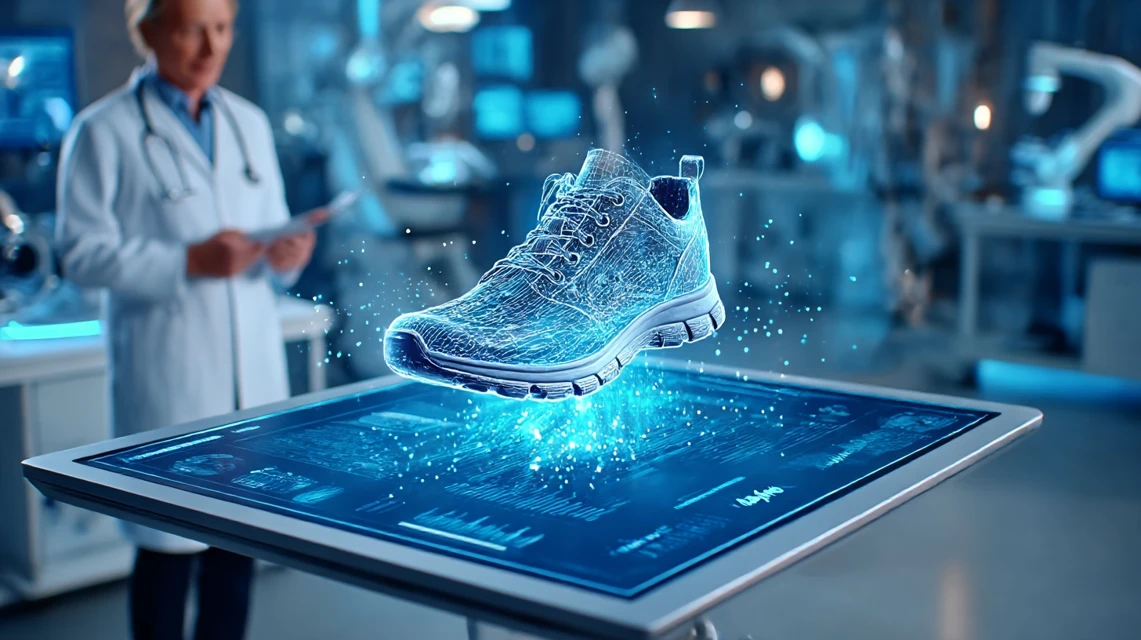
By 2040, shoes won’t just protect your feet—they’ll actively monitor your health, adjust to your body in real-time, prevent falls before they happen, and fix biomechanical problems that cause pain throughout your body. Footwear is about to go through its biggest transformation in history, evolving from passive protection to active health management.
From Dumb Objects to Smart Health Platforms
The 2040 shoe is fundamentally different from anything we wear today. It’s packed with sensors continuously mapping pressure across your entire foot, monitoring gait, stride length, balance, and micro-instabilities invisible to you but detectable by AI. These shoes know something’s wrong before you feel it—detecting early signs of neuropathy, inflammation, circulation changes, or injury patterns developing.
Your shoes will track your “locomotion profile” across months and years, learning how you walk, where you develop problems, and what adjustments help. This data feeds AI models that predict issues before they become serious and recommend interventions before pain starts.
For someone like me with circulation issues from cold injury, this means shoes that detect when blood flow is compromised and actively work to improve it. For diabetics with neuropathy, it’s potentially life-saving early detection. For aging adults at risk of falls, it’s mobility preservation. For everyone, it’s the difference between chronic pain and comfortable movement.
Auto-Adjusting Support That Adapts Constantly
The breakthrough technology enabling all of this is micro-robotic insoles that adjust automatically to your needs moment-by-moment.
Your shoes will raise or lower arch support dynamically. They’ll stiffen or soften cushioning as your foot hits the ground based on terrain, fatigue, and impact. They’ll compensate for swelling throughout the day—something anyone who’s stood for hours knows is desperately needed—tightening when you need support and loosening when your feet expand. Micro-actuators and adjustable bladders will reposition themselves to correct alignment continuously.
Instead of owning different shoes for running, walking, standing, dress occasions—you’ll own one pair that adapts itself to whatever you’re doing. The shoe becomes the universal footwear platform that reconfigures for every situation.
Fall Prevention and Balance Assistance
Falls are catastrophic for older adults—often the beginning of irreversible decline. But they’re also increasingly dangerous for middle-aged adults with neuropathy, joint issues, or circulation problems. By 2040, shoes will actively prevent them.
Sensors will detect destabilizing motion 50-150 milliseconds before a fall—faster than conscious reaction. The shoes will respond by creating counter-support, tightening around the heel, stiffening the sole, or using micro-vibrations to restore balance. Subtle tactile cues will alert you to shift weight before you’re aware you’re off-balance.
For aging populations, people with neuropathy like mine, or anyone with joint issues, these shoes will literally save lives by preventing the falls that lead to fractures, hospitalizations, and death.
Gait Correction and Pain Relief
Most foot, knee, hip, and lower-back problems originate from gait misalignments—the way your foot strikes the ground, how your weight distributes, how your pelvis rotates. I’ve experienced this firsthand—damage to my feet changed how I walk, which created knee problems, which affected my hip alignment. Traditional shoes can’t fix this. Smart shoes can.
By 2040, your shoes will map your entire biomechanical chain and apply micro-adjustments in the sole to correct pronation and supination. They’ll train better walking habits through gentle haptic feedback. And crucially, they’ll adjust differently for each foot—because almost nobody is perfectly symmetrical, and injuries like mine often affect feet differently.
This is physical therapy built into footwear, running continuously, correcting problems that would otherwise require expensive clinical intervention or lead to chronic pain.
Temperature and Circulation Management
For someone who’s dealt with circulation issues for decades after cold injury, this is deeply personal: shoes in 2040 will warm or cool your feet dynamically, use micro-vibrations to stimulate blood flow, detect early peripheral nerve changes, and reduce swelling through pressure management.
This solves one of the biggest unmet needs in footwear—addressing circulation problems before they become medical emergencies. For the massive and growing population with diabetes and neuropathy, this could prevent thousands of amputations annually. For people like me with cold-injury damage, it means finally having shoes that actively help rather than passively cover.
Growing up on a farm in South Dakota, you learn to work through physical discomfort. But you also learn that ignoring problems makes them worse. Shoes that actively monitor and respond to circulation issues would have prevented decades of complications for me—and will prevent similar problems for millions of others.
Environmental Intelligence and Personalization
Your shoes will detect ice, sand, gravel, or slippery surfaces and change traction in real-time—crucial for someone like me whose feet don’t provide normal sensory feedback in cold conditions. They’ll alert you to unsafe terrain before you step. They’ll self-clean using hydrophobic materials and micro-vibrations.
Every person walks differently. By 2040, you’ll have a locomotion fingerprint—a digital profile of your unique gait. Your shoes will optimize themselves to your exact walking signature, detect early signs of conditions like Parkinson’s or arthritis, and adjust in real-time to relieve chronic pain.
Why This Happens by 2040
Three forces make intelligent shoes inevitable:
Aging populations: More people with gait issues, neuropathy, fall risks, and arthritis needing solutions that traditional footwear can’t provide.
Sensor costs collapsing: The cost to embed 50+ sensors per shoe drops to a few dollars, making sophisticated monitoring affordable at consumer scale.
Medical AI maturation: AI systems can interpret foot and gait data better than human specialists, enabling real-time intervention that wasn’t possible with human-only analysis.
Every incentive pushes toward smarter shoes. The technology exists. The need is enormous and universal. The economics work.
Final Thoughts
By 2040, your shoes will be personalized, AI-driven, self-adjusting mobility platforms that prevent injury, enhance comfort, support balance, and continuously monitor your health. They’ll know more about your overall physical condition than your doctor does today.
For someone who’s spent decades dealing with foot problems from a single winter day on a South Dakota farm at age 19, this future can’t come soon enough. But everyone will benefit—because everyone has foot issues at some point, and current shoes do almost nothing to actually solve them.
Shoes stop being passive objects you wear and become active health systems managing one of the most important but neglected aspects of wellness—how you move through the world.
The future of footwear isn’t about fashion or cushioning. It’s about keeping you mobile, pain-free, and safe throughout your life. And it’s coming faster than most people realize.
Related Stories:
https://www.nature.com/articles/s41598-024-54038-4
https://www.sciencedaily.com/releases/2024/09/240912120847.htm
https://medicalxpress.com/news/2024-08-smart-insoles-real-time-foot-ulcer.html
