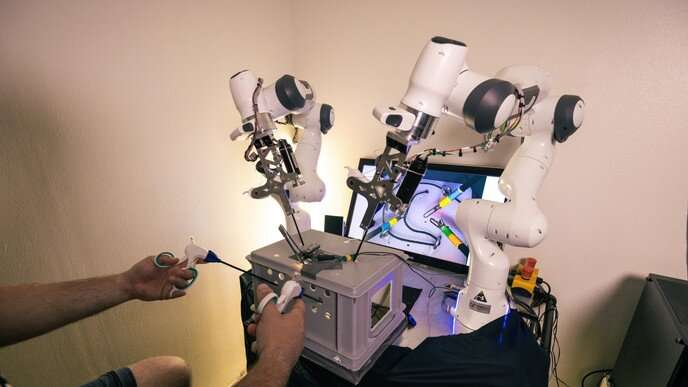
A team of researchers at the École polytechnique fédérale de Lausanne (EPFL) has achieved a remarkable milestone in the realm of laparoscopic surgery by developing the world’s first system that enables surgeons to control four robotic arms. The breakthrough was accomplished through the use of haptic foot interfaces, allowing for enhanced precision, reduced workload, and improved safety during surgical procedures. The remarkable results of this innovative system have been published in The International Journal of Robotics Research, marking a significant advancement in medical technology.
The collaborative effort between EPFL’s research group REHAssist and the Learning Algorithms and Systems Laboratory (LASA) led to the creation of a cutting-edge system that grants surgeons the ability to control two additional robotic arms alongside their natural limbs. The sophisticated haptic foot interfaces offer five degrees of freedom, enabling the surgeon to control a manipulative instrument with each hand, while one foot manages an endoscope/camera, and the other foot operates an actuated gripper.
One of the system’s key innovations lies in the concept of shared control between the surgeon and the robotic assistants. Through an advanced control framework devised by the researchers, the surgeon and the robots can seamlessly collaborate within a shared workspace, meeting the high precision and safety standards demanded by laparoscopic surgery. Mohamed Bouri, head of the REHAssist group, explains that the foot pedal actuators provide haptic feedback, guiding the surgeon’s foot towards the target as if following an invisible field-of-forces, while also limiting force and movement to prevent any inadvertent endangerment to the patient. The system opens up new possibilities for surgeons to perform complex laparoscopic procedures with a level of efficiency that was previously unattainable, potentially streamlining tasks that usually require two or more individuals.
The concept of shared control allows the robotic assistants to predict the surgeon’s intentions and proactively adjust their movements accordingly. For instance, during knot tying, the endoscope automatically adjusts its position, and the gripper moves out of the way, offering seamless assistance to the surgeon’s actions.
Professor Aude Billard, head of LASA, further explains that controlling four arms simultaneously, especially using one’s feet, is a challenging task that can be physically tiring. To alleviate this complexity, the robots actively aid the surgeon by coordinating their movements through predictive algorithms and adaptive visual tracking of laparoscopic instruments with the camera. The system also offers assistance in more accurate tissue grasping, enhancing the overall surgical outcomes.
To evaluate the system’s usability and effectiveness, a comprehensive user study was conducted involving practicing surgeons. Dr. Enrico Broennimann, who participated in the trials in collaboration with the Swiss Foundation for Innovation and Training in Surgery (SFITS), praised the idea of employing foot-controlled robotic assistants and expressed interest in its implementation in operating rooms, possibly in a dedicated cockpit to enhance ergonomics and distance from the patient.
While further testing and improvements are ongoing, the published results confirm the feasibility of performing four-arm surgical-like tasks without requiring extensive training. The shared-control strategies embedded in the system have demonstrated their ability to reduce the mental and physical load on surgeons, improve performance, enhance coordination, and increase fluency during laparoscopic tasks, presenting a promising future for advanced laparoscopic surgery techniques.
By Impact Lab