A research team led by Professor Seung Hwan Ko from Seoul National University has developed an innovative, eco-friendly air purification system that utilizes microbubble filters instead of traditional solid filters. This groundbreaking technology addresses the growing need for more sustainable air purification solutions in enclosed spaces, where air quality is often compromised due to factors like reduced oxygen levels, the accumulation of carbon dioxide, fine dust, and volatile organic compounds (VOCs).
In indoor environments, traditional air purifiers often fail to effectively handle the accumulation of fine dust and volatile organic compounds. The conventional filters used in these systems tend to deteriorate over time, especially in sealed spaces, making them less effective. Furthermore, the waste generated from the need for regular filter cleaning and replacement has contributed to environmental pollution, highlighting the urgent demand for more sustainable alternatives.
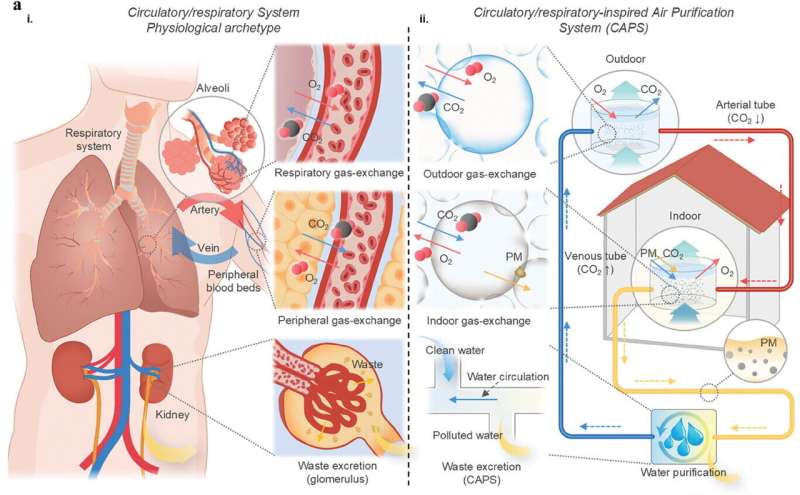
In response to these challenges, the research team took inspiration from the human respiratory and circulatory systems to develop a novel air purification approach. Just as the human body exchanges gases in the lungs—bringing in oxygen while expelling carbon dioxide—this system mimics that process to improve indoor air quality. The microbubble-based filtration system efficiently removes fine dust particles, expels accumulated carbon dioxide and VOCs, and replenishes the air with fresh oxygen, addressing both oxygen deficiencies and harmful pollutants.
The team’s system utilizes a water circulation method inspired by the flow of blood through the body, designed to maintain optimal indoor air quality. The breakthrough microbubbles, created using laser technology, are significantly smaller and more uniform compared to those produced by traditional methods. This allows for better filtration of both particulate matter and molecular pollutants, which conventional filters struggle to address.
One of the key advantages of the microbubble filtration system is its simplicity and scalability. It can be adapted for various applications, ranging from compact, portable units for personal use (such as in cars and small rooms) to larger systems for office spaces and conference rooms. The design’s versatility allows it to be easily scaled up or down to meet different air purification needs.
Professor Ko emphasized the environmental benefits of the system, stating, “This eco-friendly technology replaces traditional filters with a water-based mechanism, purifying both particulate and molecular pollutants without generating waste. It offers a sustainable and effective alternative to conventional air filtration systems, helping to reduce the environmental impact of indoor air purification.”
With this cutting-edge approach, the research team has opened the door to more efficient, waste-free, and environmentally friendly solutions for air purification, addressing the growing need for cleaner air in our increasingly urbanized world.
By Impact Lab