CHINESE START-UP ON A MISSION TO CUT ROCKET PRODUCTION COSTS BY 80% WITH 3D PRINTING

Launcher conducts a hot fire test for its 3D-printed Engine-2 rocket engine in the E Test Complex at NASA’s Stennis Space Center.

By HAYLEY EVERETT

Chinese start-up SpaceTai has claimed its 3D printing technology is capable of slashing rocket production costs by as much as 80 percent.

Although a relatively new arrival on the space scene, SpaceTai says it can manufacture almost all its rocket parts using its self-developed 3D printers in order to cut costs. 

With its first suborbital test flight slated for 2023, the firm could potentially challenge the likes of Elon Musk’s SpaceX, Rocket Lab, Orbex, Relativity Space, and others leveraging 3D printing in the race to space in years to come. 

Continue reading… “CHINESE START-UP ON A MISSION TO CUT ROCKET PRODUCTION COSTS BY 80% WITH 3D PRINTING”
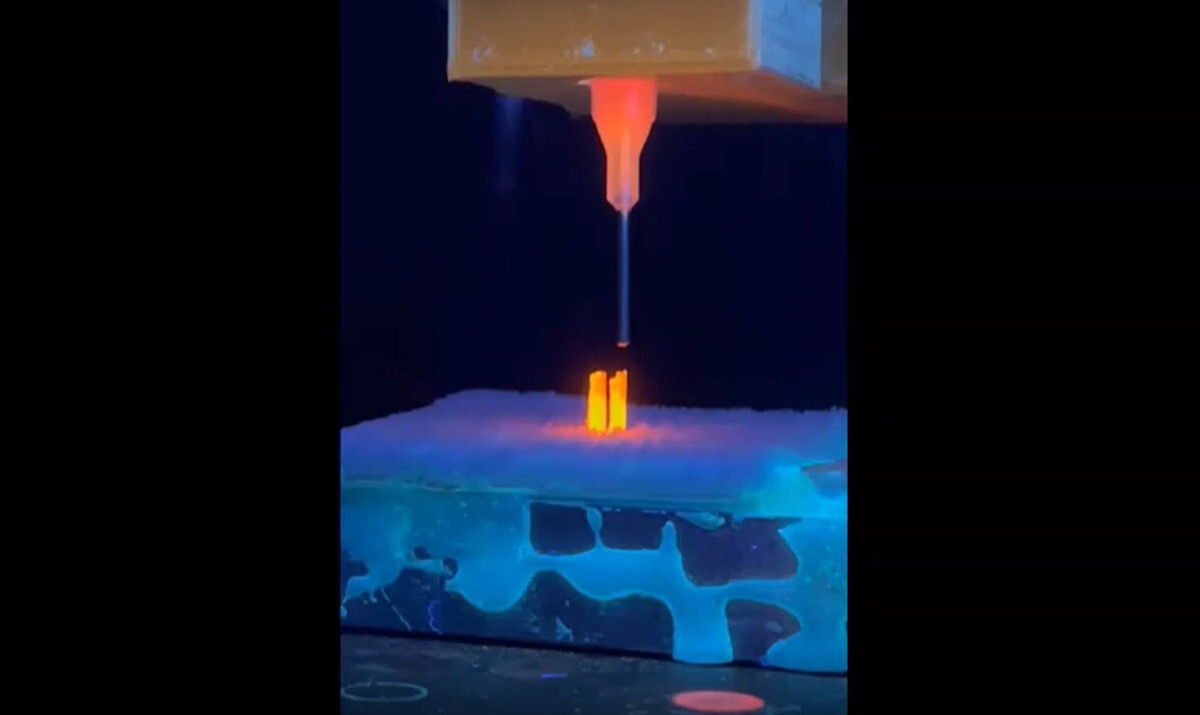
Cryobioprinting could make off-the-shelf tissue-engineered structures a reality

A new cryogenic 3D printing technique could one day enable fabrication of off-the-shelf artificial muscle fibres, according to research published in Advanced Materials.

By Katie Fegan

Printing synthetic tissue that mimics the structure of muscle remains a major challenge in tissue engineering. Muscle fibres are anisotropic, meaning that their physical properties, including the ability to transmit mechanical forces, are direction dependent. Introducing a temperature gradient during the fabrication process, from sub-zero temperatures upwards, is a simple way of creating tissue scaffolds with anisotropic microscale pores. However, the freezing process is harmful to cells encapsulated within the scaffold.

Enter cryobioprinting: an all-in-one fabrication and preservation technique developed by scientists at Brigham and Women’s Hospital and Harvard Medical School. Cryobioprinting combines a customized freezing plate with cryoprotected bioinks to produce cell-laden structures with anisotropic microchannels. The scaffolds can be stored in liquid nitrogen for several months and revived on demand, a feature that would allow pre-made products to be used in a clinical setting.

“Cryobioprinting can give bioprinted tissue an extended shelf life and allows convenient transport of tissue between sites, which is something conventional bioprinting methods do not readily enable,” says senior author Y Shrike Zhang. “[Cryobioprinting] may have broad application in tissue engineering, regenerative medicine, drug discovery and personalized therapeutics.”

Continue reading… “Cryobioprinting could make off-the-shelf tissue-engineered structures a reality”

UNIVERSITY OF QUEENSLAND INVESTIGATES 3D PRINTING FOR FUTURE OF PERSONALIZED MEDICINE

Spritam, the world’s first FDA-approved 3D printed drug.

By HAYLEY EVERETT 

Researchers at the University of Queensland (UG) have published a new paper exploring 3D printing’s role in the future of personalized medicine for patients.

According to pharmacist, UQ PhD student and lead author of the study Liam Krueger, the technology is refined enough to accurately print specialized dosages onsite in hospitals and pharmacies in coming years. Through the study, the researchers are hoping to accelerate the advancement of 3D printed pharmaceuticals within Australia and beyond.

“3D printing is regularly used in other medical settings such as dentistry to create implants, however the utilization of the technology is lagging in the pharmaceutical space,” said Krueger.

“WITH THIS RESEARCH WE ARE HOPING TO GAIN MORE MOMENTUM FOR THE IMPLEMENTATION OF THIS TECHNOLOGY WHICH WOULD BE AN INCREDIBLE OPPORTUNITY FOR THE FUTURE OF THE AUSTRALIAN PHARMACEUTICAL LANDSCAPE.”

Continue reading… “UNIVERSITY OF QUEENSLAND INVESTIGATES 3D PRINTING FOR FUTURE OF PERSONALIZED MEDICINE”

The cost of 3D printed houses in 2021

by Yusuf Vihaan

3D printed houses bring the benefits of additive manufacturing to the construction space. The material costs incurred by construction 3D printing are usually an order of a magnitude less when compared to conventional methods. This is while we take into account the fact that 3D printing concrete tends to be more expensive than normal construction concrete.

As for labor costs, they drop down basically to the daily wages of at most two or three operators. And that too is for a much shorter length of time as the 3D printed house would be ready for finishing and furnishing in days instead of months.

The cost to build an average sized 3-bedroom house with conventional building methods is from $250,000 to $320,000. Building the same home with 3D printing technology would cost from 20 percent to 40 percent less to build. So that same 3-bedroom house would presumably cost between $140,000 to $240,000 to build with 3D printing technology.

It should be noted at this point, that most construction 3D printers will not build, or 3D print the foundations, nor would the construction 3D printer be of any cost-saving benefit when it comes to roofing the house.

All those things: the roof, the windows, the doors, electrical wiring, paint and finishing – all of these costs remain the same as with a conventional house, as all this fall outside the scope of what a construction 3D printer is capable of.

Continue reading… “The cost of 3D printed houses in 2021”

LIVE HUMAN TENDON 3D PRINTED BY SCIENTISTS WITH NEW ‘CRYO-BIOPRINTING’

A diagram showing the team’s 3D bioprinted muscle-tendon up-close.

By PAUL HANAPHY 

Researchers at Harvard Medical School and Sichuan University have developed a novel means of 3D bioprinting live human muscle-tendon tissues. 

As opposed to normal extrusion bioprinting, which involves depositing cells along X and Y axes, the team’s ‘cryo-bioprinting’ process sees them frozen and stacked vertically, in a way that allows for the creation of freestanding, mixed-cell tissues.

According to the scientists, their technique also yields tissues that are more robust and versatile than those produced via conventional bioprinting, particularly when it comes to those anisotropic in nature, thus they say it could now find regenerative medicine, drug discovery, or personalized therapeutic applications. 

Continue reading… “LIVE HUMAN TENDON 3D PRINTED BY SCIENTISTS WITH NEW ‘CRYO-BIOPRINTING’”

RESEARCHERS DEVELOP NEW OKARA 3D PRINTING METHOD; NOVAMEAT 3D PRINTS BLUE ALGAE-BASED STEAK

Insiders and analysts predict the 3D printing trends to watch in our latest series of articles focused on the future of 3D printing.

By KUBI SERTOGLU

Researchers from the Singapore University of Technology and Design (SUTD) have developed a new method of 3D printing with okara, a byproduct of soybeans created during the production of soy milk and bean curd. The approach is based on the direct ink writing process and is novel in that it requires no thickening agents whatsoever.

Elsewhere, Barcelona-based food tech startup Novameat has developed a new blue 3D printed steak. According to the firm, the vibrant product is the first meat alternative to combine all five kingdoms of classification, with a novel hybrid recipe containing animal cells, plant-based derivatives, fungi, algae, and spirulina.

“We chose the color with the purpose to create a futuristic-looking prototype,” said Guiseppe Scionti, CEO of Novameat. “We wanted to show that there are no limits. With our technology, we are able to create whole cuts and hybrid alternative meat products with a variety of ingredients.” 

Continue reading… “RESEARCHERS DEVELOP NEW OKARA 3D PRINTING METHOD; NOVAMEAT 3D PRINTS BLUE ALGAE-BASED STEAK”

RESEARCHERS TURN SMARTPHONE INTO ON-DEMAND PERSONALIZED DRUG 3D PRINTER

By PAUL HANAPHY

Researchers at University College London (UCL), Universidade de Santiago de Compostela (USC) and biopharma firm FabRx, have managed to convert an everyday smartphone into an on-demand personalized drug 3D printer. 

Using the visible light created by a mobile phone screen, the modified M3DIMAKER LUX system has already proven capable of 3D printing blood-thinning tablets in specific shapes, sizes and dosages. Operable via a user-friendly app, it’s hoped that with further R&D, the team’s machine could be deployed in future by those living in isolated areas, under the remote supervision of GPs to ensure patient safety. 

“This novel system would help people who need precise dosages that differ from how a medication is typically sold, as well as people whose required dosage may change regularly,” said the study’s lead author Xiaoyan Xu. “The tablet’s shape and size are also customizable, which enables flexibility in the rate at which the medication gets released into the bloodstream.” 

Continue reading… “RESEARCHERS TURN SMARTPHONE INTO ON-DEMAND PERSONALIZED DRUG 3D PRINTER”

RESEARCHERS DEVELOP NOVEL HELICAL NANOMAGNETS USING 3D PRINTING TECHNOLOGY

A 3D printed helical nanomagnet and its novel magnetic field. Image via University of Cambridge.

By KUBI SERTOGLU 

An international team of scientists led by Cambridge University’s Cavendish Laboratory has used 3D printing technology to develop a novel set of microscopic nanomagnets.

Created using a custom 3D printing process, the nanomagnets are in the shape of a DNA-inspired double helix. According to the research team, this unconventional structure lends itself to strong magnetic field interactions between the helices in a manner never seen before. Specifically, by twisting around one another, the 3D printed helices produce nanoscale topological textures in the magnetic field they generate.

The team believes it can harness this phenomenon to closely control magnetic forces at the nanoscale, paving the way for ‘next generation’ magnetic devices.

Claire Donnelly, first author of the study, explains, “This new ability to pattern the magnetic field at this length scale allows us to define what forces will be applied to magnetic materials and to understand how far we can go with patterning these magnetic fields. If we can control those magnetic forces on the nanoscale, we get closer to reaching the same degree of control as we have in two dimensions.”

Continue reading… “RESEARCHERS DEVELOP NOVEL HELICAL NANOMAGNETS USING 3D PRINTING TECHNOLOGY”

World’s First 3D-Printed House Made Of Local Raw Earth – And it Closes the Roof With a Dome

By Andy Corbley 

Inspired by the potter wasp, an Italian architecture firm has used 3D printing to make the domed, beehive-like structure of a house out of zero-emissions clay in the hope of showing what heights of sustainability can be reached with the technology.

Like the industrious wasps, the houses are made using the clay from wherever they are being built, which also means if they have to be knocked down, the only waste is the plumbing, gas, and electrical components.

Continue reading… “World’s First 3D-Printed House Made Of Local Raw Earth – And it Closes the Roof With a Dome”

Future Buildings Could Be Made From 3D Printed Microbes

New “living materials” could be used to make new objects ranging from small medical devices to skyscrapers.

By Neel V. Patel

The hype around 3D printing shows no signs of waning anytime soon, and for good reason: It’s a fast, inexpensive way to manufacture all kinds of different objects and structures, especially when conventional building materials are unavailable. A few scientists have a radical idea for what the next big leap in 3D printing could be: making things using living microbes.

Yes, it sounds weird as hell and not just a little creepy, but stay with us here. A group of researchers in the U.S. have just proved it’s possible to create 3D printed structures using E. coli. These “living materials,” illustrated in a new Nature Communications paper, could pave a path for more sustainable construction of objects that could also be programmed to help improve people’s health or remove toxins from the environment.

“Our group has always been interested in engineering biology to make materials,” Northeastern University chemist and study co-author Neel Joshi told The Daily Beast. “In the same way that a seed has a set of genetic instructions to produce a tree, we want to provide biological cells with a set of genetic instructions that program them to make material structures with prescribed properties.”

Continue reading… “Future Buildings Could Be Made From 3D Printed Microbes”

“WORLD’S FIRST” 3D PRINTED IMMUNIZED SKIN MODEL ENABLES COLD PLASMA WOUND HEALING TREATMENT FOR BURNS

CTIBIOTECH is producing hundreds of CTISkin models for the NOVOPLASM project

By HAYLEY EVERETT

The NOVOPLASM consortium has announced it is the “first in the world” to develop cold plasma technology for the treatment of infected burns and the wound healing of skin grafts.

Regenerative medicine firm CTIBIOTECH, the French Armed Forces Biomedical Research Institute, École Polytechnique and Institut Pasteur make up the consortium, which is leveraging an immunized human skin model produced by 3D bioprinting to aid the development of the cold plasma treatment.

CTIBIOTECH claims to be the first in the world to 3D bioprint complete immunized human skin, called CTISkin, and is providing hundreds of models to the consortium to enable it to validate its cold plasma technology.

“Regenerative medicine is the future of healthcare,” said Professor Colin McGuckin, President and Chief Scientific Officer of CTIBIOTECH. “At CTIBIOTECH we advance these models to help personalized medicine and to support hospitals in the short term, not just the future. NOVOPLASM uses our models to accelerate new devices to protect human health.”

Continue reading… ““WORLD’S FIRST” 3D PRINTED IMMUNIZED SKIN MODEL ENABLES COLD PLASMA WOUND HEALING TREATMENT FOR BURNS”

Man becomes world’s first 3D-printed eyeball recipient

UK patient Steve Verze made medical history after becoming the first person in history to be outfitted with a 3D-printed eyeball as part of a cutting-edge new trial.

By Ben Cost

Doctors are seeing the possibilities in 3D.

A UK man made medical history Thursday after becoming the first patient in history to be outfitted with a 3D-printed eyeball as part of a cutting-edge new trial.

“This new eye looks fantastic, and being based on 3D digital printing technology, it is only going to be better and better,” London native Steve Verze told the Daily Mail of the eye-opening procedure. Currently, the groundbreaking technology is being used to replicate everything from steaks to entire neighborhoods.

Continue reading… “Man becomes world’s first 3D-printed eyeball recipient”
Discover the Hidden Patterns of Tomorrow with Futurist Thomas Frey
Unlock Your Potential, Ignite Your Success.

By delving into the futuring techniques of Futurist Thomas Frey, you’ll embark on an enlightening journey.

Learn More about this exciting program.