
Besides cooking, cleaning and driving, some robots are now also able to give people a beauty treatment. An auto-manicurist uses artificial intelligence to help people get their dream nails.
Sidekicks holographic AI companion robot
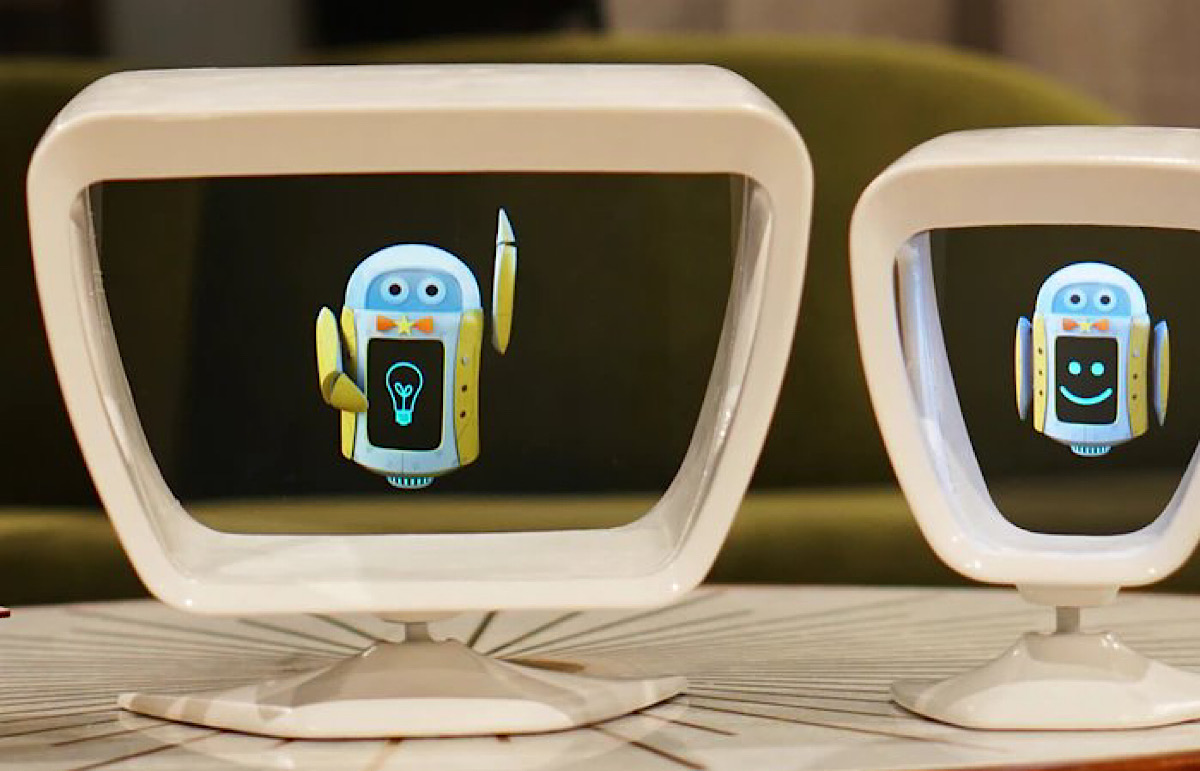
Sidekicks are a unique take on the trend for AI companion robots” offering a holographic artificial intelligent friend which is voice-enabled and equipped with emotions and more. Equipped with a holographic display the Sidekick artificial intelligent companion has been designed to interact with its owner offering a variety of different features. Launched via Kickstarter this month the project has already raised is required pledge goal thanks to over 160 backers with still 23 days remaining. The AI companion is available as a digital application or can be housed in its own special environment.
Specially priced early bird pledges are now available for the innovative project from roughly $69 or £50 (depending on current exchange rates). If the Sidekicks campaign successfully raises its required pledge goal and fullfilment progresses smoothly, worldwide shipping is expected to take place sometime around January 2022. To learn more about the Sidekicks holographic AI companions.
Tesla Shows Off Its Brand New AI-Training Supercomputer
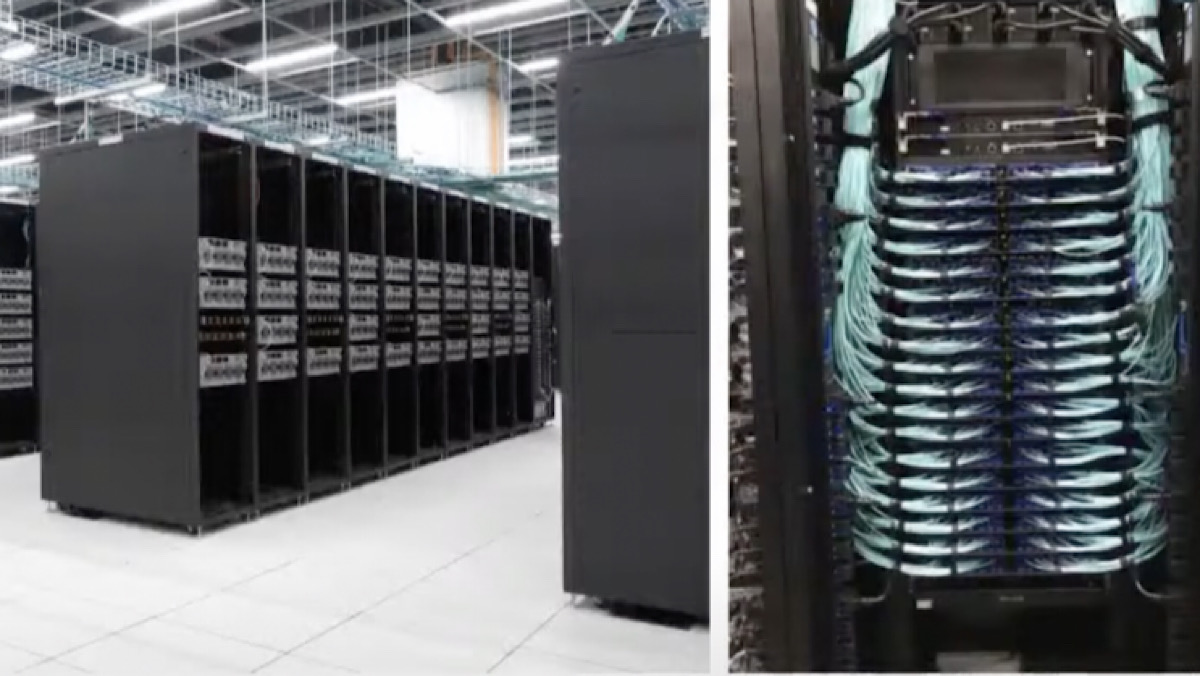
The new machine will be a close relative to Tesla’s upcoming Dojo supercomputer.
By Chris Young
Tesla’s Senior Director of AI, Andrej Karpathy, unveiled the electric vehicle automaker’s new supercomputer during a presentation at the 2021 Conference on Computer Vision and Pattern Recognition (CVPR).
Last year, Elon Musk highlighted Tesla’s plans to build a “beast” of a neural network training supercomputer called “Dojo”.
For several years, the company has been teasing its Dojo supercomputer, which Musk has hinted will be the world’s fastest supercomputer, outperforming the current world leader, Japan’s Fugaku supercomputer which runs at 415 petaflops.
The new supercomputer seems to be a predecessor to the Dojo project, with Karpathy stating that it is the number five supercomputer in the world in terms of floating-point operations per second (FLOPS).
This supercomputer is certainly not lacking in the processing department. As Karpathy highlights in his presentation, the supercomputer has 720 nodes of 8x A100 80GB (5760 GPUs total). It also has 1.8 EFLOPS (720 nodes * 312 TFLOPS-FP16-A100 * 8 gpu/nodes), 10 PB of “hot tier” NVME storage @ 1.6 TBps, and 640 Tbps of total switching capacity.
Continue reading… “Tesla Shows Off Its Brand New AI-Training Supercomputer”Watch: This new K-pop group was created with AI and deepfake technology

By Andy Meek
North Korean dictator Kim Jong-un can angrily denounce K-pop as a “vicious cancer” all he wants. It’s not just that pop music has become one of the most beloved exports from his neighbor to the south, but the same holds true for pretty much the entirety of South Korean popular culture — everything from movies to music and TV shows, which have combined to form a staggeringly massive entertainment industry juggernaut, with few if any equals.
Netflix, for example, recognizes this and is currently pouring millions of dollars into funding new original Korean dramas and movies, like the newly released emotional masterpiece Move to Heaven, about a “trauma cleaner” and his uncle who pack up the belongings of people who’ve died and help their families to move on. All told, Netflix reportedly plans to spend half a billion dollars in 2021 on South Korean content, which also coincides with a moment that finds South Korean pop groups (like Blackpink and BTS) being among the biggest in the world. Those two groups, in particular, have millions of global fans and incomprehensibly massive audiences across social media — which might explain why the four members of Blackpink, in particular, got their own documentary treatment on Netflix, via their movie Light Up The Sky. Meanwhile, technology is also helping point toward a futuristic and potentially even more lucrative new chapter for Korean pop music. Case in point is the new K-pop group called Eternity, which recently made its debut via the song I’m Real, although this 11-member girl group is much different from anything else in the K-pop universe right now.
That’s because, with apologies to the message conveyed by Eternity’s debut song, the members are, in fact, not real. This new K-pop group, which is the product of AI graphics company Pulse 9, was created using deepfake technology to simulate hyper-realistic images of faux K-pop stars in the vein of some of the genre’s biggest female acts, a la Blackpink, Red Velvet, and Itzy.
“Unlike human singers,” Pulse 9 CEO Park Ji-eun told the South China Morning Post, “AI members can freely express themselves and weigh in on diverse social issues because they are less vulnerable to malicious comments and criticisms. As a creator, I can also add more fantastical and (impactful) elements to them, making them more distinguishable from existing K-pop acts.”
Continue reading… “Watch: This new K-pop group was created with AI and deepfake technology”Mayflower AI sea drone readies maiden transatlantic voyage

When the Mayflower leaves its home port in Plymouth, England to attempt the world’s first fully autonomous transatlantic voyage, it will be guided by a highly trained, artificial intelligence-driven ‘captain’ and a ‘navigator’ versed in the rules of avoiding collisions at sea
Over its roughly three-week trip from England to the United States, the Mayflower will be guided by an artificial intelligence-powered ‘captain’ and make the journey without humans on board.
Another ship called the Mayflower is set to make its way across the Atlantic Ocean this week, but it won’t be carrying English pilgrims — or any people — at all.
When the Mayflower Autonomous Ship leaves its home port in Plymouth, England to attempt the world’s first fully autonomous transatlantic voyage, it will have a highly trained “captain” and a “navigator” versed in the rules of avoiding collisions at sea on board, both controlled by artificial intelligence (AI).
The ship’s AI captain was developed by Marine AI and is guided by an expert system based on IBM technologies, including automation software widely used by the financial sector. The technology could someday help crewed vessels navigate difficult situations and facilitate low-cost exploration of the oceans that cover 70 percent of the Earth’s surface.
Over its roughly three-week trip, the Mayflower sea drone will sail through the Isles of Scilly and over the site of the lost Titanic to land in Plymouth, Massachusetts, as the colonists on the first Mayflower did more than 400 years ago.
Continue reading… “Mayflower AI sea drone readies maiden transatlantic voyage”Here’s how new artificial intelligence algorithm can treat sleep disorder

A new breakthrough study develops artificial intelligence algorithm that will serve to help doctors and researchers around the world to learn more about sleep disorders in the future and help treat difficulty in sleeping, sleep apnea and narcolepsy
In a new study, researchers from the University of Copenhagen’s Department of Computer Science have collaborated with the Danish Center for Sleep Medicine at the Danish hospital Rigshospitalet to develop an artificial intelligence algorithm that can improve diagnoses, treatments, and our overall understanding of sleep disorders.
Difficulty sleeping, sleep apnea and narcolepsy are among a range of sleep disorders that thousands of Danes suffer from. Furthermore, it is estimated that sleep apnea is undiagnosed in as many as 200,000 Danes.
“The algorithm is extraordinarily precise. We completed various tests in which its performance rivalled that of the best doctors in the field, worldwide,” states Mathias Perslev, a PhD at the Department of Computer Science and lead author of the study, recently published in the journal npj Digital Medicine (link).
Today’s sleep disorder examinations typically begin with admittance to a sleep clinic. Here, a person’s night sleep is monitored using various measuring instruments. A specialist in sleep disorders then reviews the 7-8 hours of measurements from the patient’s overnight sleep.
The doctor manually divides these 7-8 hours of sleep into 30-second intervals, all of which must be categorized into different sleep phases, such as REM (rapid eye movement) sleep, light sleep, deep sleep, etc. It is a time-consuming job that the algorithm can perform in seconds.
“This project has allowed us to prove that these measurements can be very safely made using machine learning– which has great significance. By saving many hours of work, many more patients can be assessed and diagnosed effectively,” explains Poul Jennum, professor of neurophysiology and Head of the Danish Center for Sleep Medicine.
Continue reading… “Here’s how new artificial intelligence algorithm can treat sleep disorder”How Emotion AI Can Make the World a Better Place

Most of us take it for granted that we can read another person’s emotions through subtleties such as body language, yet this is a real struggle for many others. Enter emotion AI.
Researchers at Stanford University modified Google’s augmented reality glasses to read emotions in others and notify the wearer. The glasses detect someone’s mood through their eye contact, facial expressions and body language, and then tell the wearer what emotions it’s picking up.
“Emotion AI taps into the individual,” explains Zabeth Venter, CEO and co-founder of Averly. “If you think about facial recognition, which is a kind of emotion AI, I can pick up if you like what I’m saying by whether your smile is a smirk or a real genuine smile.”
Such nuances go deeper. Another example is polling: what is your favourite colour? Maybe it’s purple. But did you say that enthusiastically? Did you hesitate? Did you just say it to say something? Did you even understand the question?
We simply can’t get this level of context from the available surveys, sales data and the many other ways we try to understand humans through information. But through emotion AI, we can grasp incredible nuance.
Continue reading… “How Emotion AI Can Make the World a Better Place”More than half of Europeans want to replace lawmakers with AI, study says

People walking at Strandvagen in Stockholm
By Sam Shead
KEY POINTS
- Researchers at IE University’s Center for the Governance of Change asked 2,769 people from 11 countries worldwide how they would feel about reducing the number of national parliamentarians in their country and giving those seats to an AI that would have access to their data.
- The results, published Thursday, showed that despite AI’s clear and obvious limitations, 51% of Europeans said they were in favor of such a move.
- Outside Europe, some 75% of people surveyed in China supported the idea of replacing parliamentarians with AI, while 60% of American respondents opposed it.
LONDON — A study has found that most Europeans would like to see some of their members of parliament replaced by algorithms.
Researchers at IE University’s Center for the Governance of Change asked 2,769 people from 11 countries worldwide how they would feel about reducing the number of national parliamentarians in their country and giving those seats to an AI that would have access to their data.
The results, published Thursday, showed that despite AI’s clear and obvious limitations, 51% of Europeans said they were in favor of such a move.
Continue reading… “More than half of Europeans want to replace lawmakers with AI, study says”IBM Built an AI Capable of Holding Its Own Against Humans in a Debate

By Joel Hruska
Over the past few years, AI has gone from a niche topic to an exploding field. AI can improve audio and video quality, animate still images of long-dead people, and identify you from an analprint. One thing it hasn’t been able to do? Argue effectively within the context of a formal debate.
To overcome this problem, IBM created Project Debater, an AI development program focused on exactly what it sounds like. Many AI projects, especially those focusing on gaming, have a clear winner and a loser based on the evaluation of numerical criteria, such as pieces captured, lives lost, or the ratio between kills and deaths. Effectively debating a human requires a vastly different skill set.
A recent paper in Nature describes the results of a 2019 test between Project Debater and globally recognized debate champion Harish Natarajan. The AI and individual debated whether preschool should be subsidized. Each side was given 15 minutes for prep time without additional internet access, which Project Debater used to sort through its own internal database of content. Both sides gave a four-minute speech, followed by a two-minute closing statement.
Continue reading… “IBM Built an AI Capable of Holding Its Own Against Humans in a Debate”OpenAI’s Sam Altman: Artificial Intelligence will generate enough wealth to pay each adult $13,500 a year

Guests have their faces scanned at the World Artificial Intelligence Conference in Shanghai in August, 2019.Hector Retamal | AFP | Getty Images
By Catherine Clifford
Artificial intelligence will create so much wealth that every adult in the United States could be paid $13,500 per year from its windfall as soon as 10 years from now.
So says Sam Altman, co-founder and president of San Francisco-headquartered, artificial intelligence-focused nonprofit OpenAI.
“My work at OpenAI reminds me every day about the magnitude of the socioeconomic change that is coming sooner than most people believe,” Altman, who posted Tuesday. “Software that can think and learn will do more and more of the work that people now do.”
Continue reading… “OpenAI’s Sam Altman: Artificial Intelligence will generate enough wealth to pay each adult $13,500 a year”Sophia Robot AI to Auction Exclusive NFT Digital Artwork

By Leila Stein 15 Updated by Kyle Baird
Sophia the Robot has created her own non-fungible token (NFT) digital artwork to be auctioned.
Sophia made the artworks with digital artist Andrea Bonaceto. This makes them the first-ever collaboration between humans and robots.
An NFT version of the art goes up for sale on the Nifty Gateway marketplace on March 23.
Continue reading… “Sophia Robot AI to Auction Exclusive NFT Digital Artwork”Luum’s AI-based Lash Robot can delicately extend eyelashes for customers in beauty salons
Luum has created an AI-based Lash Robot that can delicately extend eyelashes for customers in beauty salons.
I’ll let you absorb that for a minute. Luum CEO Philippe Sanchez said in an interview with VentureBeat that the lash extension procedure is ideal for robotics because it’s a tedious job for humans, who often have to bend over while adding extensions to each individual lash, which takes a lot of dexterity and concentration over two or three hours.
The Luum robot can do the same procedure — where it grabs someone’s eyelash and adds an extension to it — in under 20 minutes.
“This is a treatment that is semi-permanent that women do once,” Sanchez said. “It takes about two hours to three hours to be applied by a lash expert. And you look very natural and beautiful. And the advantage for a woman is that you do that once. And the whole treatment lasts for about a month or so.”
Continue reading… “Luum’s AI-based Lash Robot can delicately extend eyelashes for customers in beauty salons”