Artificial Intelligence Is Guiding Human Return to the Moon

 · By Daniel Patrascu

There is no doubt the only way forward for humanity is to enlist the help of artificial intelligence systems, such as they presently are. They are required, you see, because humans always had a habit of biting off more than they can chew, and engage in audacious projects that are far beyond the capabilities of their brains.

One such project is the Artemis lunar exploration program. Later this year, the first flight in a longer series is set to depart for the Moon with no crew on board to test performance, life support, and communication capabilities.

Then, in 2023, astronauts will head for the Earth satellite, without landing there, followed in 2024 by the Artemis III mission that will actually put human boots on the ground after decades of absence. 

Crucial to the success of the missions is the Orion capsule. Cooked up in the Lockheed Martin laboratories, Orion is the actual spaceship that will ensure astronauts arrive at their destination alive and well, and then back to Earth.

Continue reading… “Artificial Intelligence Is Guiding Human Return to the Moon”
Intel’s 3D and AI tech now helps train athletes

By Michael Vizard

Intel today revealed that its 3D Athlete Tracking (3DAT) technology is being employed by Exos, a firm that focuses on human performance conditioning, to help train professional athletes aspiring to join the National Football League (NFL) and other organizations.

Intel’s 3DAT technology captures skeletal data when an athlete is sprinting, using a video camera running at 60 frames per second. That data is then analyzed using Intel Deep Learning Boost AI capabilities that have been built into the latest generation of Intel Xeon Scalable processors Intel has deployed in a cloud it manages.

The goal is to make it simpler for coaches and athletes to understand how different types of skeletal structures may give one athlete an edge over another, said Ashton Eaton, two-time Olympic gold medalist in the decathlon and a product development engineer in Intel’s Olympic Technology Group.

“We don’t know why people won or lost,” Eaton said. “There are a lot of unknowns.”

Continue reading… “Intel’s 3D and AI tech now helps train athletes”

Sonantic uses AI to infuse emotion in automated speech for game prototypes


By Dean Takahashi

Sonantic has figured out how to use AI to turn written words into spoken dialogue in a script, and it can infuse those words with the proper emotion.

And it turns out this is a pretty good way to prototype the audio storytelling in triple-A video games. That’s why the Sonantic technology is finding use with 200 different video game companies for audio engineering.

The AI can provide true emotional depth to the words, conveying complex human emotions from fear and sadness to joy and surprise. The breakthrough advancement revolutionizes audio engineering capabilities for gaming and film studios, culminating in hyper-realistic, emotionally expressive and controllable artificial voices.

“Our first pilots were for triple-A companies, and then when we started building this,” said cofounder Zeena Qureshi in an interview with GamesBeat. “We went a lot more vertical and deeper into just working very closely with these types of partners. And what we found is the highest quality bar is for these studios. And so it’s really helped us bring our technology into a very great place.”

Building upon the existing framework of text-to-speech, London-based Sonantic’s approach is what differentiates a standard robotic voice from one that sounds genuinely human. Creating that “believability” factor is at the core of Sonantic’s voice platform, which captures the nuances of the human voice.

Continue reading… “Sonantic uses AI to infuse emotion in automated speech for game prototypes”

Robotic glove which uses AI to improve muscle grip could help millions

A prototype robotic glove for people who struggle with daily tasks

By Sean Morrison

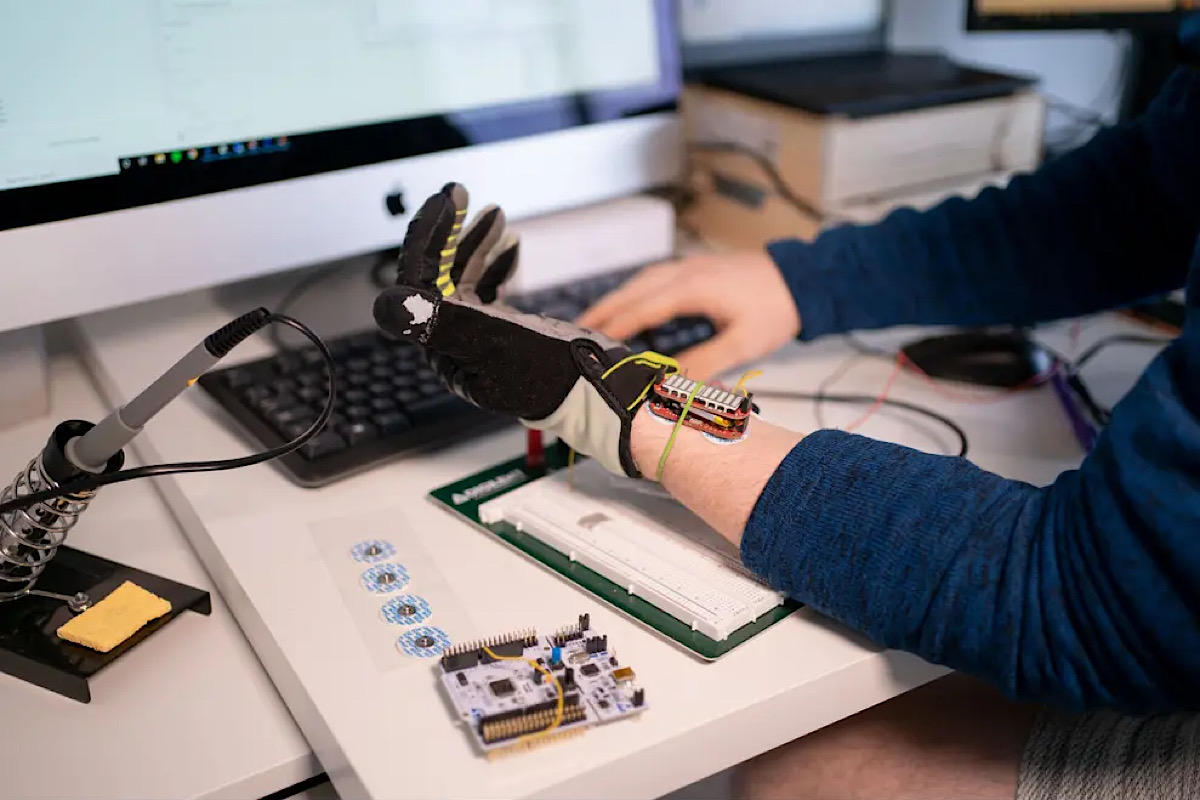
An engineering graduate hopes to aid millions of people after helping create a robotic glove which uses artificial intelligence to boost muscle grip.

Seeing his aunt’s struggles with daily tasks such as drinking water or changing TV channel after loss of movement caused by multiple sclerosis led Ross O’Hanlon, 24, to produce the device.

The glove detects the wearer’s intention to grip by using electromyography (EMG) to measure electrical activity in response to a nerve’s stimulation of the muscle.

It then employs an algorithm to convert the intention into force, helping the user to hold an item or apply the necessary pressure to complete an activity.

Continue reading… “Robotic glove which uses AI to improve muscle grip could help millions”

AI Can Now Learn to Manipulate Human Behavior

JON WHITTLE,

Artificial intelligence (AI) is learning more about how to work with (and on) humans. A recent study has shown how AI can learn to identify vulnerabilities in human habits and behaviours and use them to influence human decision-making.

It may seem cliched to say AI is transforming every aspect of the way we live and work, but it’s true. Various forms of AI are at work in fields as diverse as vaccine development, environmental management and office administration. And while AI does not possess human-like intelligence and emotions, its capabilities are powerful and rapidly developing.

There’s no need to worry about a machine takeover just yet, but this recent discovery highlights the power of AI and underscores the need for proper governance to prevent misuse.

Continue reading… “AI Can Now Learn to Manipulate Human Behavior”

DALL·E: Creating Images from Text

We’ve trained a neural network called DALL·E that creates images from text captions for a wide range of concepts expressible in natural language.

DALL·E[1] is a 12-billion parameter version of GPT-3 trained to generate images from text descriptions, using a dataset of text–image pairs. We’ve found that it has a diverse set of capabilities, including creating anthropomorphized versions of animals and objects, combining unrelated concepts in plausible ways, rendering text, and applying transformations to existing images.

Continue reading… “DALL·E: Creating Images from Text”

Researchers Develop World’s Most Powerful Neuromorphic Processor for AI

ByAlex McFarland

Researchers-develop-world's-most-powerful-neuromprphic-processor

In what is a major leap forward in the field of artificial intelligence (AI), an international team of researchers led by Swinburne University of Technology has developed the world’s most powerful neuromorphic processor for AI. It operates at an astonishing rate of more than 10 trillion operations per second (TeraOps/s), meaning it can process ultra-large-scale data.

The work was published in the journal Nature. 

Led by Swinburne’s Professor David Moss, Dr. Xingyuan Xu, and Distinguished Professor Arnan Mitchell from RMIT University, the team accelerated computing speed and processing power. They were able to create an optical neuromorphic processor capable of operating over 1,000 times faster than any previous ones. The system can also process ultra-large-scale images, which is important for facial recognition as previous optical processors have failed in this regard.

Professor Moss is Director of Swinburne’s Optical Sciences Centre, and he was named a top Australian researcher in physics and mathematics in the field of optics and photonics by The Australian.

“This breakthrough was achieved with ‘optical micro-combs,’ as was our world-record internet data speed reported in May 2020,” he said.

Continue reading… “Researchers Develop World’s Most Powerful Neuromorphic Processor for AI”

AI Matches or Beats Human Diagnoses in Award-Winning Study

AI-matches-or-beats-human-diagnoses

Denti.AI’s artificial intelligence (AI) software accurately identified pathoses that were missed by board-certified dental experts in an award-winning study by Manal Hamdan, a graduate student at the University of North Carolina Adams School of Dentistry.

Hamdan concluded that Denti.AI’s technology had comparable or improved results in detecting apical radiolucencies and that it has the potential to reduce provider fatigue and diagnostic errors.

The study won the American Academy of Oral and Maxillofacial Radiology’s 2020 Albert G. Richards Graduate Student Research Award.

“Dr. Hamdan’s research is an excellent example of university and business collaboration utilizing experts in radiology, deep learning, and statistical analysis to produce clinically relevant and potentially game changing results validating software that can elevate patient care,” said Dr. Don Tyndall, professor of oral and maxillofacial radiology at the Adams School.

“Our team at Denti.Ai is committed to being at the forefront of implementing artificial intelligence into clinical practices through rigorous academic validation and collaboration with leading academic institutions,” said Dmitry Tuzoff, founder and CEO of Denti.AI.

Continue reading… “AI Matches or Beats Human Diagnoses in Award-Winning Study”

AI can now help us detect disease at its earliest stages

ByCRAIG VENTER

AI-can-dectec-disease-earliest-stage
Combining genomics, MRI scans and artificial intelligence will usher in a new era in healthcare

In many countries, Covid-19 has spread because of a popular scepticism about science, a political manipulation of data and an abundance of inaccurate information, spread in large part on social media but fuelled at some of the highest levels of governments. In 2021, we will understand that only by developing new, science-based approaches to disease detection will we avoid similar future catastrophes.

My own country, the United States, has already provided a live demonstration of this fact. States that enforced practices such as social isolation/distancing, hand washing and use of sanitisers and face masks have had the lowest per capita rates of Covid-19 infection, averaging around 100 to 200 cases per 100,000 people. Compare that figure to the 2,300 per 100,000 people in states that did not enforce these measures.

Reconnecting science with healthcare will have impressive results. One weakness of the world’s response to the pandemic has been its unwillingness to use science to predict vulnerabilities in individuals before they become ill. Not only have many countries been reluctant to perform widespread testing on people who show no Covid-19 symptoms, but they have also been caught seemingly by surprise when pre-existing conditions have exacerbated the disease. In 2021, we will see the application of a multimodal testing approach to detect propensities to diseases in people at very early stages. 

Continue reading… “AI can now help us detect disease at its earliest stages”

DeepMind MuZero AI can master games without knowing the rules

JC Torres 

Deeming-muzero-ai-can-master-games-1

The holy grail of AI has always been to enable computers to learn the way humans do. The most powerful AIs today, however, still rely on having certain known rules, like rules for a game of chess or Go. Human learning, however, is often messy in inferential, learning the rules of life as we go. DeepMind has long been trying to create such AIs using games as their environment and test suite. Google’s sister company focusing on AI research has just revealed its latest achievement in MuZero, an AI that can master a game without learning the rules beforehand.

DeepMind’s previous AIs like AlphaGo have been widely covered in media for beating human champions in their respective games. Impressive as they may have been, they were still a few steps shy of the ultimate goal. AlphaGo, in particular, had the advantage of knowing not only the rules of Go but also domain knowledge and data from human players. Its successors, AlphaGo Zero and AlphaZero, could still bank on having the rule book to learn from.

While these AIs excelled in games with complex strategies but simple visuals, they failed when applied to more visually complex games where the rules are not so easy to infer. That’s where the new MuZero AI comes in and it uses a selection of Atari games, like Ms. Pac-Man, to test out their theory.

Continue reading… “DeepMind MuZero AI can master games without knowing the rules”

McDonald’s Restaurants Are Putting Cameras, Sensors, and AI Technology in Their Dumpsters

By B.N. Frank

McDonald's restaurants are putting cameras-in-dumpsters
Here’s why some McDonald’s restaurants are putting cameras in their dumpsters

McDonald’s restaurants are putting cameras in their dumpsters and trash containers in an effort to improve their recycling efforts and save money on waste collection.  Nordstrom department stores are doing this as well.

Jason Gates spends a lot of his time thinking about trash, and how we can generate less of it.

Since 2013 his San Francisco-based startup, Compology, has used cameras and artificial intelligence to monitor what’s thrown into dumpsters and trash containers at businesses such as McDonald’s restaurants and Nordstrom department stores. The point is to make sure dumpsters are actually full before they’re emptied and to stop recyclable materials like cardboard from being contaminated by other junk so it, too, doesn’t become waste.

“We’ve found that most businesses and people have the right intentions about recycling, but oftentimes they just don’t know what the proper way to recycle is,” Gates, CEO of Compology, told CNN Business’ Rachel Crane.

To help them do it correctly, Compology puts trash-monitoring cameras and sensors inside industrial waste containers. The cameras take photos several times each day and when the container is lifted for dumping. An accelerometer helps trigger the camera on garbage day.

AI software analyzes the images to figure out how full the container is and can also let a customer know when something is where it shouldn’t be, such as a bag of trash tossed into a dumpster filled with cardboard boxes for recycling. Gates said the company’s cameras can cut the amount of non-recyclable materials thrown in waste containers by as much as 80%.

Continue reading… “McDonald’s Restaurants Are Putting Cameras, Sensors, and AI Technology in Their Dumpsters”

TO BOOST BIRTH RATE, JAPAN’S GOVERNMENT CONSIDERS AI TO MATCH SPOUSES

Bonnie Burton

japan-government-AI-Match-spouses
In Japan, not only can you have artificial intelligence pick your mate, but you can also have two giant Pikachu mascots standing by as you say I do.

Japan’s Cabinet Office is asking for budget approval for a new dating service driven by artificial intelligence.

Finding the perfect mate can feel impossible, especially when in-person interactions have come to a screeching halt due to COVID-19 lockdowns. But if you live in Japan, the government there wants to help you find eternal love — or at least your future spouse — using artificial intelligence

In an effort to boost Japan’s declining birth rate, the government has been trying to help single heterosexual men and women find true love so they get married and start families. The number of annual marriages in Japan has fallen from 800,000 in 2000 to 600,000 in 2019.

According to Sora News 24, roughly 25 of Japan’s 47 prefectures currently have some sort of government-run matchmaking service for singles where the users plug in their preferences for a potential mate — including age, income and educational level. The dating services then provide a list of other users who meet their criteria. 

Continue reading… “TO BOOST BIRTH RATE, JAPAN’S GOVERNMENT CONSIDERS AI TO MATCH SPOUSES”
Discover the Hidden Patterns of Tomorrow with Futurist Thomas Frey
Unlock Your Potential, Ignite Your Success.

By delving into the futuring techniques of Futurist Thomas Frey, you’ll embark on an enlightening journey.

Learn More about this exciting program.