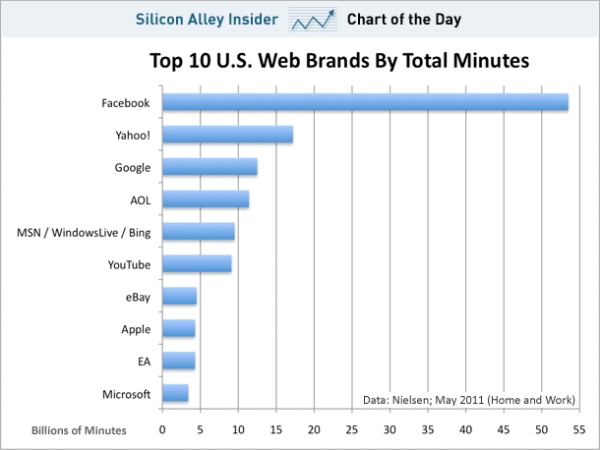
Facebook’s domination of time spent on the web is absolutely astonishing.
Continue reading… “Facebook dominates time spent on web in the U.S.”

Facebook’s domination of time spent on the web is absolutely astonishing.
Continue reading… “Facebook dominates time spent on web in the U.S.”

Beware of malicious friends on Facebook.
Lurking in the shadows of your Facebook, Twitter, Linkedin and eHarmony accounts are con artists, according to the North American Securities Administrators Association, the oldest international investor protection association.
Continue reading… “‘Affinity’ fraudsters target social media sites”

Hi there. Wanna chat? I’m hip, scruffy and funny.
Over the years, there’s been a radical change in the way we interact with our networks of friends online. It used to be that we had a few of our friends (online or offline friends) on a service, allowing us to connect to friends through the Internet and see what their activities were. Where the Internet used to be a somewhat scary world full of strangers, we suddenly had friendly anchors to explore that world with. Sure, most of our friends weren’t online, or at least not using the same services, but the familiarity was comforting and the ability to see what a few of our friends were doing allowed us to find new content and new friends.
We fell in love with sites that made us feel like there are people out there who are similar to us, who we are talking to and having common experiences with. But then, some of these networks — Facebook and Twitter in particular — began to grow explosively…
Continue reading… “The Social Network paradox”

Social networking sites like MySpace, Facebook and others, which displayed images of teens abusing alcohol and drugs, “constitutes electronic child abuse”.
According to a new study by the National Center on Addiction and Substance Abuse at Columbia University suggests that teens who use social media are more likely to abuse drugs and alcohol.
Continue reading… “Does Facebook promote drug and alcohol abuse in teens?”

Facebook also has 870 million unique users.
Social networking site Facebook reached 1,000,000,000,000 page views in June. It’s also got 870 million unique users, according to Google’s DoubleClick Ad Planner. That makes it the number-one site in terms of broad reach of Internet users.
Continue reading… “Facebook tops 1 trillion page views”

Facebook is gaining momentum in the video realm.
Facebook is already the largest photo site in the U.S., and now it is climbing up the charts for online video. Facebook now ranks as the third largest video site on the Web in terms of unique viewers according to comScore, with an estimated 51.5 million people on Facebook watching a video during the month of July. The month before it was No. 6. It passed Microsoft, Yahoo, and Viacom. Only Vevo (with 62 million monthly viewers) and YouTube (158 million) are bigger.
It is only a matter of time before Facebook passes Vevo, but can it ever take the crown from Google/Youtube?
Continue reading… “Facebook climbs to no. 3 video site in US”

The NYPD has formed Facebook and Twitter units in order to track down and monitor criminals and criminal behavior on social media sites.
The New York Police Department has formed a new unit to track troublemakers who announce plans or brag about their crimes on Twitter, MySpace and Facebook.
Continue reading… “NYPD forms new unit to track troublemakers on social media sites”

Students love technology.
It’s a fact that college students are obsessed with technology. Key surveys were performed recently to gauge students’ tech use scientifically. And OnlineEducation.net has made an infographic based on results from the student/technology study. (Infographic)
Continue reading… “College students are addicted to technology: study”

Our technological world has plenty of pitfalls.
If you feel like you’re scrambling to keep up with technology, you’ve got plenty of company as technology has been moving forward in leaps and bounds. There’s not a gadget on the market that doesn’t aim to make our lives easier, but now we’re tangled up in a strange new world. It’s a complex web of tweets and roaming charges in which we we hunt for open power outlets with the urgency of our ancestors foraging for their next meal.
Continue reading… “Five ways technology is getting worse”

64% of small businesses don’t think social media is necessary.
According to a new study, small businesses don’t seem to be swept up in the social media revolution.
Continue reading… “Small businesses think social media is unnecessary”

Visa-owned PlaySpan with research firm VGMarket have released a new study on how and what gamers are spending on virtual goods. Nearly one-third of the general gamer population has used real world money (as opposed to virtual currency) to purchase virtual goods, according to the study. Console games with online play account for the majority (51%) of virtual purchases using real world money, with social networking games (30%) coming in at second.
Continue reading… “A third of gamers use real world money to buy virtual goods”

“Face it, Don’t Facebook It”
A conference in Boston was held to teach 200 teenagers how to have “healthy breakups”, according to a story in the New York Times. Unsurprisingly, a lot of the discussion revolved around proper Facebook breakup etiquette.
Continue reading… “Teaching teens how to breakup Facebook”

By delving into the futuring techniques of Futurist Thomas Frey, you’ll embark on an enlightening journey.
Learn More about this exciting program.