
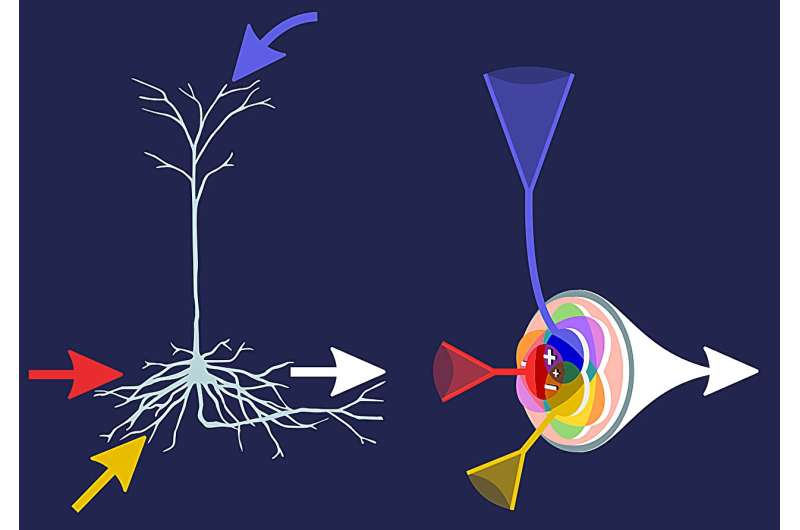
In a breakthrough that could redefine the future of artificial intelligence, researchers have developed a new kind of artificial neuron that mimics the brain more accurately than ever before. Known as “infomorphic neurons,” these units can learn independently, just like their biological counterparts.
Developed by scientists at the Göttingen Campus Institute for Dynamics of Biological Networks (CIDBN) at the University of Göttingen and the Max Planck Institute for Dynamics and Self-Organization (MPI-DS), these artificial neurons were designed to self-organize and extract meaningful patterns from their local network environment—without relying on external coordination. The research was recently published in the Proceedings of the National Academy of Sciences.
In both human brains and artificial neural networks, neurons act as simple processing units, passing signals along a complex web. Traditional artificial networks rely on multiple layers of neurons, where signals move forward and are shaped by extensive outside training. However, this approach doesn’t mirror how real brains operate.
Biological neurons, especially the pyramidal cells in the cerebral cortex, learn through localized input. They adapt by interpreting signals only from their nearby connections—making them far more energy-efficient and flexible than conventional artificial neurons.
The infomorphic neurons take their cues from this biological model. Each neuron in the network learns autonomously, deciding for itself which information is relevant. This shift reduces the need for top-down control and introduces a new level of adaptability in artificial systems.
“These artificial neurons don’t wait for instructions—they figure out what’s important on their own,” says Marcel Graetz from CIDBN. “We can now actually see and understand how each neuron learns inside the network.”
By setting general, easy-to-interpret learning goals, the researchers enabled each neuron to determine its own learning rules. Using an innovative information-theoretic approach, they were able to fine-tune the behavior of each neuron. Some sought redundancy with nearby neurons, others coordinated efforts, while some specialized in unique parts of the overall task.
“By specializing and collaborating, each neuron contributes to the network’s larger objective,” adds Valentin Neuhaus from MPI-DS. “This is a powerful step toward both improving AI and deepening our understanding of the brain.”
The implications of infomorphic neurons go beyond machine learning—they offer new insights into how learning works in the human brain. By closing the gap between artificial and biological networks, this technology may pave the way for more intelligent, energy-efficient AI systems that can adapt and learn as humans do.
As AI continues to evolve, this approach marks a fundamental shift: from top-down programming to bottom-up learning—bringing machines one step closer to thinking like us.
By Impact Lab
