

By Futurist Thomas Frey
When Good Ideas Meet Incompetent Implementation
I spend my professional life analyzing breakthrough technologies, envisioning elegant futures, and mapping pathways to better tomorrows. But some days I just want to ban two products from planet Earth: smoke detectors and public restroom toilet paper dispensers. Not the concepts—the implementations. Because both represent catastrophic failures of design thinking that have somehow become accepted as normal despite making millions of people miserable every single day.
Let’s start with smoke detectors, because I guarantee you’re reading this at 2 AM after being jolted awake by that soul-destroying chirp indicating low battery. Not a helpful notification at a convenient time—a piercing beep in the dead of night that requires stumbling through darkness, finding a step ladder, and reaching a ceiling-mounted device specifically positioned to be as inaccessible as possible.

The Smoke Detector Insanity
The core concept is sound: detect smoke, alert occupants, save lives. Beautiful. The implementation is sadistic. Mount it on the ceiling where nobody can reach it without equipment. Use batteries that die exclusively between midnight and 4 AM. Make the low-battery warning identical to the fire alarm so you wake up in full panic mode before realizing it’s just a battery complaint. Add false positive triggers for steam from showers, normal cooking, or even excessive dust, training occupants to ignore alarms because they’re probably false anyway.
My favorite feature: the battery compartment that requires tools to open, ensuring that the 2 AM battery change becomes a full home improvement project rather than a simple swap. And the batteries themselves—9-volt, which nobody stocks in bulk, guaranteeing you don’t have replacements when the chirping starts.
Here’s what truly baffles me: we have technology for self-driving cars, AI that passes bar exams, and robots performing surgery. But we cannot design a smoke detector that distinguishes between smoke and steam? That notifies you of low battery during daylight hours? That mounts at accessible height or uses rechargeable batteries or—radical idea—just plugs into outlets like every other electronic device?
The false positives are particularly maddening. Cook bacon and the detector screams. Take a hot shower with the door open and it screams. Exist in your own home performing normal activities and your smoke detector treats you like you’re committing arson. So people disable them, defeating the entire safety purpose because the implementation is so terrible that the cure becomes worse than the disease.
The Toilet Paper Dispenser Conspiracy
Now let’s talk about public restroom toilet paper dispensers, which appear to have been designed by people who’ve never actually used a bathroom. My nine-year-old grandson came out crying because he couldn’t figure out how to make it work. A child reduced to tears by toilet paper. That’s where we are as a civilization.
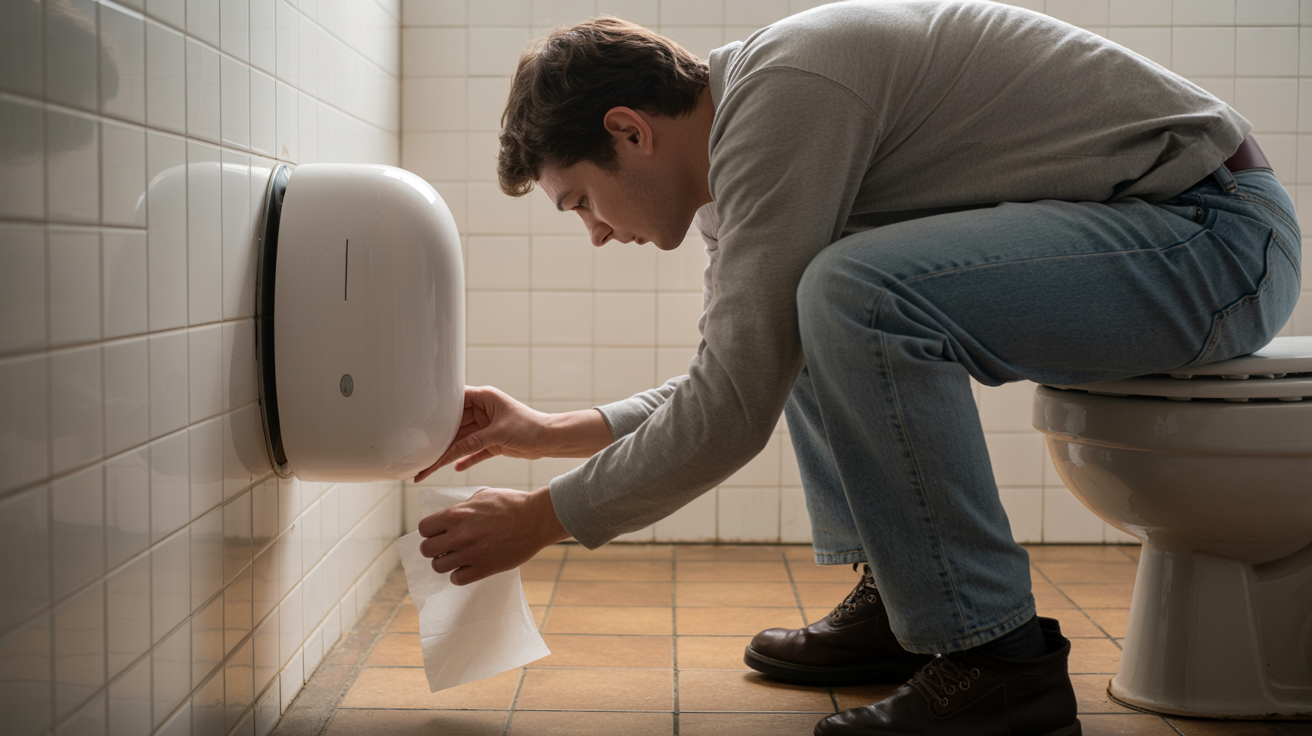
These dispensers are mounted deliberately close to the floor—not for any functional reason, but seemingly to maximize discomfort and difficulty. You’re forced to bend, twist, reach, all while dealing with a mechanism that releases paper in fragments, creating a shower of confetti that goes everywhere except into your hand. The paper tears unpredictably, leaving you with either useless scraps or massive unwieldy wads. There’s no consistency, no intuitive operation, just humiliation and frustration.
People enter restrooms to do their business and leave. Simple. Instead they spend five minutes wrestling with industrial dispensers that seem engineered specifically to fail. Paper fragments fly everywhere. You’re crouched awkwardly reaching toward the floor. The dispenser jams. The paper tears wrong. You try again. More fragments. More frustration. Finally you give up and leave, humiliated, having spent more time fighting the dispenser than actually using the facilities.
Why This Matters Beyond Personal Frustration
These aren’t minor inconveniences—they’re design failures so fundamental they reveal how little thought we give to everyday experiences. We accept that smoke detectors will wake us at 2 AM because “that’s just how they work.” We accept that public restrooms will be exercises in humiliation because “that’s just how it is.”
But it doesn’t have to be this way. Smart smoke detectors exist that can distinguish smoke from steam, notify you of low batteries via phone app during daytime, and mount at reasonable heights. They’re just not standard because we’ve normalized the terrible implementation.
Better toilet paper dispensers exist—commercial ones that mount at reasonable heights, dispense paper smoothly, and don’t require engineering degrees to operate. They cost marginally more, so businesses install the cheapest garbage available, ensuring their customers have terrible experiences because saving three dollars per dispenser matters more than basic human dignity.
Final Thoughts
I envision futures with regenerating limbs, AI companions, and space infrastructure. But I’d trade all of it for smoke detectors that don’t chirp at 2 AM and toilet paper dispensers a nine-year-old can operate without crying. Sometimes the future isn’t about breakthrough innovation—it’s about fixing the inexcusably bad implementations of simple things we use every single day.
Ban both products. Start over. And this time, maybe ask actual humans what would work instead of designing for some theoretical user who apparently enjoys midnight ceiling acrobatics and bathroom humiliation.
After all, when we can’t get smoke detectors and toilet paper right, maybe we should worry less about colonizing Mars and more about making Earth livable first.
Related Articles:
The Most Profitable Question in Business: What’s Still Missing in 2025?
The Emptiness of Being Unnecessary: When Nobody Needs You Anymore
