
By Futurist Thomas Frey
The End of Accidental Friendship
By 2040, the traditional ways people meet—through work, school, church, malls, neighborhood proximity—will be mostly obsolete. Work is automated or remote. Schools are decentralized and personalized. Malls are gone. Churches are again growing, but have aging congregations. Neighborhoods are transient as people move frequently for economic opportunity.
So how do people actually socialize in a world where the old gathering structures have collapsed? The answer: AI-supervised social matching, hyper-intentional third spaces, and technology that removes friction from human connection rather than replacing it. Let me walk you through what socializing looks like in 2040.
AI-Supervised Serendipity
People rely on personal AI concierges that coordinate introductions based on shared interests, compatible personality models, recent life events, emotional readiness, mutual friends, and proximity. Instead of hoping for random encounters, AI constructs optimized moments of serendipity.
You don’t swipe through profiles. Your AI quietly arranges encounters: “There’s someone at the coffee hub down the street reading the same book you are. Want to meet?”
Friendship discovery becomes intentional, not accidental. Your AI and their AI have already determined compatibility, reducing the awkwardness and uncertainty that makes approaching strangers difficult.
Third Spaces Become Hyper-Social Hubs
With malls gone, schools decentralized, and workplaces automated, new kinds of physical gathering spaces emerge: micro-venue cafés, sensor-driven wellness lounges, mixed-reality social theaters, autonomous cooking studios, drone-delivered picnic parks, and community skill labs.
These become the new town squares, designed specifically for human connection. Instead of going to the mall, you go to “The FlowSpace,” “The Social Commons,” or “The Immersion Garden”—places optimized for serendipitous encounters and structured social experiences.
Mixed-Reality Social Layers
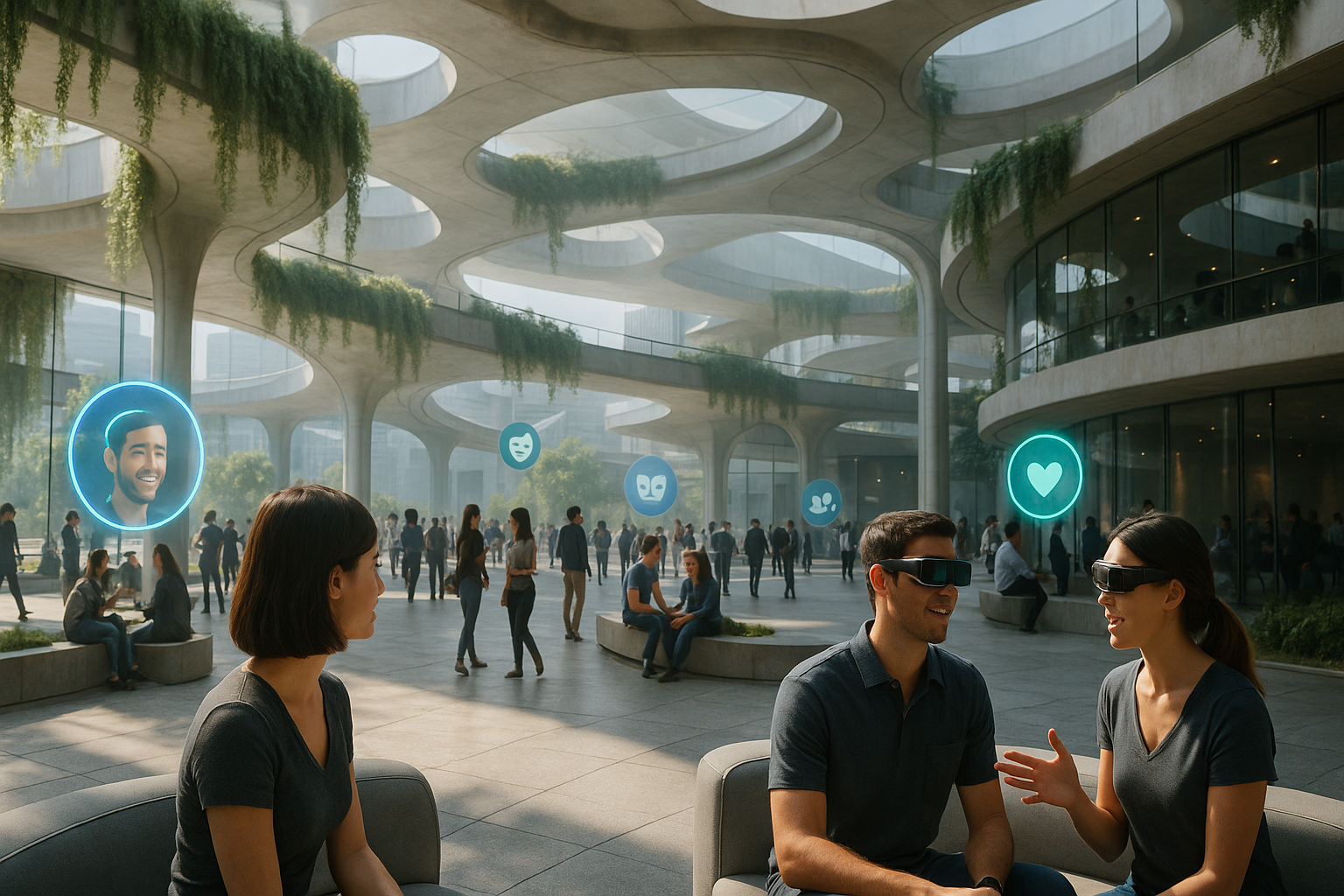
Every public space in 2040 has an optional social layer—a mixed-reality overlay you can toggle on or off. With it on, you see interest badges floating above people, conversation starters, compatibility markers, shared friends, and “looking for company” signals.
It’s not intrusive—it’s ambient. Privacy is opt-in, but most people opt in because it reduces social friction. Meeting people becomes as simple as looking around and seeing who’s open to connection and what you have in common.
Autonomous Transportation as Rolling Social Graphs
Since vehicles drive themselves, interiors become lounges, conversation pods, and mini-cafés with shared seating. You step into a city shuttle and your AI says: “Two others onboard match your hiking interests. Want a quick intro?”
Transit becomes a rolling social graph where commute time transforms into networking opportunity. The previously wasted time traveling becomes structured social experience.
Experience-Based Clubs Replace Geographic Ones
Without traditional workplaces or schools binding people geographically, social identity shifts toward interest-based membership networks: creativity guilds, robotics maker clubs, VR adventure leagues, healthspan communities, skill cooperatives, AI performance groups.
These clubs exist both physically and in mixed reality, giving people immediate community regardless of where they live. Your primary social identity comes from what you’re interested in, not where you happen to be located.
Emotional-State Matching
Wearable sensors detect mood, stress, excitement, openness, and conversational readiness. Social systems don’t match by demographics—they match by emotional compatibility at that moment. You meet the right people at the right time, when both parties are emotionally open to connection rather than forcing interaction when someone’s stressed or withdrawn.
Micro-Events Replace Big Parties
Instead of big parties, 2040 favors 10-minute micro-events matching people by emotional state and current interests: pop-up storytelling circles, rooftop gratitude sessions, zero-prep cooking co-ops, dynamic board game rounds, rapid hobby exchanges.
You show up as you are; your AI guides the rest. The barrier to participation drops dramatically when events are short, spontaneous, and precisely matched to your current state and interests.
Autonomous Event Curators
Cities deploy autonomous “event bots” that identify underutilized spaces, gather 10-50 people with compatible interests, and set up spontaneous meetups complete with food, atmosphere, and activities. They turn empty plazas into living social theaters without requiring human organizers.
Final Thoughts
The old world of meeting through work, school, retail, church, malls, and neighborhood proximity has been replaced by a world where connection is designed, not accidental. The result is a society that’s more intentional, more personalized, more dynamic, more emotionally aligned, and surprisingly, more human.
Because when technology removes friction, human connection becomes easier—not harder. People in 2040 socialize more, not less—they just do it through AI-curated introductions, interest-driven communities, mixed-reality overlays, and autonomous social venues that didn’t exist in 2025.
The future of friendship isn’t lonelier. It’s just orchestrated by systems that understand compatibility better than random chance ever did.
Related Articles:
The Loneliness Paradox: When AI Makes You Feel Connected While You Slowly Disappear
Meet Gwen Lawster: The Woman Who Trains Robots Before Breakfast and Builds Startups by Lunch
2025: The Year Systems Started Running Themselves
