
By Futurist Thomas Frey
Why Everyone Arguing About Robot Shape Is Asking the Wrong Question
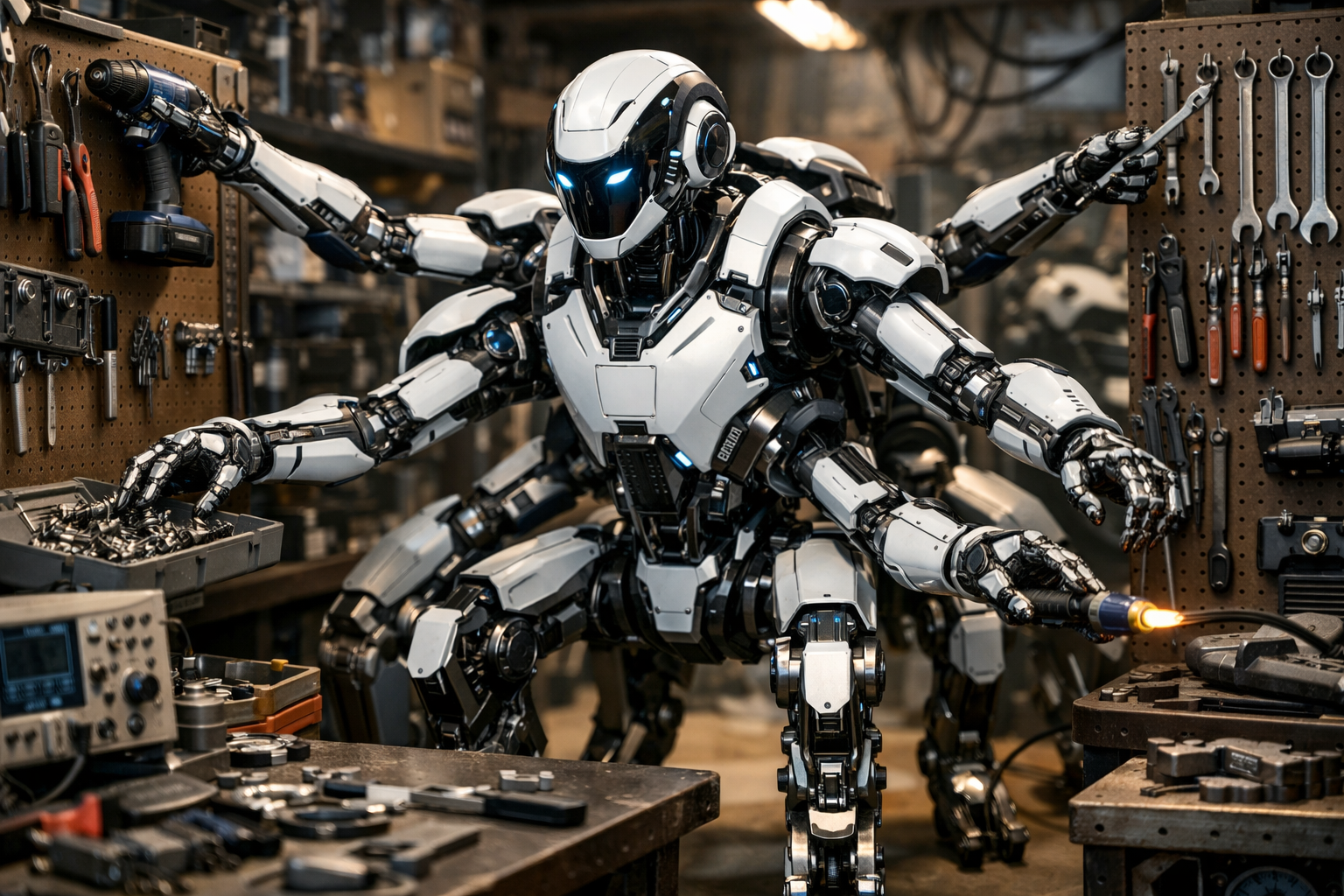
We’re seeing intense debate about whether humanoid robots are the optimal form factor. Critics argue two arms and two legs are inefficient—why not five arms, four legs, seven fingers, or spherical units that roll? Defenders claim humanoid shapes work in human-designed environments without infrastructure changes.
Both sides miss the fundamental point: there is no one-size-fits-all robot form that’s perfect for everyone and every application. The question isn’t “what’s the best robot shape?” It’s “what’s the best robot shape for this specific task in this specific environment?”
Let me show you why form factor diversity is the actual future, not humanoid domination or any single alternative.
Why Humanoid Makes Sense (Sometimes)
Humanoid robots excel in environments designed for humans: buildings with stairs, doorknobs, standard-height counters, tools designed for human hands, vehicles with human-oriented controls.
Tesla’s Optimus, Boston Dynamics’ Atlas, Figure’s robots—these work in factories, warehouses, and homes without requiring infrastructure redesign. You don’t rebuild your house for the robot; the robot adapts to your house.
The humanoid advantage: Navigates existing infrastructure, uses existing tools, fits existing spaces. For applications where environment modification is impossible or expensive, humanoid form factors make economic sense.
The humanoid disadvantage: Two arms and two legs are suboptimal for most specific tasks. Humans evolved for versatility, not specialized efficiency. A robot doesn’t need versatility the same way—it can be purpose-built.
Why Non-Humanoid Makes Sense (Often)
Warehouse robots don’t need legs—wheels are faster, more efficient, more reliable. Surgical robots don’t need two arms—they have four, six, eight appendages providing precision impossible with human anatomy.
Inspection robots crawling through pipes are snake-like. Agricultural robots are tractor-like with specialized harvesting appendages. Cleaning robots are disc-shaped. Search and rescue robots are dog-like for rough terrain.
The specialized advantage: Optimized for specific tasks, often dramatically more efficient than humanoid alternatives attempting the same work.
The specialized disadvantage: Limited to designed purpose, can’t easily adapt to different tasks or environments without modification.
The Real Future: Form Factor Diversity
The actual robotics future isn’t humanoid domination or specialized replacement—it’s proliferation of diverse form factors optimized for specific contexts.
Homes: Combination of humanoid robots handling general tasks (loading dishwasher, folding laundry, basic cleaning) and specialized robots (robotic vacuum, window-cleaning bots, lawn maintenance units). Each form optimized for its function.
Factories: Humanoid robots for flexible tasks requiring tool use and navigation of human-designed spaces. Specialized robotic arms for assembly. Autonomous mobile robots (AMRs) for transport. Inspection drones. Each form factor doing what it does best.
Healthcare: Humanoid robots for patient transport and basic assistance. Specialized surgical robots with multiple arms. Exoskeletons for rehabilitation. Pill-dispensing units. Diagnostic equipment with robotic components. The diversity matches the diversity of medical tasks.
Agriculture: Tractor-style autonomous vehicles for large-scale operations. Multi-armed harvesters for delicate crops. Drone swarms for monitoring and targeted treatment. Humanoid robots for tasks requiring dexterity in varied terrain. Form follows agricultural function.
Construction: Humanoid robots for tasks in partially completed buildings designed for human workers. Specialized concrete-printing robots. Heavy-lifting units with forms optimized for load-bearing. Inspection drones. Each construction phase might use different robot types.
Why the Debate Is Misframed
Arguing “humanoid versus non-humanoid” is like arguing “should vehicles have two wheels, four wheels, or treads?” The answer is obviously “depends on the use case.”
Motorcycles, cars, trucks, tanks, trains—all are vehicles, all have different form factors optimized for different purposes. Nobody argues one is universally superior.
Robots will follow the same pattern. Humanoid is one option in a diverse ecosystem, not the final form factor all robots converge toward.
The Economic and Technical Reality
Economic: Form factor depends on environment modification cost versus specialized robot cost. If you can redesign the environment (new factory, purpose-built facility), specialized robots are cheaper and more efficient. If you can’t (existing homes, legacy buildings), humanoid robots avoid renovation costs.
Technical: We’re getting better at building both humanoid and specialized robots simultaneously. Advances in actuators, AI control systems, and materials science improve all form factors, not just humanoids.
Practical: Most organizations will deploy multiple robot types. A warehouse might have humanoid robots for flexibility, wheeled AMRs for transport, and specialized arms for packing—each doing what it does best.
Final Thoughts
The humanoid robot debate misses the point entirely. There is no perfect robot form factor because there’s no singular robot use case. The future is form factor diversity: humanoid robots where human-designed environments make them economically sensible, specialized robots where task optimization outweighs versatility, and hybrid ecosystems deploying multiple types collaborating on complex operations.
Stop asking “what’s the best robot shape?” Start asking “what’s the best robot shape for this specific application in this specific context with these specific constraints?” That’s the question that actually matters, and the answer is almost always “it depends.”
The robotics revolution isn’t humanoid or specialized—it’s both, and everything in between, each optimized for the problems they’re actually solving.
Related Articles:
The Coming Maintenance Apocalypse: When Everything Breaks and Nobody Knows How to Fix It
2025: The Year Systems Started Running Themselves
The Megaprojects of the AI Age: What Becomes Possible When Machines Help Build Civilization
