

By Futurist Thomas Frey
The eVTOL era is arriving on schedule — and its real implications have almost nothing to do with aviation
The Promise That Kept Getting Delayed
People have been predicting flying cars for so long that the prediction became a punchline. The Jetsons promised them in 1962. Blade Runner put them in 2019. Every decade or so, a prototype appears at an air show, gets covered breathlessly, and then quietly disappears into a legal or engineering or funding cul-de-sac. The joke writes itself: we were supposed to have flying cars, and instead we got 140-character messages.
I want to suggest that this particular joke has an expiration date, and we’re approaching it. What’s happening right now in the eVTOL — electric vertical takeoff and landing — industry is not another hype cycle. It’s a genuine inflection point with specific companies, specific aircraft, specific regulatory milestones, and a specific deadline in the form of the 2028 Los Angeles Olympics that is driving everything toward a concrete moment of arrival. The flying car is coming. Not for everyone, not everywhere, not all at once — but it is coming, and the implications go considerably further than a faster ride to the airport.
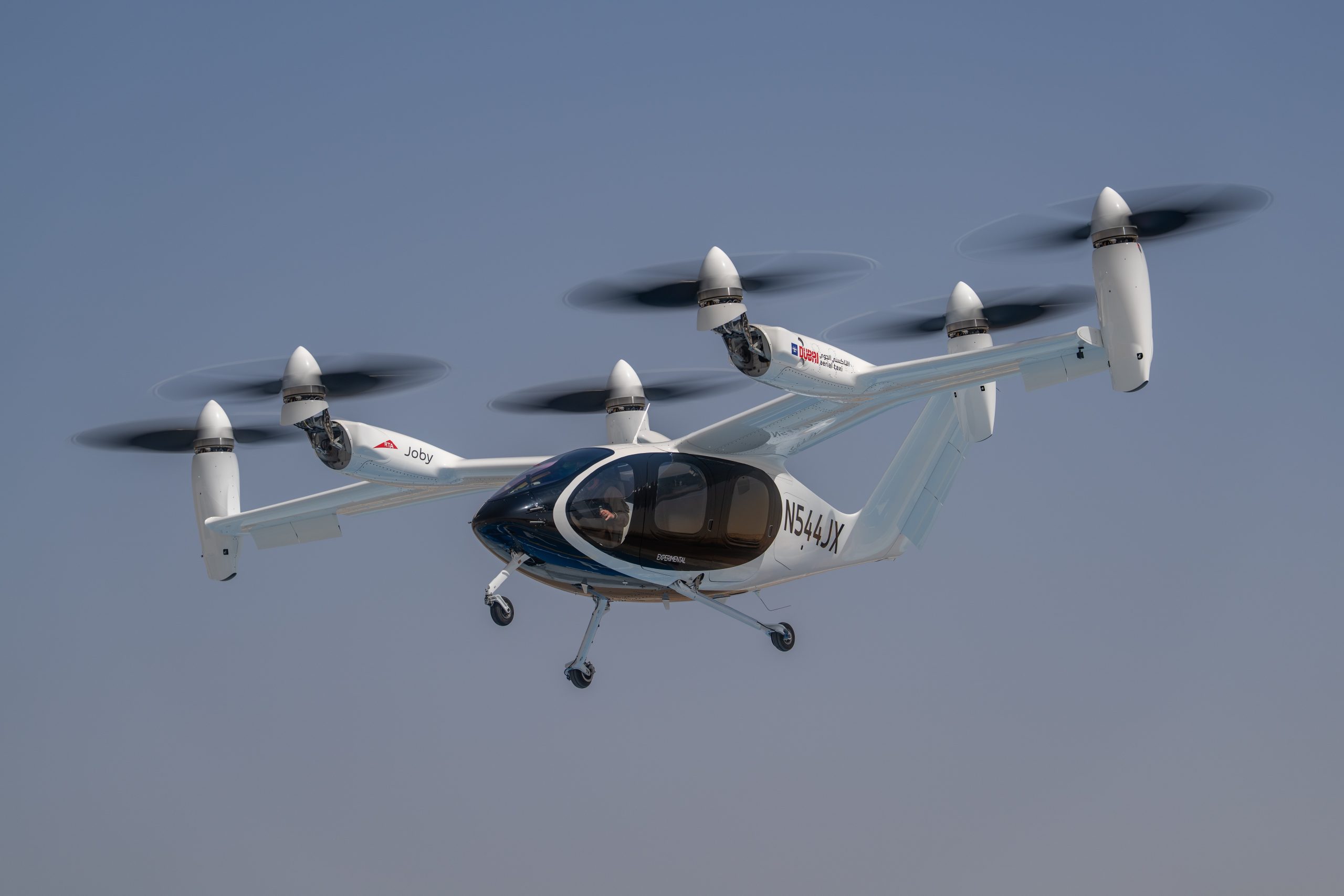
Joby Aviation: The Flying Uber Black
Joby Aviation was founded by JoeBen Bevirt over a decade ago and has been quietly building toward this moment ever since. Their S4 aircraft carries one pilot and four passengers — think of it as a flying Uber Black — and cruises at up to 200 miles per hour with a range of up to 150 miles on a single charge. That’s Los Angeles to San Diego in one hop. Manhattan to the Hamptons. It operates at roughly 45 decibels at cruise altitude, about the sound level of a quiet library, and is 100 times quieter than a conventional helicopter during takeoff and landing. The aircraft recharges in under 20 minutes, designed for rapid back-to-back urban missions rather than single long-haul flights. It is, in the most literal sense, closer to riding in a Tesla than to riding in a helicopter — quiet, smooth, electric, and surprisingly civilized.
As of February 2026, Joby has completed more than 9,000 miles of flight testing across three countries, progressed through four of the FAA’s five certification stages, and begun power-on testing of its first FAA-conforming aircraft for Type Inspection Authorization — the final formal evaluation before a Type Certificate can be issued. FAA pilots are expected to fly the aircraft later in 2026 as part of “for-credit” testing. Joby has also partnered with Delta Air Lines for launch operations in New York and Los Angeles markets, and received exclusive rights to operate in Dubai, where a vertiport network anchored at Dubai International Airport is already under construction with commercial passenger operations targeted for 2026. The White House-backed eVTOL Integration Pilot Program, launched by executive order in 2025, has selected Joby as a participant for pre-certification demonstration operations in the U.S. — meaning passengers could be riding in Joby aircraft in American cities before full FAA Type Certification is even complete.
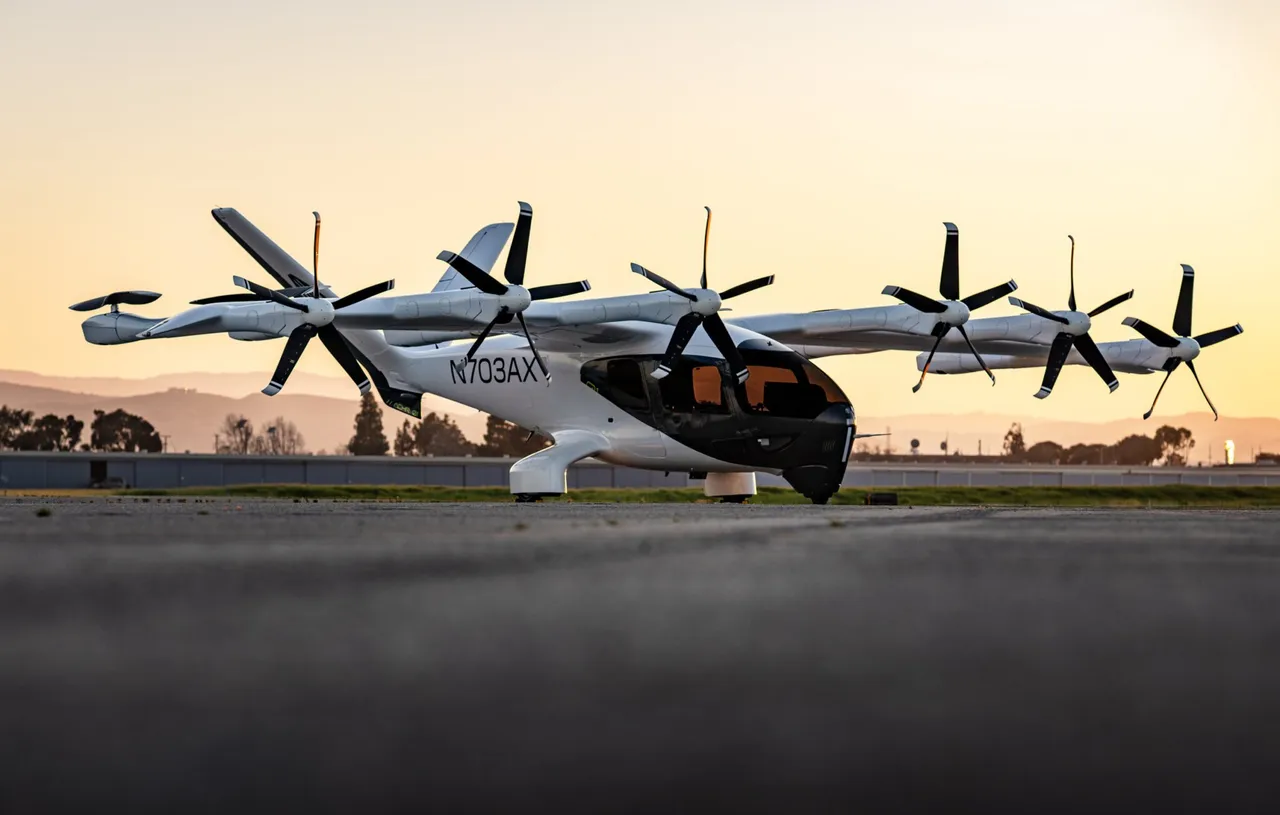
From 90-minute traffic to 15-minute flights—Archer Aviation’s air taxis are targeting the everyday commute, and the Olympics may be the deadline that makes it real.
Archer Aviation: The Olympic Air Taxi
Archer Aviation’s Midnight aircraft is built for a slightly different mission — four passengers and a pilot, up to 60 miles at 150 miles per hour, optimized for the bread-and-butter urban trip: airport to downtown, suburb to business district, across a congested city. Archer’s explicit goal is to replace 60 to 90-minute car commutes with 10 to 20-minute electric air taxi flights. The Midnight uses a 12-engine, 12-propeller configuration — six tilting forward props and six fixed-lift props — that gives it remarkable fault tolerance. If multiple systems fail, the aircraft keeps flying. The FAA has never certified this class of aircraft before: it’s categorized as “powered-lift,” the first new category of civil aircraft since helicopters were introduced in the 1940s, which is partly why the certification process has been demanding and the timeline has been conservative.
In May 2025, Archer was named the Official Air Taxi Provider of the 2028 Los Angeles Olympic and Paralympic Games — an announcement that functions both as a commercial partnership and as a public deadline. The Games are expected to bring more than 15 million visitors to a city already famous for its traffic, and Archer’s plan is to operate vertiport hubs at or near every major Olympic venue: LAX, SoFi Stadium, the Forum, the Intuit Dome, downtown Los Angeles. Archer has already acquired Hawthorne Airport — Jack Northrop Field, less than three miles from LAX — for $126 million and is converting it into the operational hub of its Los Angeles network. First commercial service is planned to launch in Abu Dhabi in 2026, with New York, San Francisco, Los Angeles, and Miami to follow. The 2028 Olympics is the forcing function. Everything is pointed at it.
The Broader Field
Joby and Archer are the two most advanced U.S. players, but they are competing in a global field of serious depth. There are over 500 eVTOL companies active worldwide, of which roughly 20 are credible contenders at the forefront of real development and certification. The rest of the credible field includes Eve Air Mobility, backed by Embraer and targeting 2028 for commercial operations; Wisk, backed by Boeing, which is pursuing a fully autonomous (pilotless) certification — the most ambitious regulatory target in the industry; Vertical Aerospace out of the UK; Volocopter out of Germany; and EHang out of China, which became the world’s first certified eVTOL when China’s Civil Aviation Administration granted its EH216-S type certification in October 2023, following 40,000 test flights in just 31 months. EHang’s aircraft is smaller and slower than the American competitors — it carries two passengers and is designed for shorter urban hops — but it holds the distinction of being the first eVTOL in the world to achieve government certification and enter commercial service. That’s not nothing.
It’s also worth noting what has already failed. Germany’s Lilium, which promised a jet-powered eVTOL with extraordinary range and speed, declared insolvency in November 2024 after failing to secure EASA approval in time. The Paris 2024 Olympics were supposed to feature Volocopter flights over the Seine — what actually happened was a single demonstration ascent from the Palace of Versailles with no passengers aboard. These are not reasons for despair, but they are reasons for calibration. The gap between a credible aircraft and a commercially operating service is substantial, and the companies that have crossed it are the ones that deserve the most attention.
What This Actually Is
Here is the insight that most coverage of the eVTOL industry consistently misses: this is not a transportation story. This is an urban redesign story. And the key to understanding why lies in a single observation about American geography.
Fly across the United States in a commercial airplane and look out the window for any extended period. What you see is emptiness. Vast, unoccupied, beautiful emptiness. Fields and forests and plains and mountains extending to every horizon with no people in sight. The United States has an average population density of roughly 94 people per square mile — comparable to countries like Chad and Bolivia. We are not running out of land. We are not crowded. We have an almost incomprehensible abundance of space relative to our population.
And yet we behave as though land is scarce, because in the places where we want to be — near jobs, near amenities, near opportunity — it is genuinely scarce, and the reason it’s scarce is not that there isn’t enough of it. It’s that we haven’t been able to move people efficiently enough to make more of it usable. The constraint has never been land. It has been mobility. Distance — specifically, the cost and time of covering distance — determines where people can live, which determines where density accumulates, which determines where land prices spike, which drives out the people who can’t afford the prices, which concentrates poverty and limits opportunity.
eVTOL aircraft don’t solve a transportation problem. They dissolve a constraint. When a 60-minute gridlocked car commute becomes a 12-minute aerial hop, the geography of where people can reasonably live relative to where they work expands dramatically. A home 40 miles from a city center that was previously inaccessible for a daily commuter becomes viable. Land that was functionally isolated by distance and traffic becomes accessible. The radius of what counts as “near” a major economic hub expands — not by improving roads or building rail, but by making the air usable for everyday civilian transportation at a cost that approaches ground-level alternatives.
What Happens When Land Becomes Abundant
If eVTOL networks achieve the scale their developers envision, the downstream effects cascade through multiple industries and social systems simultaneously.
Real estate is the most immediate and most dramatic. Urban core premium — the price markup that proximity to a city center commands — is fundamentally a function of accessibility. When aerial mobility makes 40 miles feel like 10, the concentric rings of pricing that currently define metropolitan real estate markets spread outward. Places that were genuinely remote become genuinely accessible. This doesn’t mean city centers empty out — density creates value beyond commute convenience — but it means the scarcity premium that drives urban housing costs moderates as the supply of accessible land effectively increases. The same dynamics that the automobile created in the 20th century, expanding functional urban areas by making suburbs accessible, will play out again at a different scale and speed.
Healthcare is the second major domain. One of the most consequential barriers to quality healthcare in the United States is geographic — the distance between patients and the facilities or specialists they need. Rural America is dramatically underserved not primarily because of funding shortages but because the density of need is insufficient to support local facilities and the mobility infrastructure to reach distant ones is inadequate. An eVTOL network connecting rural communities to regional medical centers changes this equation. The same flight that takes a Los Angeles Olympic visitor from LAX to SoFi Stadium in 10 minutes can, in a different configuration, take a patient from a rural county to a trauma center in the time it used to take an ambulance to reach the highway.
Emergency response is the third domain, and arguably the most immediate. Current first responder systems are constrained by road infrastructure — traffic, bridges, the same gridlock that eVTOL aircraft fly over. An aerial first responder network operating alongside traditional ground systems dramatically reduces response times in the scenarios that matter most: cardiac events, stroke, fire, accident. Archer’s LA28 partnership explicitly includes support for emergency services and security — not as a side note but as a core use case. This is where the technology’s societal value is most straightforward and least controversial.

The Honest Timeline
The industry has a credibility problem rooted in years of optimistic timelines that didn’t hold. Joby originally targeted commercial operations in the early 2020s. Archer expected FAA certification in 2025 before the timeline slipped to 2026 or 2027. The 2024 Paris Olympics were supposed to be a showcase for the technology; they were not. Sergio Cecutta of SMG Consulting — who tracks eVTOL manufacturers’ progress with rigorous skepticism — has noted that FAA certification timelines have consistently slipped and that even if Archer achieves certification by 2028, the LA Olympics service is likely to be limited in scale rather than the on-demand urban network the marketing suggests.
That honest assessment is important. But it doesn’t change the underlying reality: the aircraft work, the regulators are engaged and supportive, the White House has made urban air mobility a priority through executive order, and the 2028 deadline is creating a convergence of commercial, regulatory, and political pressure that is without precedent in the industry’s history. The FAA is processing four concurrent eVTOL certification applications and has published harmonized certification standards with regulators in Canada, Australia, New Zealand, and the UK. This is not a technology looking for a path. It is a technology on a path, moving through the last and hardest miles before commercial arrival.
The most accurate prediction I can make is this: sometime between 2026 and 2029, a person in an American city will book an air taxi on their phone, walk to a vertiport, board a quiet electric aircraft, and arrive at their destination in a fraction of the time ground transportation would have required. It will be covered extensively. It will feel futuristic and completely natural at the same time — the way the first Uber ride felt in 2010, like something that should have already existed. And then, over the following years, the network will expand, the prices will fall, the routes will multiply, and at some point people will stop marveling at it and start building their lives around it. That is when the real story begins — not the technology story, but the city story, the land story, the opportunity story. We don’t have a land scarcity problem. We have a mobility problem. And we’re about to solve it.
Archer Selected as the Official Air Taxi Provider of the LA28 Olympic and Paralympic Games
LA28 / Archer Aviation — The official announcement, partnership scope, and what Midnight’s Olympic role actually involves
Joby Aviation: U.S. Government’s Advanced Air Mobility Plan is a Pivotal Step Toward Commercial Launch
Joby Aviation — The White House eIPP program, FAA certification progress, and Joby’s view of 2026 as an inflection point
Electric Aircraft Taxis Face Olympic-Sized Challenge
Flying Magazine — The honest assessment: what Archer and Joby still need to accomplish and why industry analysts are urging caution on 2028 scale
