
By Futurist Thomas Frey
Why We Don’t Need Flying Cars When We Have Pilotless Drones
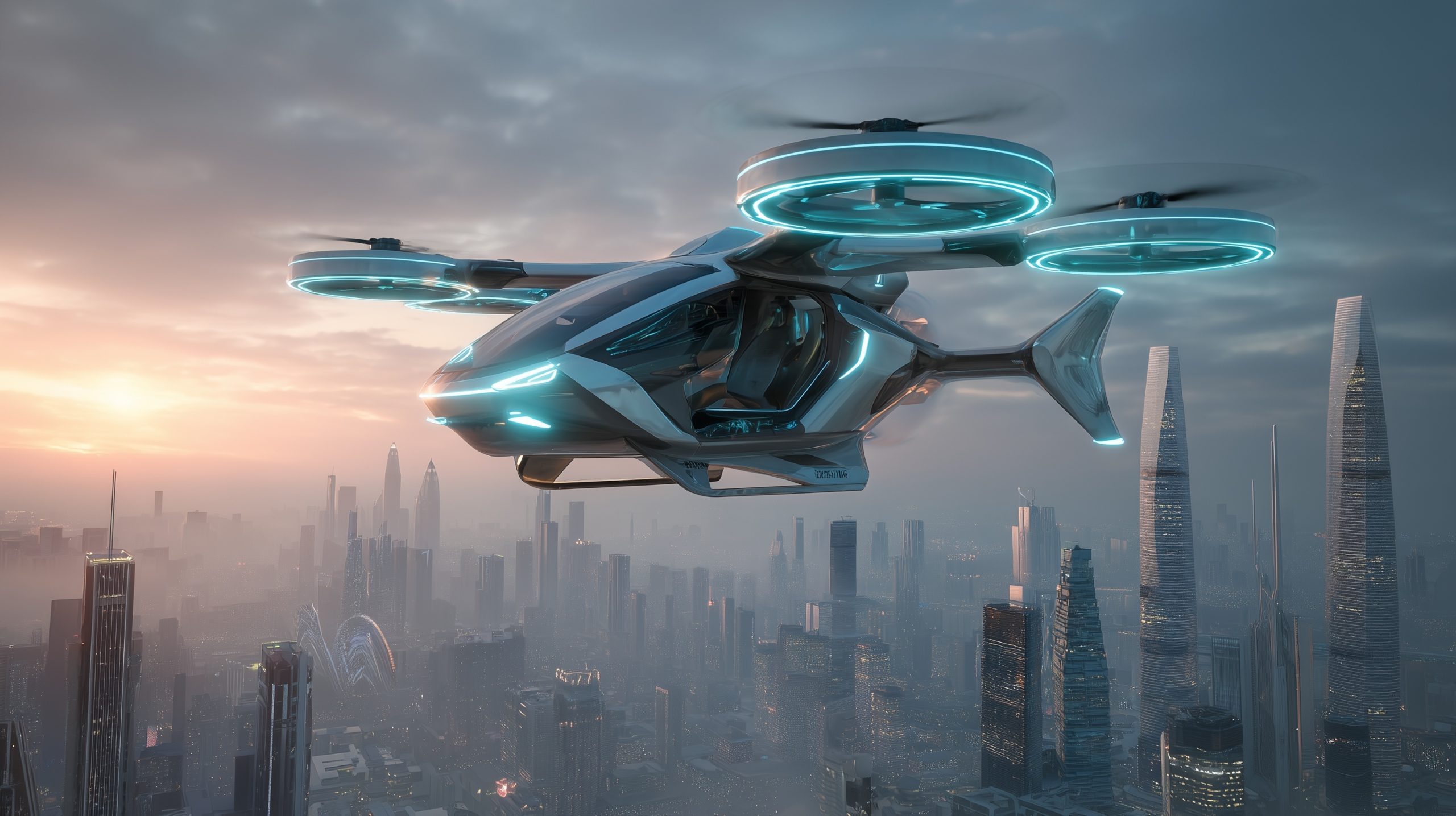
Forget flying cars—they’re an engineering nightmare that solves nothing. Heavy, inefficient, dangerous, and requiring massive energy to keep them aloft. The real revolution is pilotless drones optimized for passengers, and they’re maybe a decade from widespread deployment. But the harder question isn’t building the drones—it’s figuring out where they can operate and how we control airspace when thousands of autonomous aircraft occupy the same sky simultaneously.
Can drones land in your driveway? Pick you up from your backyard? Or will we need droneports requiring ground transportation to reach, defeating the entire convenience proposition? The answer determines whether drone transport becomes ubiquitous or just another niche service for people near specialized infrastructure.
The breakthrough concept might be what I call the Norman Matrix—named after my father, Norman Frey—a system of directional air layering where every altitude corresponds to a specific compass heading. Everything flying at 1,000 feet goes due north. At 1,010 feet, aircraft fly one degree east of due north. At 1,020 feet, two degrees east. Continue the pattern through 360 degrees and you’ve created a self-organizing airspace where altitude determines direction, eliminating the need for complex traffic control.
How the Norman Matrix Actually Works
Picture airspace divided into ten-foot altitude bands from ground level to perhaps 5,000 feet—the range where personal drones will operate. Each band corresponds to a specific compass heading in one-degree increments. Since a full circle contains 360 degrees, you cycle through all directions every 3,600 feet of altitude.
A drone traveling from downtown to the suburbs doesn’t file a flight plan—it calculates the required heading, climbs to the corresponding altitude, travels in a straight line at constant elevation, then descends when approaching destination. If you need to travel northeast (45 degrees), you climb to 1,450 feet. Southwest (225 degrees)? That’s 3,250 feet. The system is self-enforcing because drones can’t maintain altitude without active control, so deviation from assigned heading-altitude pairs becomes immediately obvious to monitoring systems.
Conflicts become geometrically impossible. Two drones at the same altitude must be traveling the same direction, so they can’t collide head-on. Crossing traffic occurs at different altitudes with vertical separation built into the system. The only collision risk is same-direction drones at the same altitude, which is manageable through spacing algorithms that adjust speed rather than routing.
Residential Landing: The Make-or-Break Question
The Norman Matrix solves air traffic control, but the killer question remains: can drones land at your house? If they can’t, if you need ground transportation to reach droneports, the convenience advantage mostly disappears. Why drive twenty minutes to a droneport when you could drive forty minutes to your destination?
The technical answer is yes—modern drones can land in spaces not much larger than a parking spot. The regulatory answer is far more complicated. Residential landings create noise pollution, safety risks from malfunctioning drones crashing into homes, and privacy concerns from aircraft constantly hovering near windows.
The solution likely splits into tiers. Urban dense areas require droneports—rooftop facilities on commercial buildings where vertical takeoff and landing happens away from residential zones. Suburban areas with larger lots allow residential landing pads, probably regulated similarly to helipads with setback requirements and noise restrictions. Rural areas operate with minimal restrictions because there’s space and fewer neighbors to disturb.
This means drone transport looks different depending on where you live. City dwellers still need ground transportation to droneports, limiting convenience. Suburban residents can summon drones to their homes, making the service genuinely door-to-door. Rural residents get maximum flexibility but probably have less frequent service because demand is dispersed.
The Control Systems Nobody’s Building Yet
The Norman Matrix creates elegant self-organization, but it still requires monitoring. Enforcement drones patrol altitude bands, identifying aircraft deviating from assigned headings and either correcting them remotely or forcing emergency landings. Ground-based radar tracks everything in the air, cross-referencing actual positions against filed flight plans.
Weather creates complications. Strong winds at certain altitudes might make assigned headings unsafe or impossible to maintain. The system needs dynamic altitude restrictions that close specific bands during adverse conditions, requiring drones to recalculate routes using available altitudes.
The Norman Matrix works because it’s simple enough that drones can navigate it autonomously without constant communication with central control. Calculate heading, climb to corresponding altitude, travel straight, descend at destination. No complex routing, no dynamic traffic management, no air traffic controllers managing hundreds of aircraft simultaneously. Just geometric elegance that scales naturally as drone traffic increases.
Final Thoughts
We won’t have flying cars, but we’ll have pilotless passenger drones operating through directionally layered airspace that makes traffic control geometrically elegant rather than computationally complex. Whether you can summon drones to your house or need to travel to droneports determines if this becomes transformative or just marginally convenient.
The Norman Matrix—directional air layering where altitude determines heading—might be the key to making it work at scale. It’s simple enough that autonomous systems can navigate it without constant oversight, robust enough to handle thousands of aircraft simultaneously, and elegant enough that it feels obvious once you understand it.
After all, the best solutions to complex problems are usually the ones that make you wonder why nobody thought of them sooner.
Related Articles:
When Machines Start Talking to Each Other: The Bizarre Choreography of Autonomous Everything
When Borders Become Meaningless: Which Countries Survive the AI Transition?
When Swarms of Micro-Drones Become Your Personal Army: The Timeline and Terror of Swarmbots
