By Futurist Thomas Frey
The Moment Personal Aviation Became Sport
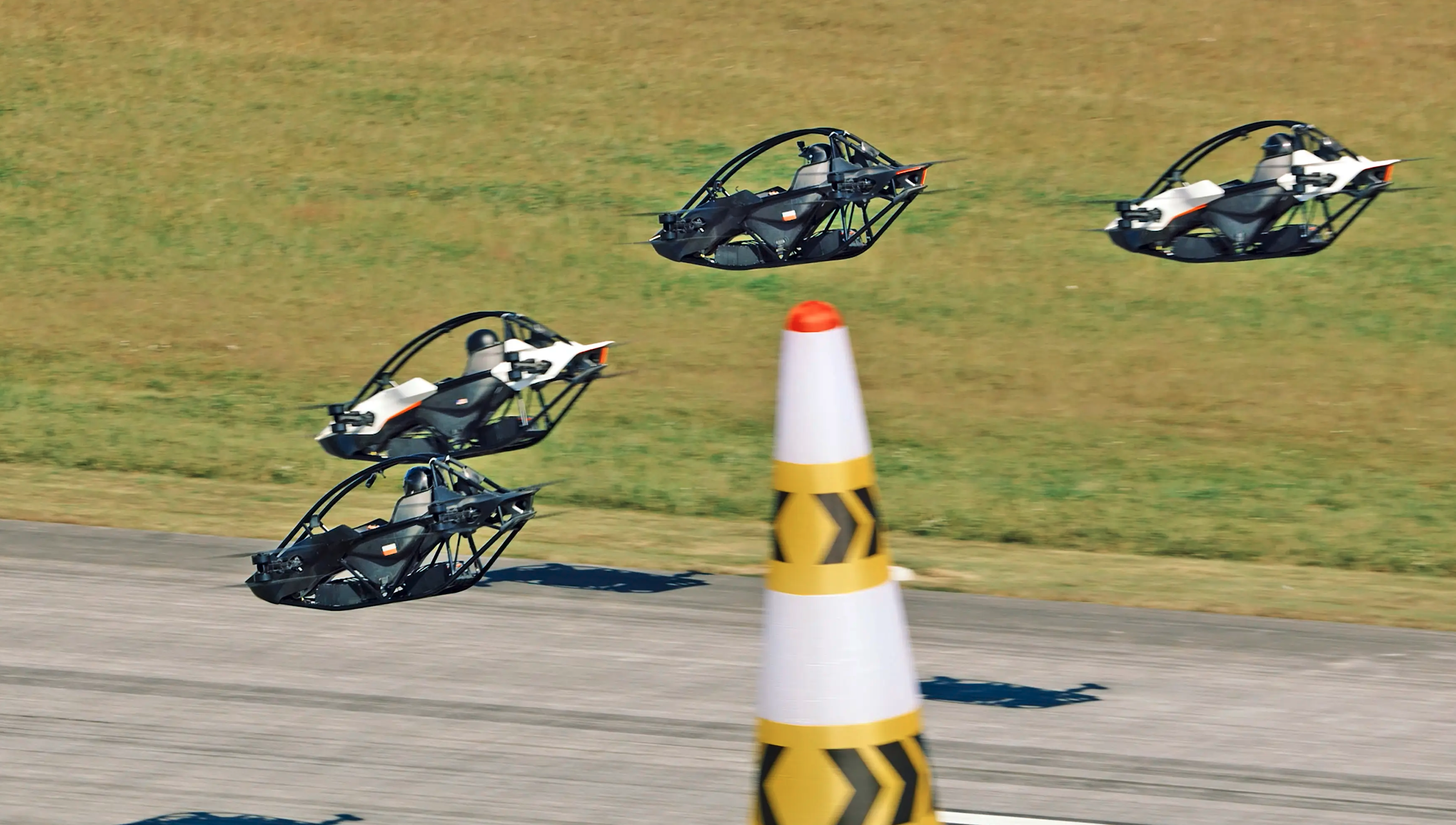
Four electric vertical take-off aircraft screaming through a pylon course in formation flight. Pilots banking hard around checkpoints. The crowd roaring as Jetson’s founder Tomasz Patan pulls a solo aerial display that looks like something from a science fiction movie. This wasn’t a concept demonstration or computer simulation—it was the world’s first competitive flying car race, held at UP.Summit 2025, and it marks the exact moment personal aviation stopped being experimental technology and became legitimate sport.
The “Jetson Air Games” concept unveiled at UP.Summit represents more than clever marketing for Jetson’s ONE personal electric aircraft. It’s the declaration that we’ve crossed a threshold: the technology works reliably enough, the pilots are skilled enough, and the aircraft are safe enough to race competitively. And once you can race something, once you can turn it into spectacle and competition, mass adoption accelerates exponentially.
Let me walk you through why this demonstration matters far beyond the impressive aerial acrobatics, and what it signals about the timeline for personal aviation becoming accessible reality rather than futuristic fantasy.
Why Racing Changes Everything
Every transformative transportation technology followed the same pattern: racing preceded widespread adoption. Automobiles became socially acceptable after winning public races in the 1890s. Aviation captured imaginations through barnstorming and air racing in the 1920s. Motorcycles, speedboats, even bicycles—competition legitimized the technology by proving reliability, safety, and performance under stress.
Jetson’s pylon race at UP.Summit follows this playbook perfectly. By demonstrating four-ship formation flight and high-speed maneuvering through a marked course, they proved several critical points simultaneously: the aircraft maintain stable flight in proximity to each other, pilots can execute precision maneuvers safely, the systems handle dynamic conditions reliably, and the whole operation can be conducted as public entertainment without incident.
This wasn’t about showing the aircraft can fly—Jetson’s been doing that for years. This was about showing they can fly competitively, repeatedly, safely, in front of crowds. That’s the difference between prototype and product.
The Numbers That Matter
The demonstration’s significance becomes clearer when you understand Jetson’s current position. Nearly 550 units on order representing $75 million in future sales. Deliveries officially begun—with tech entrepreneur Palmer Luckey becoming the first Jetson ONE owner. The company is now taking orders for 2028 delivery, suggesting production scaling is underway rather than aspirational.
This isn’t vaporware. This is a company transitioning from startup to manufacturer, and using competitive aerial demonstration as both marketing strategy and technical validation. The UP.Summit race served dual purpose: generating buzz while proving the technology has matured beyond experimental status.
The Jetson ONE itself remains impressive on specifications: fully electric, single-pilot, vertical take-off and landing capability, designed for recreational flight under ultralight regulations in most jurisdictions. But specs mean nothing without demonstrated reliability, which is exactly what competitive racing provides.
What Happens When Personal Aircraft Become Entertainment
Here’s where it gets interesting for the broader personal aviation industry: once flying becomes spectacle—once crowds gather to watch races, once social media amplifies the imagery, once competition creates heroes and storylines—public perception shifts from “dangerous experimental technology” to “exciting new sport I want to try.”
Red Bull didn’t sponsor extreme sports because energy drinks pair well with base jumping. They recognized that spectacle creates aspiration, aspiration creates participants, and participants become customers for equipment, training, insurance, and entire ecosystems around the activity. Jetson appears to understand this dynamic perfectly.
The “Jetson Air Games” brand isn’t just about races at UP.Summit. It’s framework for recurring competitions, pilot development programs, spectator events, and media content that normalizes personal aviation. When your kids watch TikTok videos of flying car races the same way they watch Formula 1 highlights, the psychological barrier to “normal people flying” dissolves.
The Infrastructure Question Nobody’s Asking
The clever aspect of Jetson’s strategy: they’re creating demand for personal aviation before infrastructure exists to support it. Regulations remain unclear in most jurisdictions. Air traffic management for thousands of personal aircraft doesn’t exist. Charging infrastructure, maintenance networks, pilot training programs—all nascent at best.
But by generating massive public interest through racing spectacle, Jetson creates pressure on regulators and infrastructure providers to catch up. Governments struggle to regulate activities nobody cares about. When hundreds of thousands of people want to buy personal aircraft, suddenly regulatory frameworks materialize, airspace gets allocated, and infrastructure investment follows.
This is classic “build demand, force infrastructure” strategy. Tesla didn’t wait for charging networks to exist before selling electric cars—they created demand that forced charging infrastructure into existence. Jetson appears to be following the same playbook for personal aviation.
The Timeline We’re Actually Looking At
Based on Jetson’s current trajectory and the UP.Summit demonstration, here’s the realistic timeline for personal aviation becoming accessible:
2025-2027: Early adopters and wealthy enthusiasts. Jetson and competitors deliver hundreds of units to customers willing to navigate regulatory complexity and operate in permissive jurisdictions. Racing events proliferate, building public interest.
2027-2030: Regulatory frameworks emerge in progressive countries and states. Pilot training programs standardize. Prices begin dropping as production scales. Thousands of units in operation.
2030-2035: Mass market accessible. Prices under $100,000. Clear regulations. Established infrastructure for charging and maintenance. Tens of thousands flying regularly. Personal aviation shifts from novelty to niche transportation option.
The UP.Summit race in 2025 will be remembered as the inflection point—when personal aviation transitioned from “someday maybe” to “actually happening now.”
Final Thoughts
Jetson’s flying car race wasn’t just marketing spectacle—it was strategic declaration that the technology has matured sufficiently for competitive sport. And competitive sport is how transportation technologies transition from experimental to mainstream.
We’re watching in real-time the same pattern that made automobiles ubiquitous, aviation accessible, and motorcycles mainstream. Create technology. Prove reliability through competition. Generate public enthusiasm. Force infrastructure development. Scale production. Transform society.
The personal aviation revolution doesn’t start when regulations are perfect or infrastructure is complete. It starts when four pilots race through a pylon course in front of cheering crowds and everyone watching realizes: this is actually happening.
That moment was UP.Summit 2025. Everything that follows is simply scaling the inevitable.
Related Articles:
Jetson Completes First-Ever Global Delivery with Tech Visionary Palmer Luckey https://jetson.com/news/jetson-palmer-luckey
Jetson ONE Saving Lives! World’s First eVTOL Mountain Rescue Operations Trials https://jetson.com/news/jetson-mountain-rescue
Jetson Racing Series: Part-Two https://jetson.com/news/jetson-pylon-racing-series-part-two