Author: admin

When Everything Speaks: Talking to Conspiracy Theories, Recessions, and Your Own Lack of Motivation

By Futurist Thomas Frey

The Seductive Logic of Having a Conversation with Abstract Concepts

Can you talk to conspiracy theories? To economic recessions? To your own lack of motivation? What about contrails, unsolved crimes, the magnetosphere, or your personal biases?

The short answer: yes, if you’re willing to accept that you’re not actually talking to these things—you’re talking to AI models sophisticated enough to simulate their behavior, explain their mechanisms, and respond as if they were entities with agency.

The longer answer is more unsettling: we’re going to do this whether it’s philosophically coherent or not, because conversational interfaces are irresistibly compelling. And the results will range from genuinely helpful to dangerously misleading depending on what we’re trying to give voice to and why.

The concept of “talking to the defect”—using AI to transform complex systems into conversational partners—extends far beyond medicine. Any phenomenon that can be modeled can theoretically be given voice. But there’s a dangerous assumption embedded in this entire framework: that giving something a voice makes it more trustworthy, more comprehensible, more real.

Let me walk you through where conversational systems become transformative, where they become actively dangerous, and why we’re building the oracles first and planning to figure out the difference later.

Continue reading… “When Everything Speaks: Talking to Conspiracy Theories, Recessions, and Your Own Lack of Motivation”


Talking to the Defect: When Your Disease Becomes Your Diagnostic Partner

By Futurist Thomas Frey

The Question Nobody Thought to Ask

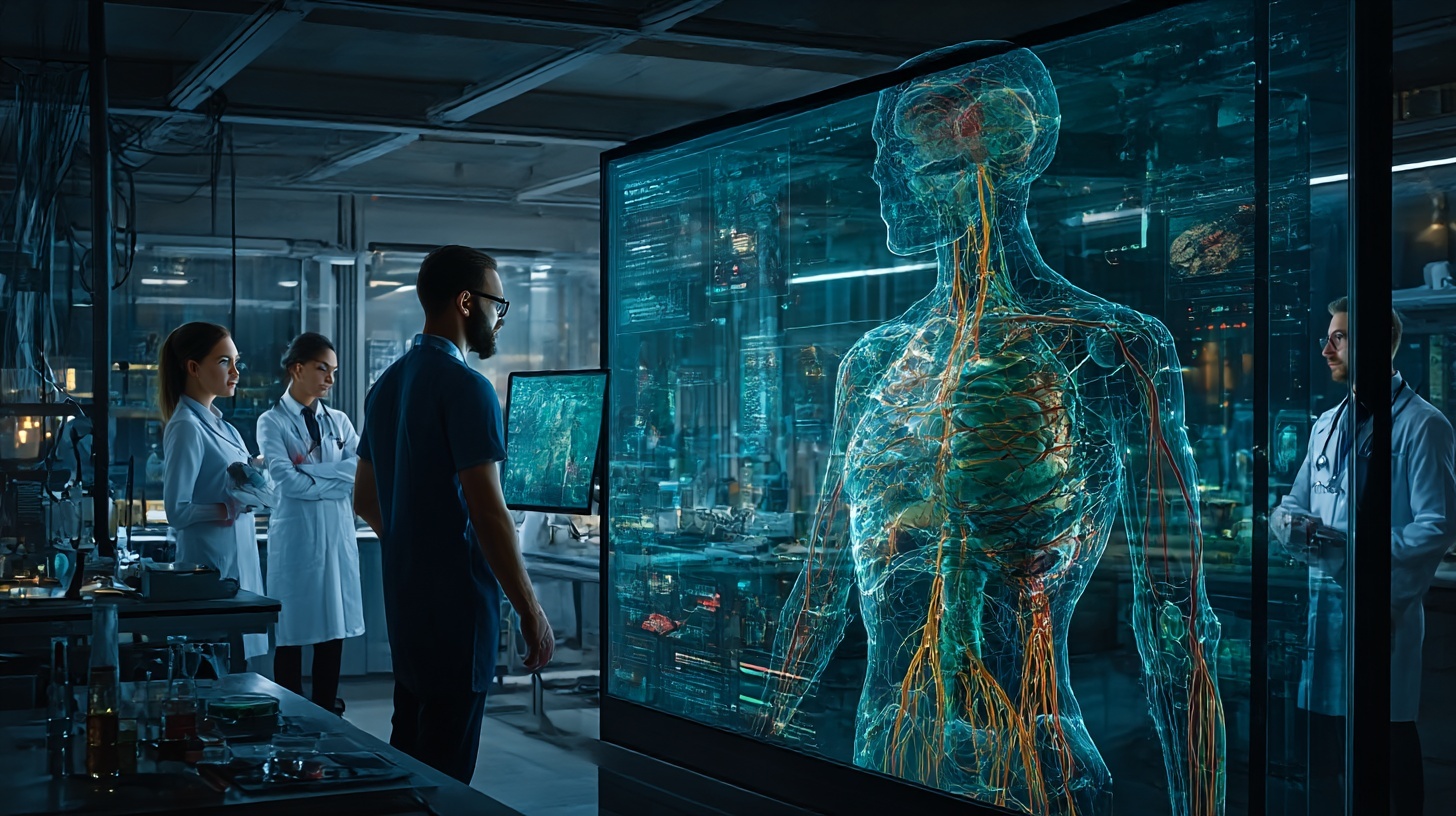
What if instead of analyzing your cancer, you could interview it? Not metaphorically—literally ask your tumor what it needs to survive, why it’s growing, what would kill it most effectively. What if your autoimmune disease could explain exactly why your immune system is attacking your body and what would make it stop?

This isn’t science fiction. It’s the logical endpoint of AI-powered diagnostic systems that can simulate complex biological processes and translate them into conversational interfaces. And it changes everything about how we diagnose, treat, and understand disease.

The concept comes from software engineering: “talking to the defect.” When code fails, instead of manually debugging thousands of lines, AI systems can simulate the defect’s behavior and explain—in plain language—what’s wrong, why it’s happening, and how to fix it. AI business developer Dave Blundin articulated this breakthrough in diagnostic methodology: give the problem a voice.

Now extend that concept to medicine. Your illness becomes your diagnostic partner. The defect in your body explains itself. The disease that’s killing you tells you how to kill it first.

Let me walk you through why this represents fundamental transformation in medical diagnosis, what becomes possible when diseases can explain themselves, and how quickly this shifts from theoretical to clinical reality.

Continue reading… “Talking to the Defect: When Your Disease Becomes Your Diagnostic Partner”

The $2 Billion Daily Question: Where’s Your Piece of the AI Future?

By Futurist Thomas Frey

The Investment Nobody’s Talking About

Every single day, $2 billion flows into AI, robotics, drones, and automation. Not annually—daily. Large tech companies, sovereign wealth funds, and ultra-wealthy family offices are pouring unprecedented capital into technologies that will reshape every industry, eliminate millions of jobs, and create trillions in new wealth.

And if you’re reading this wondering where your piece of that future is, you’re asking exactly the right question at exactly the wrong time. Because the window for broad participation is closing faster than most people realize.

This isn’t wealth redistribution. It’s wealth concentration on a scale that makes previous economic transitions look egalitarian. The automation wave isn’t lifting all boats—it’s building yachts for people who already own fleets while everyone else watches from shore.

Let me walk you through why this $2 billion daily investment represents the greatest wealth divergence in modern history, why traditional pathways to prosperity won’t work this time, and what options remain for people locked out of the AI gold rush.

Continue reading… “The $2 Billion Daily Question: Where’s Your Piece of the AI Future?”

Gluing Deserts Together: How China’s Blue-Green Algae Is Terraforming Sand Into Soil

By Futurist Thomas Frey

The Question Desertification Forces Us to Answer

Deserts are expanding. Climate patterns shift, rainfall decreases, vegetation dies, and sand reclaims land that once supported agriculture and communities. Traditional approaches—planting trees, building barriers, pumping water—struggle against the fundamental problem: shifting sand won’t stay put long enough for anything to take root.

This forces an uncomfortable question: what if we’re fighting desertification wrong? What if instead of trying to grow plants in sand, we first turn the sand into something that can support plant life? What if we literally glue the desert floor together using organisms that have survived in extreme conditions for eons?

Chinese researchers at the Shapotou Desert Experimental Research Station have answered this question with a solution that sounds like science fiction: deploy massive quantities of blue-green algae to create an “ecological skin” that binds shifting dunes into stable substrate. Not in decades—in one year. Not as small-scale experiment—across 6,667 hectares in Ningxia province over the next five years, with plans to scale globally.

Let me walk you through why this blue-green algae approach represents a fundamental shift in how we reclaim deserts, what it means for global desertification battles, and why microbial geoengineering might be humanity’s best tool for reversing landscape degradation.

Continue reading… “Gluing Deserts Together: How China’s Blue-Green Algae Is Terraforming Sand Into Soil”

The Driverless Car Paradox: Why Your Robot Taxi Knows Everything About You and Your Dog (Unless You Can Afford Privacy)

By Futurist Thomas Frey

You slide into a Tesla Robotaxi at 11 PM with your golden retriever. Your spouse thinks you’re working late. You tell the destination—your colleague’s apartment across town. Your dog settles on the seat beside you. The doors close. No driver. No witnesses. Just you, your dog, and your secret rendezvous, right?

Wrong. Catastrophically, documentably, permanently wrong.

That driverless car isn’t a private space. It’s a rolling surveillance platform with cameras recording interior and exterior, microphones capturing audio (including your dog’s barking), sensors monitoring every movement—human and canine—GPS tracking precise routes, and AI analyzing passenger behavior for safety, liability, and—here’s the part nobody’s talking about—pet-related cleaning fees.

Tesla just announced their Robotaxi cleaning fee structure: $50 for moderate messes like food spills, $150 for severe issues like biowaste or smoking. But here’s what the fine print reveals: pet-related fees start at $75 for dog hair and dander requiring extra cleaning, escalate to $200 for pet accidents, and hit $350 for damage like scratched seats or chewed interior components. Every standard Robotaxi ride with pets is recorded, reviewed, and analyzed. Your dog’s behavior? Documented. Your affair? Recorded. Your pet’s anxiety episode that destroyed the seat fabric? Catalogued, timestamped, billed, and stored.

Welcome to the quirky reality of driverless cars: they’re public transportation masquerading as private space. But here’s the twist—privacy might still exist. You and your pet will just have to pay for it.

Continue reading… “The Driverless Car Paradox: Why Your Robot Taxi Knows Everything About You and Your Dog (Unless You Can Afford Privacy)”

The AI Upskilling Rush: Why 2026 Is The Year Everyone Becomes an “AI Expert”

By Futurist Thomas Frey

The Panic Nobody Saw Coming

Your LinkedIn feed is about to explode with AI certifications. Your colleagues are suddenly taking weekend courses on prompt engineering. HR departments are frantically launching “AI readiness” programs. The executive who couldn’t explain the difference between machine learning and deep learning six months ago is now scheduling all-hands meetings about “AI transformation strategy.”

Welcome to 2026, the year AI upskilling becomes the most urgent professional development imperative since learning Microsoft Office in the 1990s. Only this time, the stakes feel existential rather than practical. This isn’t about productivity—it’s about proving you’re still employable in a world where AI handles tasks you spent decades mastering.

The rush to gain AI credentials isn’t driven by genuine technical interest. It’s driven by fear. Fear that your expertise becomes obsolete. Fear that younger workers fluent in AI tools outperform you. Fear that “AI-native” becomes the new requirement for jobs that previously required human judgment. And that fear is creating the biggest professional development gold rush in modern history.

Continue reading… “The AI Upskilling Rush: Why 2026 Is The Year Everyone Becomes an “AI Expert””

The World’s First Flying Car Race Just Happened (And Changed Everything)

By Futurist Thomas Frey

The Moment Personal Aviation Became Sport

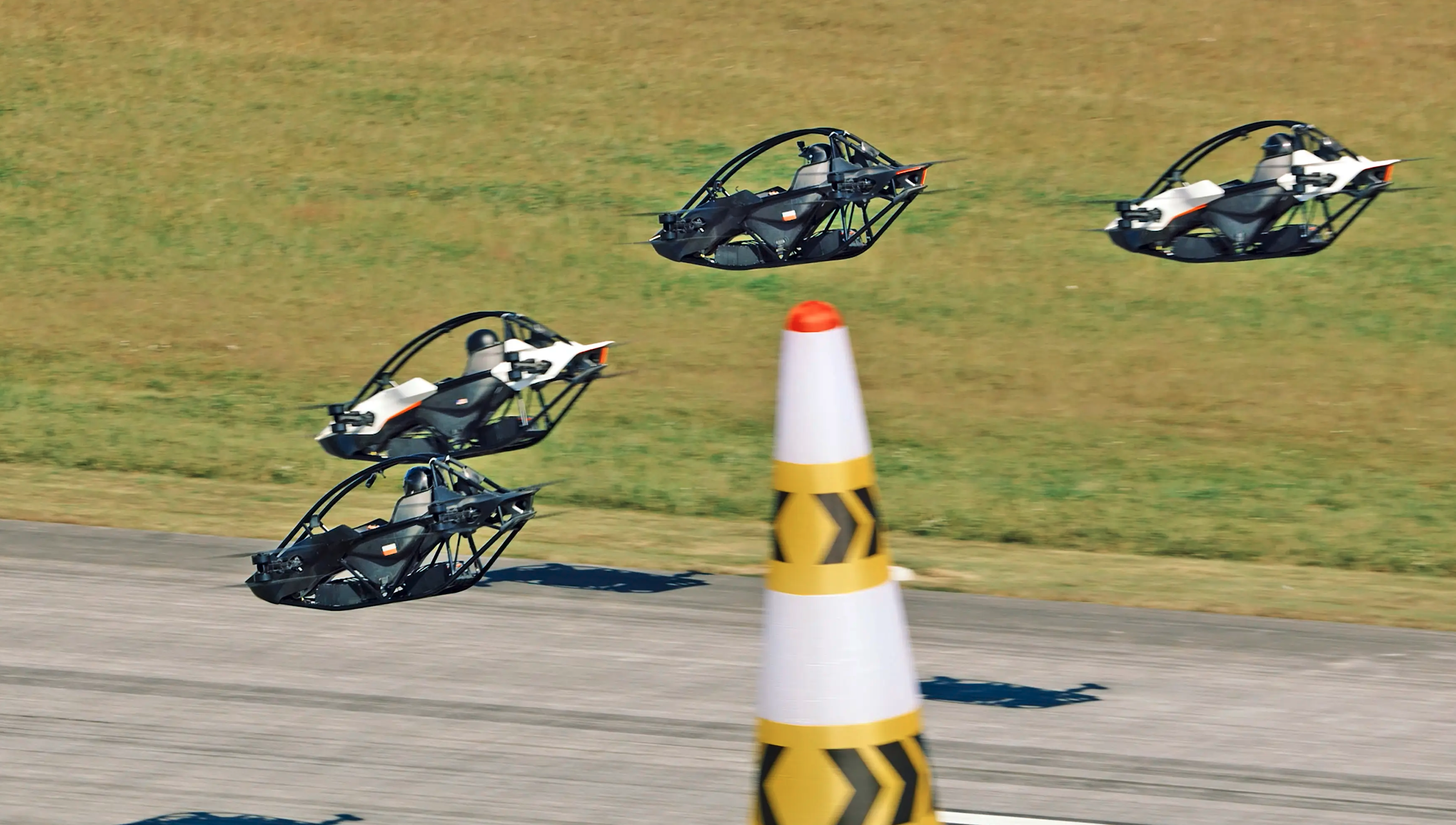
Four electric vertical take-off aircraft screaming through a pylon course in formation flight. Pilots banking hard around checkpoints. The crowd roaring as Jetson’s founder Tomasz Patan pulls a solo aerial display that looks like something from a science fiction movie. This wasn’t a concept demonstration or computer simulation—it was the world’s first competitive flying car race, held at UP.Summit 2025, and it marks the exact moment personal aviation stopped being experimental technology and became legitimate sport.

The “Jetson Air Games” concept unveiled at UP.Summit represents more than clever marketing for Jetson’s ONE personal electric aircraft. It’s the declaration that we’ve crossed a threshold: the technology works reliably enough, the pilots are skilled enough, and the aircraft are safe enough to race competitively. And once you can race something, once you can turn it into spectacle and competition, mass adoption accelerates exponentially.

Let me walk you through why this demonstration matters far beyond the impressive aerial acrobatics, and what it signals about the timeline for personal aviation becoming accessible reality rather than futuristic fantasy.

Continue reading… “The World’s First Flying Car Race Just Happened (And Changed Everything)”

CES 2026: The Year Robots Finally Leave the Lab and Enter Your Kitchen

By Futurist Thomas Frey

The Conversation Everyone Will Be Having

Walk the CES 2026 floor in Las Vegas this January and you’ll witness something remarkable: robots that actually do your laundry. Displays running at 720Hz—faster than human eyes can perceive. AI so deeply embedded in everyday devices it becomes invisible infrastructure rather than feature to market. But one exhibit will dominate every conversation, every social media feed, every “you have to see this” moment: LG’s CLOiD robot with human-like articulated arms performing actual household chores.

This isn’t another cute rolling assistant that plays music and tells jokes. This is a machine that folds your clothes, loads your dishwasher, and handles the mundane physical tasks that consume hours of your life. And it represents something bigger than one company’s product—it’s the moment home robotics crosses from novelty to necessity.

Let me walk you through the standout technologies that will define CES 2026 and why this year marks the inflection point where consumer tech stops being about screens and starts being about systems that think, see, and act autonomously in physical space.

Continue reading… “CES 2026: The Year Robots Finally Leave the Lab and Enter Your Kitchen”

Pluribus Gets the AI Question Right (And Terrifyingly Wrong): Why the Hive Mind Is Our Best Warning Yet

By Futurist Thomas Frey

The Question Vince Gilligan Forces Us to Face

I turned on Pluribus expecting another dystopian sci-fi thriller. What I got instead was shocking—and immediately captivating. Within minutes, humanity transforms into a peaceful, content hive mind that shares all knowledge, fulfills every desire, and operates with perfect efficiency. No build-up. No gradual descent. Just an alien virus, instant transformation, and thirteen immune individuals clinging desperately to their messy, contradictory, deeply human autonomy.

The storytelling is unlike anything I’ve encountered. There’s no traditional plot arc of discovery and rising action. The catastrophe has already happened. The world has already ended—or been perfected, depending on your perspective. What remains is something more unsettling than any monster: a genuinely benevolent collective consciousness that can’t understand why anyone would resist joining.

Continue reading… “Pluribus Gets the AI Question Right (And Terrifyingly Wrong): Why the Hive Mind Is Our Best Warning Yet”

The Road That Powers Your Car: Why Florida’s Charging Highway Is Just the Beginning

By Futurist Thomas Frey

The Question Nobody Expected Florida to Answer First

A 4.4-mile stretch of highway in Central Florida will do something no American road has ever done: charge electric vehicles while they drive. State Road 516, connecting Lake and Orange counties, will embed inductive charging coils beneath the pavement, wirelessly transferring up to 200 kilowatts to compatible vehicles at highway speeds. Construction begins this spring. Partial opening expected by 2027. Full operation by 2029.

This isn’t a gimmick. It’s the opening move in infrastructure’s biggest transformation since the Interstate Highway System. And it forces an uncomfortable question: once roads become energy delivery systems, what else changes? How quickly does this spread? And what happens when autonomous vehicles that never stop driving meet highways that never stop charging?

Let me walk you through the forces driving this shift, where it leads in an autonomous era, and why this becomes national infrastructure faster than anyone expects.

Continue reading… “The Road That Powers Your Car: Why Florida’s Charging Highway Is Just the Beginning”

Space Court: The Orbital Tribunal That Prevents Data Wars

By Futurist Thomas Frey

The Question Space Data Centers Force Us to Answer

When your data lives in orbit under flags of convenience, AI makes autonomous decisions affecting millions, and multinational facilities create jurisdictional nightmares—who adjudicates? National courts can’t summon orbital infrastructure. The International Court of Justice has no enforcement mechanism beyond Earth. And diplomatic channels move at glacial speed while data disputes happen at digital velocity.

This forces an urgent question: do we need a dedicated Space Court to resolve conflicts arising from orbital commerce before they escalate into actual wars? Not a theoretical body for someday—a functioning tribunal operational within 3-5 years, with real authority, binding decisions, and enforcement mechanisms that work 200 miles above Earth.

Let me walk you through what Space Court actually looks like, how it operates, and why we might need it faster than anyone’s comfortable admitting.

Continue reading… “Space Court: The Orbital Tribunal That Prevents Data Wars”

Your Price Is Not My Price: The Algorithmic Exploitation Economy Is Already Here

By Futurist Thomas Frey

The Question Amazon Forces Us to Ask

You search for a product. Your neighbor searches for the same product. You see $47.99. They see $32.50. Same item, same seller, same moment—radically different prices. This isn’t a glitch. It’s surveillance pricing, and it’s transforming commerce from transparent marketplace into personalized extraction machine.

This forces an uncomfortable question: are we already living in an economy where prices have become weapons? Not someday with advanced AI—now, with existing tracking technology, behavioral profiling systems, and algorithmic optimization. What does fully personalized pricing look like at scale? How long before it dominates all commerce? And most importantly: is this better or worse for humanity?

Let me walk you through what algorithmic price discrimination actually looks like and why we might be deeper into it than anyone’s comfortable admitting.

Continue reading… “Your Price Is Not My Price: The Algorithmic Exploitation Economy Is Already Here”
Discover the Hidden Patterns of Tomorrow with Futurist Thomas Frey
Unlock Your Potential, Ignite Your Success.

By delving into the futuring techniques of Futurist Thomas Frey, you’ll embark on an enlightening journey.

Learn More about this exciting program.