MIT is building a ‘one-stop shop’ for 3D-printing robots

By Brian Heater

Additive manufacturing has proven an ideal solution for certain tasks, but the technology still lacks more traditional methods in a number of categories. One of the biggest is the requirement for post-printing assembly. 3D printers can create extremely complex components, but an outside party (be it human or machine) is required to put them together.

MIT’s CSAIL department this week showcased “LaserFactory,” a new project that attempts to develop robotics, drones and other machines than can be fabricated as part of a “one-stop shop.” The system is comprised of a software kit and hardware platform designed to create structures and assemble circuitry and sensors for the machine.

A more fully realized version of the project will be showcased at an event in May, but the team is pulling back the curtain a bit to show what the concept looks like in practice. Here’s a breakdown from CSAIL’s page:

Continue reading… “MIT is building a ‘one-stop shop’ for 3D-printing robots”
A 3D printed house is for sale in New York. Builders say it will cut housing construction costs

The Riverhead, New York, home is listed online through Zillow with an asking price of $299,999. 

By Cole Higgins, CNN

(CNN)You’ve probably heard of 3D printed face masks and even 3D printed hands, as 3D printing technology has expanded over the past few decades. Now a company says it has listed the first 3D printed house in the United States for sale. The Riverhead, New York, home is listed online through Zillow with an asking price of $299,999. “This is the future, there is no doubt about it,” says Kirk Andersen, the director of operations at SQ4D Inc.SQ4D uses automated building methods, or 3D printing, to build structures and homes.”What we want to do is print homes fast, and cheap and strong,” Andersen said.

Continue reading… “A 3D printed house is for sale in New York. Builders say it will cut housing construction costs”

Researchers create a 3D-printed bioresorbable airway stent

By Shane McGlaun 

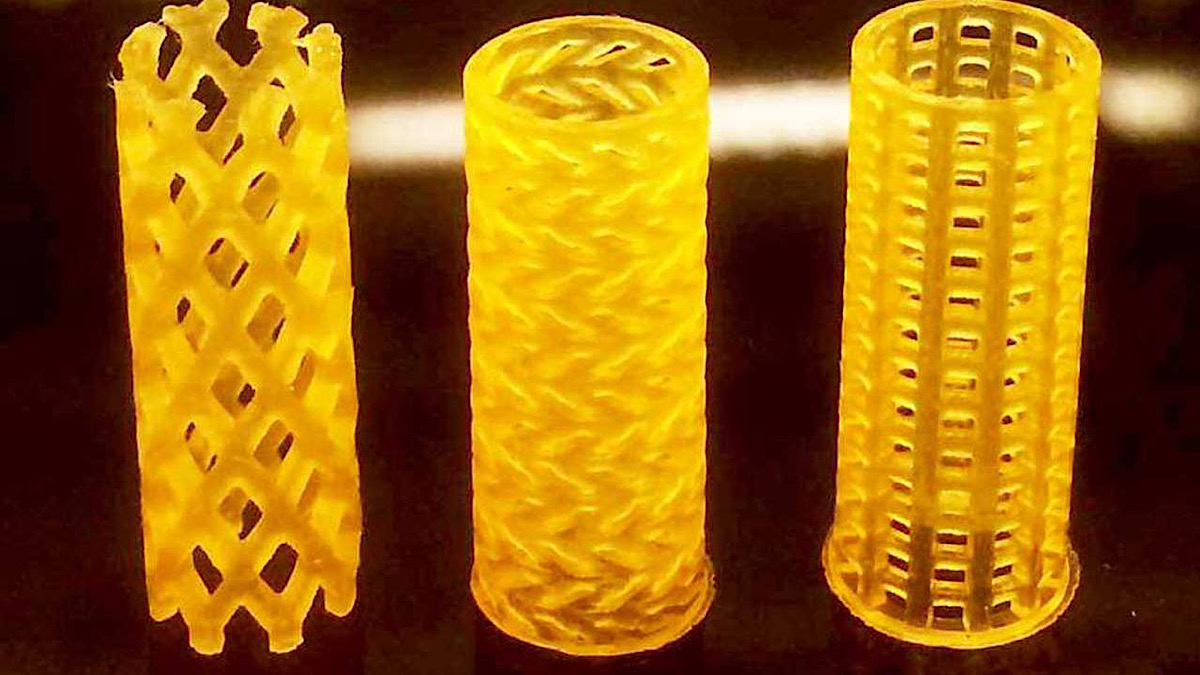
Researchers from ETH Zürich created a new 3D-printed airway stent that is bioresorbable. Researchers believe the new stent could simplify the future treatment of upper airway obstruction. The new device is usable for treating narrowing of the trachea or the main bronchi due to injury or illness.

This type of injury or illness can lead to death because it can restrict the amount of oxygen the person gets to the brain. Today, surgeons use stents made of silicone or metal as a way to treat those patients. However, metal stents have to be removed surgically when they’re no longer needed leading to the potential for infections and surgical difficulties.

Silicone stents can migrate away from the insertion site. Researchers say that is because the implants aren’t adapted to the patient’s anatomy. The new stent developed by the researchers is tailored specifically to the patient and is bioresorbable. Being bioresorbable is important because it allows the stent to gradually dissolve after it’s implanted.

The 3D printing process used to create the stent is known as digital light processing and uses light-sensitive resins that have been adapted specifically to this purpose. The process requires researchers to create a computer tomography image of a specific section of the airway. That image is used to develop the 3D model for the stent before transferring the data to the DLP printer.

Continue reading… “Researchers create a 3D-printed bioresorbable airway stent”

A 3D PRINTED GLOBAL HOUSING COMMUNITY IS BEING CONSTRUCTED IN ITALY FOR SUSTAINABLE LIVING!

BY RUCHI THUKRAL  

Sustainable designs are now taking center stage in the design world as we battle the climate crisis affecting several industries. To implement sustainability in architecture is trickier given the scale of design but if we find the right solutions, the impact will also be big enough to cause ripples of positive changes. Fun fact: it is not the aviation industry but actually the construction industry that contributes to the global greenhouse gas emissions and the difference is 2% vs 39%. In fact, cement alone is responsible for 8% of global greenhouse gas emissions which is why the need for more sustainably constructed housing arose. Mario Cucinella Architects and WASP decided to do something about it and designed TECLA – a completely 3D printed global habitat based on natural materials.

TECLA’s construction started as a prototype in 2019 near Bologna, Italy as a response to pressing societal issues of explosive population growth which inevitably led to a lack of affordable accommodation. TECLA is created using entirely reusable, recyclable materials taken from the local terrain – it aims to be a model for circular housing as well as eco-housing. The habitat has been designed by Mario Cucinella Architects and brought to life by WASP’s engineering and printing tech. TECLA is set to be the first house to be entirely 3D-printed using locally sourced clay which has been used for centuries in countries like India as a cost-effective and environmentally friendly alternative to cement – clay is a biodegradable and recyclable material that will make the building a zero-waste structure. The project’s name comes from an imaginary city described by writer Italo Calvino, it will be built using multiple collaborative 3D-printers all working at the same time – a feat in itself given the scale.

Continue reading… “A 3D PRINTED GLOBAL HOUSING COMMUNITY IS BEING CONSTRUCTED IN ITALY FOR SUSTAINABLE LIVING!”

Novameat 3D Prints “World’s Biggest” Cell-Based Meat Prototype

By Vanesa Listek

Alternative meat startup Novameat has unveiled what it calls the world’s biggest piece of cell-based, whole-cut meat analog. Since its foundation in 2018, the Barcelona-based startup has been 3D printing plant-based meat substitutes to combat the unsustainable and insufficient global agricultural system and solve the world’s food supply problem. The news comes weeks after Novameat received €250,000 through the Spanish government to ramp up 3D printed meat production by integrating its microextrusion-technology into higher-output industrial printing machines.

Novameat’s proprietary technology mimics the texture, taste, appearance, and nutritional properties of animal meat products, including beef steaks. Based on CEO and Founder Giuseppe Scionti’s decade-long tissue engineering research, the company’s microextrusion platform takes in vegetable fat (3%), water (72%), and plant protein sources (25%) to print a meat fiber matrix that looks and tastes like the real thing.

Novameat released the “world’s biggest piece of cell-based whole cut analog meat.

In an interview with the media site FoodNavigator, Scionti revealed that Novameat’s latest development, along with the 3D printing technology that created it, could be a game-changer for the cultured meat industry. Scionti referred to his new product as a “hybrid meat analog” since his company mixed mammalian adipose cells with a biocompatible plant-based large-scale scaffold with a volume of 22,500 mm3.

Continue reading… “Novameat 3D Prints “World’s Biggest” Cell-Based Meat Prototype”

Ceramic ink could allow doctors to 3D print bones directly into a patient’s body

By Luke Dormehl

The term 3D bioprinting refers to the use of 3D printing technology to fabricate biomedical parts that, eventually, could be used to create replacement organs or other body parts as required. While we’re not at that point just yet, a number of big advances have been made toward this dream over the past couple of decades.

Now research from the University of New South Wales in Sydney, Australia, have demonstrated a promising advance in one of the toughest areas of 3D bioprinting: 3D printing bones.

They have developed a special ceramic ink that’s able to be printed with live cells, and without dangerous chemicals, at room temperature. The eventual goal is to be able to 3D print bones directly into the cavity of a patient, for scenarios in which a certain portion of bone has been removed or destroyed.

Continue reading… “Ceramic ink could allow doctors to 3D print bones directly into a patient’s body”

3D bioprinting technology to detect drugs’ toxicity

Hepnalysis is creating 3D bio-printed human liver models to detect the toxicity of drugs and reduce costs in the development of medicines.

To create liver human models bio-printed in 3D to detect the toxicity of drugs and reduce costs in the development of medicines is the objective of the Hepnalysis project, promoted by Cytes Biotechnologies, a spin-off by the UB with its base in the Barcelona Science Park (PCB), and the French company CTIBiotech.

The liver damage caused by medicines is a medical, scientific and public health-problem which is becoming more important every day. The hepatic injury induced by idiosyncratic drugs, known as drug-induced liver injury (DILI), is an usually under-diagnosed pathology that affects between one and two million patients per year worldwide. Also, it is the most common cause of acute liver failure –more than 50% of the cases– and the primary reason why the drugs are removed from the market –about 30%– and hospitalizations related to medicines.

Continue reading… “3D bioprinting technology to detect drugs’ toxicity”

GM Opens Its First Major 3D Printing Facility for Production Car Parts

BY ROB STUMPF

GM-opens-3d-printing-facility-car-parts-1
YOUR NEXT NEW CAR COULD HAVE 3D PRINTED PARTS INSIDE.

General Motors announced on Monday the opening of a new ground-up facility dedicated to additive manufacturing. That means GM’s engineers will have access to an entire branch whose main purpose is rapid prototyping, which will not only speed up vehicle development but also significantly cut down on the costs required to design a new car.

The new 15,000-square-foot facility, called the Additive Industrialization Center (AIC), houses 24 3D printers capable of printing parts using different manufacturing techniques to produce components in both polymer and metal solutions.

Continue reading… “GM Opens Its First Major 3D Printing Facility for Production Car Parts”

AI plastering robot developed for construction sites

B7BBB74A-3E77-4EDB-BF31-2A0546CFA93D

Amid the ever-increasing use of artificial intelligence (AI) robots at construction sites, a new robot that can perform concrete plastering work on its own has been developed.

 Hyundai Engineering Co., a plant engineering affiliate of Hyundai Motor Group, announced on Wednesday that it had developed the nation’s first AI plastering robot that can flatten concrete floors by itself, adding that it has applied for related patents.

The AI plastering robot, which was developed in collaboration with Robo Block Systems, is a device that rotates two motors with four micro blades to flatten a floor infilled with concrete.

Compared to existing floor plastering machines, the newly-developed AI robot features a lighter design and a greater usability. By making use of an electric motor, the AI robot generates less noise compared to existing machines that use gasoline motors.

The patented ‘AI plastering robot floor flattening technology’ precisely measures the concrete-infilled floor space with a 3D scanner.

Continue reading… “AI plastering robot developed for construction sites”

‘Like having billions of tiny 3D printers’: Scientists train BACTERIA to build complex microscopic structures

 35E6A4DF-C420-4004-8624-6BCB2EAE0CA3

Researchers at Finland’s Aalto University have successfully turned bacteria into a microscopic workforce of nanobots, using molds made of hydrophobic material to create incredibly intricate three-dimensional objects.

The researchers placed the Komagataeibacter medellinensis bacteria in a mould with water and the requisite amount of nutrients like sugar, proteins and air. Once sufficiently fuelled-up, the bacteria begin to produce nano cellulose structures, in line with the hydrophobic (water repellant) mold in which they were placed.

Cellulose is the main component found in the cell walls of plants and substances like wood and cotton.

This type of guided growth through the use of superhydrophobic materials, which also minimize the accumulation of dust and microorganisms, could soon be used for extremely intricate tissue regeneration and organ repair in the human body.

Continue reading… “‘Like having billions of tiny 3D printers’: Scientists train BACTERIA to build complex microscopic structures”

Scientists 3D Bioprint a hybrid tissue construct for cartilage regeneration

89ED079E-3298-4412-86C5-205F03D75228

Wake Forest Institute for Regenerative Medicine scientists (WFIRM) have developed a method to bioprint a type of cartilage that could someday help restore knee function damaged by arthritis or injury.

This cartilage, known as fibrocartilage, helps connect tendons or ligaments or bones and is primarily found in the meniscus in the knee. The meniscus is the tough, rubbery cartilage that acts as a shock absorber in the knee joint. Degeneration of the meniscus tissue affects millions of patients and arthroscopic partial meniscectomy is one of the most common orthopedic operations performed. Besides surgery, there is a lack of available treatment options.

In this latest proof-of-concept strategy, the scientists have been able to 3D bioprint a hybrid tissue construct for cartilage regeneration by printing two specialized bioinks – hydrogels that contain the cells – together to create a new formulation that provides a cell-friendly microenvironment and structural integrity. This work is done with the Integrated Tissue and Organ Printing System, a 3D bioprinter that was developed by WFIRM researchers over a 14-year period. The system deposits both biodegradable, plastic-like materials to form the tissue “shape” and bioinks that contain the cells to build new tissues and organs.

Continue reading… “Scientists 3D Bioprint a hybrid tissue construct for cartilage regeneration”

Tunisian Startup 3D prints solar-powered bionic hands

12E610B6-FA89-4E1E-ACA1-AFCB5B233408

A Tunisian startup is developing a 3D-printed bionic hand, hoping the affordable and solar-powered prosthetic will help amputees and other disabled people across Africa.

Unlike traditional devices, the artificial hand can be customised for children and youths, who otherwise require an expensive series of resized models as they grow up.

The company Cure Bionics also has plans to develop a video game-like virtual reality system that helps youngsters learn how to use the artificial hand through physical therapy.

Continue reading… “Tunisian Startup 3D prints solar-powered bionic hands”

Discover the Hidden Patterns of Tomorrow with Futurist Thomas Frey
Unlock Your Potential, Ignite Your Success.

By delving into the futuring techniques of Futurist Thomas Frey, you’ll embark on an enlightening journey.

Learn More about this exciting program.