Michael Grothaus: There is a quote I love that says, “Life is 10% what happens to you and 90% how you react to it.” I’ve found that to be true: Anything of significance I’ve accomplished in my life has, at least in part, been due to the attitude I’ve held, even when there were negative factors working against me that were outside my control.
Korea University and TU Berlin scientists have developed a brain-computer interface (BCI) for a lower limb exoskeleton used for gait assistance by decoding specific signals from the user’s brain.
New research has found that the brain is directly connected to the immune system by vessels previously thought not to exist. The finding means the textbooks will have to be rewritten.
Tim Dettmers: In this blog post I will delve into the brain and explain its basic information processing machinery and compare it to deep learning. I do this by moving step-by-step along with the brains electrochemical and biological information processing pipeline and relating it directly to the architecture of convolutional nets. Thereby we will see that a neuron and a convolutional net are very similar information processing machines. While performing this comparison, I will also discuss the computational complexity of these processes and thus derive an estimate for the brains overall computational power. I will use these estimates, along with knowledge from high performance computing, to show that it is unlikely that there will be a technological singularity in this century.
Strapping electrodes to your head and running a small amount of electrical current through it can actually help your brain perform better, according to a growing body of scientific evidence. Continue reading… “The future of therapy: DIY brain shocking?”
It is now possible to reconstruct spoken sentences from activity patterns of the human brain surface. “Brain to Text” combines knowledge from neuroscience, medicine and informatics.
For around $120, anyone can can buy a headset that reads the electrical activity of their brain. It’s called an electroencephalogram, or EEG, a devise that reads the electrical activity of their brain, and you can use it to control devices with the power of your mind. But there are some drawbacks: they don’t work when the wearer is moving and they look silly, so no one wants to wear them. Continue reading… “Digital tattoo for controlling devices with your mind”
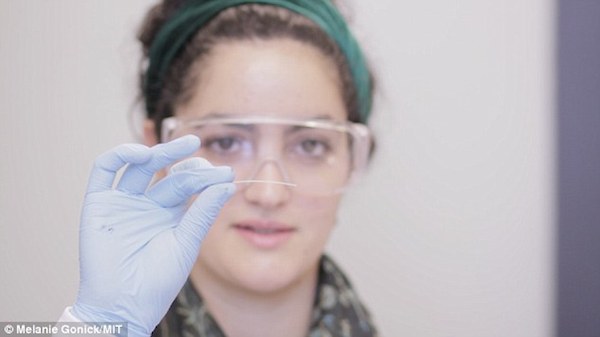
MIT senior, Christina Tringides, holds a sample of the multifunction fiber.
MIT researchers reveal an interface that could make plugging our brain into a computer a reality. Their system uses new fibers less than a width of a hair that could deliver optical signals and drugs directly into the brain, along with electrical readouts to continuously monitor the effects of the various inputs.
Nasal spray could improve memory in people with Alzheimer’s disease.
A new study published in the Journal of Alzheimer’s Disease found that an insulin nasal spray can improve cognitive function in those with Alzheimer’s disease and normal age-related memory problems. The study involved 60 adults who had normal age-related memory problems or mild to moderate Alzheimer’s (Claxton et al., 2015).
Nearly 50 million people worldwide suffer from dementia. It is a devastating disease that leaves individuals as shells of their former selves. For the millions of family members of those affected by the disease, one of the hardest things in dealing with the disease is empathizing with the victims. What the patients are going through simply is not within our own personal realms of experience, and it makes it hard to relate and help them cope with their disorder. With Alzheimer’s Disease International projecting the number of sufferers to nearly double within the next 15 years, it is clear there is a need to help caregivers and families empathize better with these victims. That is exactly what Opaque Multimedia is hoping to accomplish with the Virtual Dementia Experience.