Scientists find first evidence of huge Mars underground water system

32F325F7-C1F7-4FB0-9A20-02E1979DA77C

The first evidence for a planet-wide underground water system will help aid future missions in our hunt for life on Mars.

Mars wasn’t always a dusty, barren planet.

Previous modeling has demonstrated the planet was once overflowing with water that eventually retreated under the surface. But new research details the first direct geological evidence for a “planet-wide groundwater system” explaining Mars’ watery history and providing new sites for future missions to hunt for signs of life.

The revelations come via some plucky Mars geologists and the European Space Agency’s Mars Express Orbiter. The spacecraft, launched in 2003, circles the planet and is fitted with a number of high-resolution cameras constantly snapping images of the Martian surface. Researchers at the University of Utrecht, led by Francesco Salese, pored over these images, intently studying 24 deep craters in Mars’ northern hemisphere looking for signs that water once flowed there.

Continue reading… “Scientists find first evidence of huge Mars underground water system”

How China’s space-bound solar installation will beam power down to earth

180AC6B2-8587-40ED-BF37-556521B20F3B

Solar panels in space

Researchers are exploring new means of providing power.

Researchers in China are planning a solar farm in space, an ambitious project that could deliver energy at six times the intensity of installations on Earth. The project, which made the front page of China’s Science and Technology Daily last week, would orbit in space and beam down energy to a receiver.

The station would reportedly orbit 22,000 miles above the Earth and benefit from harvesting energy without any complications from seasonal changes or atmospheric conditions, providing energy 99 percent of the time. It’s expected to weigh a staggering 1,000 tons, around 600 tons more than the International Space Station, so the researchers are exploring alternatives like using robots and 3D printers to build the construction in space. The idea is nothing new: NASA started researching the idea in the mid-1970s during the Arab oil embargo, and even devised bold concepts like the SunTower:

Continue reading… “How China’s space-bound solar installation will beam power down to earth”

Take a look at the world’s largest 3D-printed rocket engine

dims

3D printing in one piece avoids the weaknesses of welding.

It’s a long way from taking on Blue Origin or SpaceX, but UK startup Orbex is confident enough to show off its Prime Rocket’s second stage. Inside the engineering prototype’s shell is what it claims is the “world’s largest” 3D printed rocket engine, which is also designed to run on bio-propane, a renewable fuel source. The rocket itself is made of a carbon fiber and aluminum composite that’s supposed to be 30 percent lighter than any other vehicle in its category.

Continue reading… “Take a look at the world’s largest 3D-printed rocket engine”

Giant leaf for mankind? China germinates first seed on moon

2900

A photo of the cotton sprout. ‘This is the first time humans have done biological growth experiments on the lunar surface,’ said Xie Gengxin, who led the design of the experiment. Photograph: AFP/Getty Images

A small green shoot is growing on the moon after a cotton seed germinated onboard a Chinese lunar lander, scientists said.

The sprout has emerged from a lattice-like structure inside a canister after the Chang’e 4 lander touched down earlier this month, according to a series of photos released by the Advanced Technology Research Institute at Chongqing University.

Continue reading… “Giant leaf for mankind? China germinates first seed on moon”

Rocket launch in New Zealand brings quick, cheap space access

  • Launch sends Rocket Lab to lead in global space competition
  • Six satellites carried into low orbit from sheep farm launchCheap, quick access to space has officially arrived — and in some serious style.On a late Sunday afternoon in New Zealand, Rocket Lab successfully launched its third rocket. Dozens of employees gathered at the company’s headquarters in Auckland clad in Rocket Lab’s black-and-red colors and let out a series of primordial screams as the rocket took off, flew into space and dropped its satellite payload into orbit. Continue reading… “Rocket launch in New Zealand brings quick, cheap space access”

China plans to launch an ‘artificial moon’ to light up the night skies

69C0E147-BA51-4CAE-B4F3-87D880904141

The night skies might soon have company: Chinese scientists are planning to launch an artificial moon into orbit by 2020 to illuminate city streets after dark.

Scientists are hoping to hang the man-made moon above the city of Chengdu, the capital of China’s southwestern Sichuan province, according to a report in Chinese state media. The imitation celestial body — essentially an illuminated satellite — will bear a reflective coating to cast sunlight back to Earth, where it will supplement streetlights at night.

Continue reading… “China plans to launch an ‘artificial moon’ to light up the night skies”

Reaction Pre-cooled Engines could deliver reusable hypersonic planes by 2025

BF5C3008-C6BB-4F83-B9EB-A10CAD74E68B

Reaction Engines of the UK could be part of a winning group of bidders for open-ended hypersonic weapons development.

They have proven an innovative pre-cooling system which does not require the development of new materials to handle the heat of hypersonic flight speeds.

The US Air Force Research Labs are already working with them. They would need to partner with US companies like Lockheed or Boeing to get the big military contract.

The pre-coolers are made from thousands of thin-walled tubes to provide high surface area to low weight. Each tube is joined to an inlet and outlet manifold, which allows coolant to be injected and removed for the cooling process. We’re the only people in the world with the heat exchanger manufacturing experience to bond thousands of joints in a single operation, and achieve zero leakage. The joints in our pre-cooler modules are hermetically sealed, meaning that the gas which escapes can be measured by the molecule.

Continue reading… “Reaction Pre-cooled Engines could deliver reusable hypersonic planes by 2025”

Carbon dioxide fertilization greening earth, study finds

712D4F15-2A27-4768-A891-3341621100B5

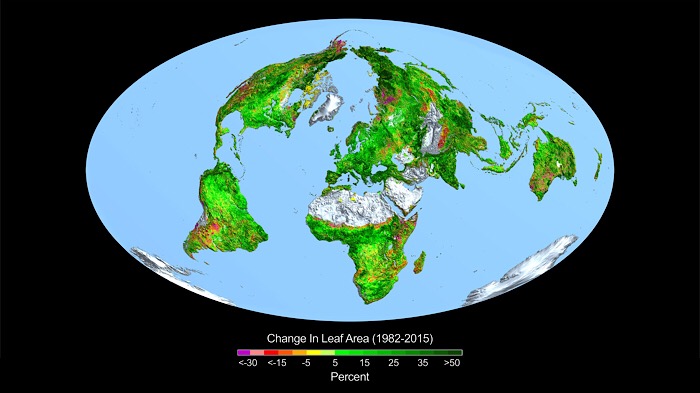
From a quarter to half of Earth’s vegetated lands has shown significant greening over the last 35 years largely due to rising levels of atmospheric carbon dioxide, according to a new study published in the journal Nature Climate Change on April 25.

An international team of 32 authors from 24 institutions in eight countries led the effort, which involved using satellite data from NASA’s Moderate Resolution Imaging Spectrometer and the National Oceanic and Atmospheric Administration’s Advanced Very High Resolution Radiometer instruments to help determine the leaf area index, or amount of leaf cover, over the planet’s vegetated regions. The greening represents an increase in leaves on plants and trees equivalent in area to two times the continental United States.

Continue reading… “Carbon dioxide fertilization greening earth, study finds”

Jeff Bezos predicts we’ll have 1 trillion humans in the solar system, and Blue Origin wants to help get us there

A9F4C2B2-8CB9-4991-8780-8700D9643F9A

Blue Origin’s aim is to lower the cost of access to space, Jeff Bezos said during a surprise appearance at Wired’s 25th anniversary conference.

Amazon and Blue Origin founder Jeff Bezos provides the keynote address at the Air Force Association’s Annual Air, Space & Cyber Conference in Oxen Hill, MD, on September 19, 2018.

Blue Origin founder and Amazon CEO Jeff Bezos predicts we’ll have 1 trillion humans in the solar system one day — and he laid out Monday how the rocket company plans to help get there.

“I won’t be alive to see the fulfillment of that long-term mission,” Bezos said at the Wired 25th anniversary summit in San Francisco. “We are starting to bump up against the absolute true fact that Earth is finite.”

Blue Origin’s aim is to lower the cost of access to space, Bezos said. He will spend a “little more” than $1 billion next year to support Blue Origin, he said.

Continue reading… “Jeff Bezos predicts we’ll have 1 trillion humans in the solar system, and Blue Origin wants to help get us there”

This crazy ambitious timeline shows when and how Elon Musk and Space X plan to colonize Mars

DA4F04D9-185D-4C93-A59E-0D7169792CFB

Elon Musk is hell-bent on colonizing Mars.

That’s the spirit with which he founded SpaceX, his rocket company, in 2002. Musk was frustrated that NASA wasn’t doing more to get people to the red planet – and concerned a backup plan for humanity wasn’t being developed (for when Earth becomes an uninhabitable wasteland).

Since then, SpaceX has developed several impressive aerospace systems: Falcon 1, SpaceX’s first orbital rocket; Grasshopper, a small self-landing test rocket; Falcon 9, a reusable orbital-class launcher; Dragona, a spaceship for cargo and soon NASA astronauts; and Falcon Heavy, a super-heavy-lift launcher.

But Mars is a cold, unforgiving, and almost airless rock located some 140 million miles (225 million kilometres) from the Sun.

Continue reading… “This crazy ambitious timeline shows when and how Elon Musk and Space X plan to colonize Mars”

Japan just became the first country to deploy rovers on an asteroid

IMG_9080

The Hayabusa 2 mission is visiting an asteroid 200 million miles from Earth to collect samples. The mission profile involves a lot of robots, bullets, and explosives.

In 2014, the Japanese Aerospace Exploration Agency (JAXA) launched the Hayabusa 2 spacecraft on a four year journey to Ryugu, an asteroid nearly 200 million miles from Earth. The spacecraft has been in orbit around the asteroid since June and early Friday morning dispatched two rovers to the asteroid’s surface.

Continue reading… “Japan just became the first country to deploy rovers on an asteroid”

A revolutionary new space launch idea: Introducing The Pythagoras Sling

IMG_8793

The Pythagoras Sling uses a lengthy graphene string pulled via two hoops suspended from simple parachutes to rapidly accelerate a projectile into orbit. Graphene string will likely become widely available over the next two decades. If it works as expected, the Pythagoras Sling launch system could greatly reduce the cost of getting into space compared to any current rocket-based system and could help accelerate space development. Total cost of the fully reusable launch system could be as low as $1M for small and medium sized satellites so cost per kg could be two orders of magnitude cheaper than today. Apart for human spacecraft or more delicate satellites that need low g-forces, the system needs little or no fuel to achieve orbit, only ground electricity, so would be safer and more environmentally friendly as well as cheaper than current rocket-based approaches.

Continue reading… “A revolutionary new space launch idea: Introducing The Pythagoras Sling”

Discover the Hidden Patterns of Tomorrow with Futurist Thomas Frey
Unlock Your Potential, Ignite Your Success.

By delving into the futuring techniques of Futurist Thomas Frey, you’ll embark on an enlightening journey.

Learn More about this exciting program.