Scientists at Keio University have developed a “neurocam” — a wearable camera system that detects emotions, based on an analysis of the user’s brainwaves. (Video)
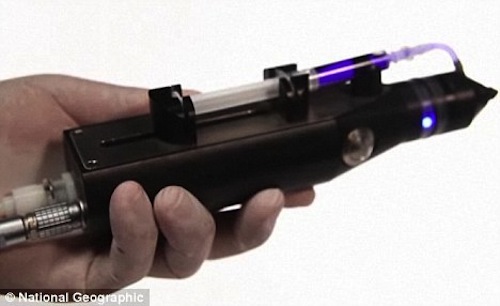
Revolutionary development: The stem cell spray gun treats burns in 1.5 hours.
Doctor Jörg Gerlach, of the University of Pittsburgh’s McGowan Institute for Regenerative Medicine has created a prototype medical device that literally sprays skin cells onto burn victims to re-grow skin.
80% of Facebook’s TV “chatter” comes through mobile devices.
Facebook competes with Twitter in the budding social media analytics market with their trove of user data. In a report produced in conjunction with SecondSync, a social media television analytics firm, Facebook breaks down anonymized user data surrounding television shows by a variety of measures such as types of interaction, demographics, device and genre.
Storing energy along the U.S. grid could help keep the power on.
For years, RenewableEnergyWorld.com has said that if the energy industry could solve the energy storage problem, it would unlock gigawatts of renewable energy capacity all over the world. About a year ago, progress started really picking up. More than 200 energy storage companies were present at Intersolar in Munich in 2013, exhibiting their solutions.
The UAE is looking to use drones to deliver government documents.
Drone delivery could soon become a reality in the United Arab Emirates. The UAE government announced it is developing a plan to use drones to deliver “official documents and packages,” stuff like government IDs and drivers licenses.
A Pennsylvania State University team has discovered that nanomotors made from tiny metal rods can be manipulated by sound waves and magnets, giving them precise control over their actions inside of cells.
Dyson Vacuum entrepreneur to announce new robotics laboratory in London.
Sir James Dyson, the British entrepreneur, has outlined his vision for a new era of household android robots that will be able to clean the windows, guard property – and, presumably, vacuum the carpet.
Recently, there has been a lot of talk about learning computer programming especially with the current wave of programs encouraging kids to learn to code. So it may be worthwhile to look at the difference between coding and computer science.
The FDA has approved the PillCam for use as an alternative for patients who are unable to have a complete colonoscopy. The pill-shaped capsule has a camera on both ends. It navigates through your intestines over an eight-hour period, taking high-speed images that are sent to a device worn by a patient that are later examined by a doctor. (Video)
In vitro fertilization (IVF)—involving DNA from three parents—could become legal in the UK by July.
The prospect of altering DNA to produce a genetically-modified human could move from science fiction to science reality by the middle of 2014. The UK parliament is likely to vote on whether a new form of in vitro fertilization (IVF)—involving DNA from three parents—becomes legally available to couples by July. If it passes, the law would be the first to allow pre-birth human-DNA modification, and another door to the future will open.
At Ford Motor Company “big data” means many things, which has ones and zeros piling up everywhere it looks. There’s data coming off the cars, data generated by the machinations of a Fortune 500 company and even the data customers are generating out in the real world about how they view the company. Michael Cavaretta, the Ford data science leader, is one of they guys charged with helping the company sort all this data out.