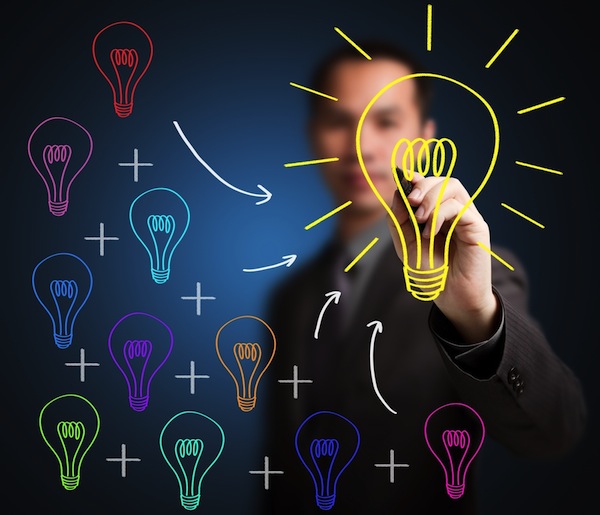
There is a shift from students as consumers to students as creators
On February 3, 2014, the NMC Horizon Report: 2014 Higher Education Edition, officially launched. The report aims to examine emerging technologies for their potential impact on and use in teaching and learning within higher education settings.
California could be the first state to mandate a way for consumers to disable lost or stolen mobile phones.
Legislators in California are expected to outline a proposal requiring mobile devices sold in the state to come equipped with “kill switches” that would disable them if stolen or lost, beginning Jan. 1, 2015.
Google Glass could potentially give NYPD officers in the field facial recognition capabilities.
Google Glass may soon become a favorite tool for law enforcement in the United States. The New York Police Department has recently received several pairs of Google Glass to test out.
Our brains edit our memories with new information by updating our past memories.
Try thinking about your fifth birthday when your mom was carrying the cake. Can you remember what her face looked like? You are not alone if you have a hard time imagining the way she looked then rather than how she looks now.
Dennis Sørensen smiles confidently with his new robotic hand as he flexes his robotic fingers, and gingerly closes them around a disposable plastic cup. Sørensen is blindfolded but he instantly recognizes what he is touching. Round. Hard. Breakable. Lethargic sensory nerves, rusty and unused since an accident nine years ago, begin to stir.
Ray Kurzweil, Google’s engineering director, is famous for the strides he has made in machine learning, speech recognition and music technology. But he would rather be known for achieving immortality.
A city is a large, permanent human settlement. But try and define it more carefully and you’ll soon run into trouble. A settlement that qualifies as a city in Sweden may not qualify in China, for example. And the reasons why one settlement is classified as a town while another as a city can sometimes seem almost arbitrary.
A demonstration of two sugar biobatteries connected in a series to power a digital clock.
Almost all living cells break down sugar to produce energy. Researchers at Virginia Tech say they have developed a battery that can store the most energy for its weight using sugar as a fuel source by mimicking what plants and animals do naturally..
Even a moderately innovative idea can become a huge success.
If you want to be a success and an economic opportunity, it’s important that your idea meet certain criteria for it to be groundbreaking. Even a moderately innovative idea can become a huge success if it has all the right “ingredients.” But keep in mind, some ideas could go either way depending on the execution and the choices you make in developing your idea into a real product.
The Hugo Award was given to Philip K. Dick in 1963 for his novel The Man in the High Castle. He beat out such sci-fi luminaries as Marion Zimmer Bradley and Arthur C. Clarke. The Guardian writes about this novel, “Nothing in the book is as it seems. Most characters are not what they say they are, most objects are fake.” The plot—an alternate history in which the Axis Powers have won World War II—turns on a popular but contraband novel called The Grasshopper Lies Heavy. Written by the titular character, the book describes the world of an Allied victory, and—in the vein of his worlds-within-worlds thematic—Dick’s novel suggests that this book-within-a-book may in fact describe the “real” world of the novel, or one glimpsed through the novel’s reality as at least highly possible.
Last year, Los Angeles decided to replace its high-pressure sodium streetlights, which are know for their distinctive yellow hue, with new, blue-tinted LED’s. The new streetlights might have a profound effect on at least one local industry.
Scholarly articles in digital forms overtook printed ones, but survey suggests increase in reading may have reached a peak.
A 35-year trend of researchers reading ever more scholarly papers seems to be leveling off. In 2012, US scientists and social scientists estimated that they read, on average, 22 scholarly articles per month (or 264 per year). That is, statistically, not different from what they reported in an identical survey last conducted in 2005. It is the first time since the reading-habit questionnaire began in 1977 that manuscript consumption has not increased.