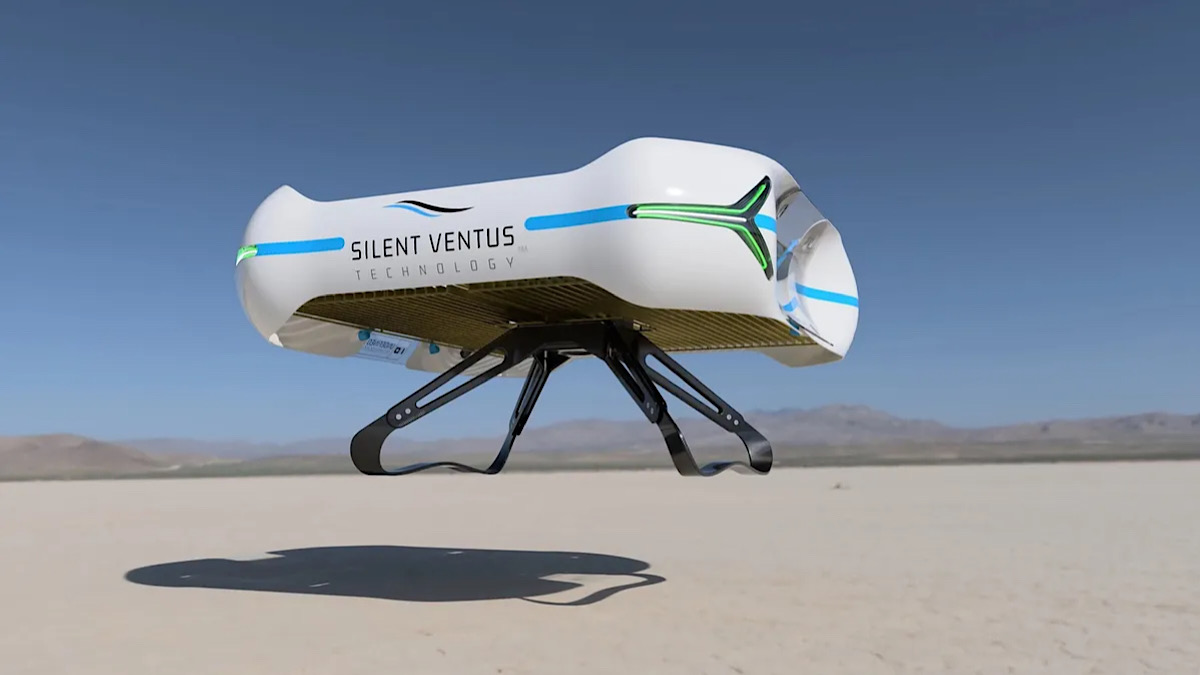
Drone startup claims it flew its zero-emissions ion propulsion drone on 4.5-minute test flight

The company believes its design will lead to far fewer noise complaints for urban cargo drones in the future.

By Chris Young

Florida-based tech startup Undefined Technologies announced its unique ionic propulsion drone has passed an outdoor flight test, meaning it’s on track for commercial release in 2024, according to a report from New Atlas.

The drone, called Silent Ventus, uses proprietary technology to ionize the oxygen and nitrogen molecules in the surrounding air to create an “ionic wind” that propels the machine in the direction it wants to go. According to Undefined, the drone could be used for cargo.

Continue reading… “Drone startup claims it flew its zero-emissions ion propulsion drone on 4.5-minute test flight”

New wireless charging works from nearly 100 feet away 

In the future, a room could start charging your phone as soon as you enter it.

By Kristin Houser

A new wireless charging system uses harmless infrared light to power devices from nearly 100 feet away — putting us one step closer to truly wireless technology.

The challenge: Wireless charging isn’t new — you might already own a coaster-shaped wireless charging pad for your smartphone or watch.

However, those wireless chargers typically require your device to remain very close to the charger and stationary — pick it up, and the charging stops. Plus, the chargers still require power cords themselves, meaning they don’t exactly help declutter your living or working spaces.

The system is already powerful enough for sensors and could charge mobile devices with further development.

Researchers have started developing technologies that charge devices over the air — these could be used to turn entire rooms into wireless chargers, meaning your device would start powering up as soon as you entered.

However, many wireless charging prototypes require that the entire room be modified, which isn’t terribly practical.

Others only work over distances of a few meters — that prevents their use in larger spaces, such as factories, where wireless power could eliminate cords that pose a safety hazard. 

Continue reading… “New wireless charging works from nearly 100 feet away “

Drone Swarms Use 3D Printing to Build Concrete Structures

These drones could work autonomously and in tandem to construct and repair buildings.

By Rainer Klose

Future vision: Swarms of drones could also be used in space, for example on a future Mars mission.

3D printing is gaining momentum in the construction industry. Both on-site and in the factory, static and mobile robots print materials for use in construction projects, such as steel and concrete structures.

A new approach to 3D printing – led in its development by Imperial College London and Empa, the Swiss Federal Laboratories of Materials Science and Technology – uses flying robots, known as drones, that use collective building methods inspired by natural builders like bees and wasps.

The system, called Aerial Additive Manufacturing (Aerial-AM), involves a fleet of drones working together from a single blueprint.

It consists of BuilDrones, which deposit materials during flight, and quality-controlling ScanDrones, which continually measure the BuilDrones’ output and inform their next manufacturing steps.

The researchers say that in contrast to alternative methods, in-flight 3D printing unlocks doors that will lead to on-site manufacturing and building in difficult-to-access or dangerous locations such as post-disaster relief construction and tall buildings or infrastructure.

The research was Led by Professor Mirko Kovac of Imperial’s Department of Aeronautics and Empa’s Materials and Technology Center of Robotics.

Continue reading… “Drone Swarms Use 3D Printing to Build Concrete Structures”

Meet Erica, the laughing robot designed to make AI more empathic humans to give better answers

The humanoid robot can detect when you’re laughing, decide whether to laugh in return, and choose to reciprocate with either a chuckle or a giggle. Creepy or ingenious?

It’s the weekend, and you decide to pay a visit to your grandma, who lives alone. When you arrive, however, you realize she has another visitor, and you hear through the door the two of them laughing. You don’t make anything of it until you walk in and find that the visitor, sitting across the dining table from grandma, is a humanoid robot—and it’s laughing at your grandma’s joke.

This isn’t going to become a reality this year, or in the next 10 years, but it’s exactly the kind of scenario that a team of scientists is working toward. Researchers at Kyoto University in Japan are teaching a humanoid robot how to laugh in response to a human laughing. The robot, named Erica, can detect when a person is laughing, decide whether it’s appropriate to laugh in return or not, and choose to respond with two different kinds of laughs: a small chuckle and a more boisterous giggle.

Continue reading… “Meet Erica, the laughing robot designed to make AI more empathic humans to give better answers”

Intelligent microscope uses AI to capture rare biological events

Intelligent control: The fluorescence microscope at EPFL’s Laboratory of Experimental Biophysics.

By Tami Freeman

Fluorescence microscopy of live cells provides an indispensable tool for studying the dynamics of biological systems. But many biological processes – such as bacterial cell division and mitochondrial division, for example – occur sporadically, making them challenging to capture.

Continually imaging a sample at a high frame rate would ensure that when such divisions do occur, they will definitely be recorded. But excessive fluorescence imaging causes photobleaching and can prematurely destroy living samples. A slower frame rate, meanwhile, risks missing events-of-interest. What’s needed is a way to predict when an event is about to happen and then instruct the microscope to begin high-speed imaging.

Researchers at the Swiss Federal Institute of Technology Lausanne (EPFL) have created just such a system. The team developed an event-driven acquisition (EDA) framework that automates microscope control to image biological events in detail while limiting stress on the sample. Using neural networks to detect subtle precursors of events-of-interest, EDA adapts the acquisition parameters – such as imaging speed or measurement duration – in response.

Continue reading… “Intelligent microscope uses AI to capture rare biological events”

Robo-Farmers: Solinftec’s Solar-Powered Robots Will be Offered to US Farmers Soon

A weeding robot is pictured during a demonstration of new technologies “Digifermes” (Digital farms) at the Arvalis farm, an applied agricultural research organisation dedicated to arable crops, on June 15, 2016 in Saint-Hilaire-en-Woevre, eastern France

By Joaquin Victor Tacla

Solar-powered robots will now be offered to US farmers.

With the help of the e-commerce platform Farmers Business Network, a business with the financial support of a wealthy Brazilian family will provide US farmers with robots that spray pesticides and fertilizer, according to a report by Bloomberg.

However, these are not your regular robots. They are autonomous, solar-powered, and AI-driven!

Continue reading… “Robo-Farmers: Solinftec’s Solar-Powered Robots Will be Offered to US Farmers Soon”

A pilot project in the North Sea will develop floating solar panels that glide over waves ‘like a carpet’

This illustration shows how SolarDuck’s technology could be deployed at sea.

Anmar Frangoul

  • German energy firm RWE is to invest in a pilot project centered around the deployment of floating solar technology in the North Sea.
  • RWE describes “integration of offshore floating solar into an offshore wind farm” as “a more efficient use of ocean space for energy generation.”
  • Earlier this month, energy firm EDP inaugurated a 5 MW floating solar park in Portugal. 

German energy firm RWE is to invest in a pilot project centered around the deployment of floating solar technology in the North Sea, as part of a wider collaboration focused on the development of “floating solar parks.”

Set to be installed in waters off Ostend, Belgium, the pilot, called Merganser, will have a capacity of 0.5 megawatt peak, or MWp. In a statement earlier this week, RWE said Merganser would be Dutch-Norwegian firm SolarDuck’s first offshore pilot.

RWE said Merganser would provide both itself and SolarDuck with “important first-hand experience in one of the most challenging offshore environments in the world.”

Learnings gleaned from the project would allow for a quicker commercialization of the technology from 2023, it added.

RWE described SolarDuck’s system as being based around a design enabling the solar panels to “float” meters above water and ride waves “like a carpet.” 

Continue reading… “A pilot project in the North Sea will develop floating solar panels that glide over waves ‘like a carpet’”

OpenAI’s image generator DALL-E can now edit human faces

The feature was previously off-limits for fears of misuse

By JAMES VINCENT

OpenAI is letting users of its AI art generator program DALL-E edit images with human faces. This feature was previously off-limits due to fears of misuse, but, in a letter sent to DALL-E’s million-plus users, OpenAI says it’s opening up access after improving its filters to remove images that contain “sexual, political, and violent content.” 

The feature will let users edit images in a number of different ways. They can upload a photograph of someone and generate variations of the picture, for example, or they can edit specific features, like changing someone’s clothing or hairstyle. The feature will no doubt be useful to many users in creative industries, from photographers to filmmakers.

“With improvements in our safety system, DALL·E is now ready to support these delightful and important use cases — while minimizing the potential of harm from deepfakes,” said OpenAI in its letter to customers announcing the news. 

Continue reading… “OpenAI’s image generator DALL-E can now edit human faces”

In a 1st, scientists use designer immune cells to send an autoimmune disease into remission

In lupus, B cells release “autoantibodies” that latch onto the body’s cells, triggering a damaging immune response.

By Nicoletta Lanese

The therapy will now be tested in larger trials.

Five patients with hard-to-treat lupus entered remission after scientists tweaked their immune cells using a technique normally used to treat cancer. After the one-time therapy, all five patients with the autoimmune disease stopped their standard treatments and haven’t had a relapse. 

This treatment, known as chimeric antigen receptor (CAR) T-cell therapy, needs to be tested in larger groups of lupus patients before it can be approved for widespread use. But if the results hold up in larger trials, the therapy could someday offer relief to people with moderate to severe lupus.

“For them, this is really a breakthrough,” said Dr. Georg Schett, director of rheumatology and immunology at Friedrich Alexander University Erlangen-Nuremberg in Germany. Schett is the senior author of a new report describing the small trial, which was published Thursday (Sept. 15) in the journal Nature Medicine.

“It’s a single shot of CAR T cells and patients stop all treatments,” Schett told Live Science. “We were really surprised [at] how good this effect is.” 

Continue reading… “In a 1st, scientists use designer immune cells to send an autoimmune disease into remission”

Uber Is Expanding EV Rides, Commits to an EV-Only Fleet by 2030

Uber’s Comfort Electric option is expanding to 25 cities throughout North America. The option allows users of the app to request electric vehicles specifically. 

BY JACK FITZGERALD

  • Uber’s Comfort Electric service, which lets customers request EVs, is expanding from operating solely in California to 25 cities throughout North America. 
  • Uber CEO Dara Khosrowshahi reaffirmed in an interview with CBS News that he wants all Uber fleet vehicles to be electric by 2030.
  • Drivers with gasoline-powered vehicles at that time will be forced to either switch to an electric vehicle or stop driving for the company. 

Uber has expanded its Comfort Electric service from operating solely in California to 24 cities throughout the United States and in Vancouver, B.C., Canada. The Comfort Electric service within the app allows users to specifically request electric vehicles over traditional gasoline-powered vehicles.

The Comfort Electric service separates itself from Uber Green (another electrification effort) by requiring vehicles to be fully electric. Uber Green is less stringent, allowing both EVs and hybrids to qualify for the service. Uber specifically singles out Tesla, Polestar, and the Ford Mustang Mach-E as the “premium” electric vehicles available with Comfort Electric. 

Continue reading… “Uber Is Expanding EV Rides, Commits to an EV-Only Fleet by 2030”

Shanghai rocket maker considering developing huge methane-fueled rockets

A Long March 5 launches the Chang’e-5 lunar sample return mission Nov. 23, 2020.

By Andrew Jones

PARIS — A major arm of China’s state-owned space contractor is looking at developing a series of partially and fully-reusable launch vehicles apparently in response to SpaceX’s Starship.

A paper published in the journal Aerospace Technology outlines plans under consideration by the Shanghai Academy of Spaceflight Technology (SAST) for a number of launch vehicles with varying diameters and clusters of methalox engines.

A first generation of three launch vehicles with reusable first stages would have diameters of 3.35, 4.0 and 7.0 meters, powered by clusters of five, seven-to-nine and 9-22 “Longyun” 70-ton-thrust engines. Second stages would use vacuum-optimized versions of the engine.

The 3.35m version is to be capable of lifting 2,500 kilograms to a 700-kilometer sun-synchronous orbit (SSO), while the 4.0m variant—a size chosen to meet the maximum which can be transported to China’s inland launch sites—could launch up to 6,500 kg of payload to a similar orbit. 

The 7.0 meter version is planned to be able to launch more than 20,000 kg to 700 km SSO, while requiring new launch facilities and an offshore platform for recovering the first stage. 

Continue reading… “Shanghai rocket maker considering developing huge methane-fueled rockets”

This Reusable Space Freighter Would ‘Open the Door’ to European Space Exploration

Artist’s conception of SUSIE performing a vertical landing

By Passant Rabie

CALLED SUSIE, THE REUSABLE SPACECRAFT WOULD BE CAPABLE OF DELIVERING CREWS AND CARGO TO SPACE, AND PERFORM VERTICAL LANDINGS WHEN RETURNING HOME.

French aerospace company ArianeGroup has revealed a concept for a reusable upper stage spacecraft that would be capable of delivering heavy payloads to space and carry out crewed missions before landing vertically back on Earth. 

SUSIE, short for Smart Upper Stage for Innovative Exploration, was introducedto the world at the International Astronautical Congress held in Paris from September 18 to 22. The fully reusable upper stage could eventually serve as an automated freighter and payload transporter, as well as a spacecraft for crewed missions carrying a crew of up to five astronauts. SUSIE remains a concept for now, but if realized, the spacecraft would support various European space endeavours for years to come. 

Reusability is fast becoming a necessity in modern spaceflight, as launch providers work to keep costs down. “It is our industrial duty to contribute to this ambition and offer European decision-makers smart and ambitious technological solutions capable of contributing to independent access to space, and also to open the door to European space exploration and address commercial and institutional needs for services in space over the coming decades,” Morena Bernardini, head of strategy and innovation at ArianeGroup, said in a statement.

Europe’s private space industry has fallen a bit behind its American counterparts in terms of developing reusable vehicles. SpaceX’s Falcon 9 rocket is a reusable two-stage rocket that has flown to space nearly 200 times, while the company’s reusable Dragon capsules, whether for cargo or crews, are now in steady circulation. Boeing’s Starliner, a reusable crew capsule, recently completed its first uncrewed end-to-end test flight (although it was a less-than-perfect mission). Reusable launchers and vehicles aren’t so much the future as they are the present.

Continue reading… “This Reusable Space Freighter Would ‘Open the Door’ to European Space Exploration”
Discover the Hidden Patterns of Tomorrow with Futurist Thomas Frey
Unlock Your Potential, Ignite Your Success.

By delving into the futuring techniques of Futurist Thomas Frey, you’ll embark on an enlightening journey.

Learn More about this exciting program.