
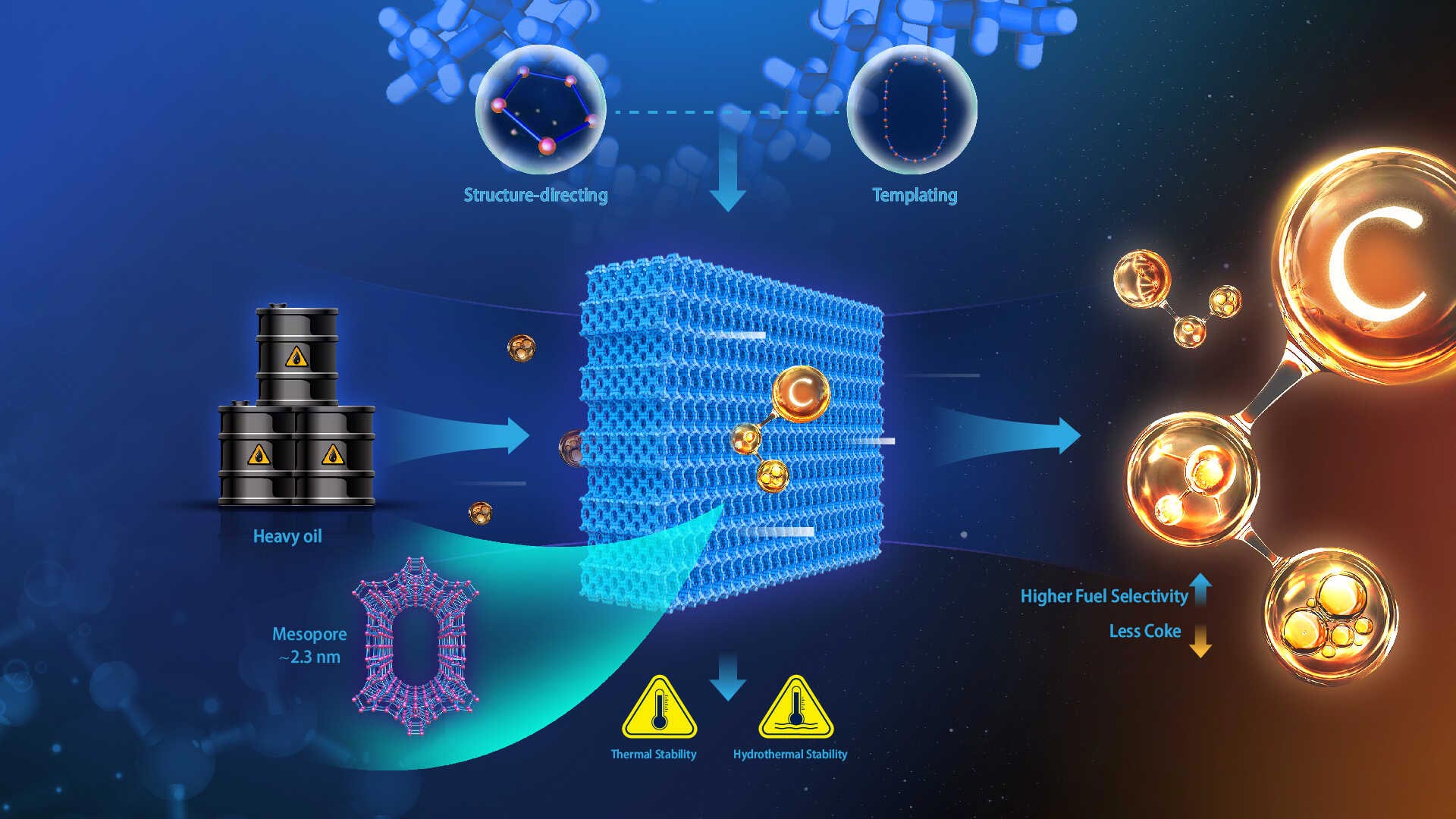
Zeolites are crystalline materials widely used in applications like ion exchange, adsorption, and catalysis. However, their microporous structure restricts their ability to process larger molecules. To overcome this challenge, researchers have developed ZMQ-1, a zeolite that incorporates intrinsic mesopores—pores larger than 20 Å—while preserving both stability and acidity.
Previous attempts to create mesoporous zeolites struggled with issues like structural instability and reduced acidity, rendering them unsuitable for industrial use. ZMQ-1, however, presents a solution to these problems. The researchers utilized a phosphonium-based organic structure-directing agent (OSDA) to form the mesoporous framework. Unlike traditional ammonium-based OSDAs, phosphonium-based OSDAs offer a stronger positive charge and greater stability, which allows for the synthesis of more robust mesoporous structures. The crystallization of ZMQ-1 was accomplished through hydrothermal synthesis with tunable silicon-to-aluminum (Si/Al) ratios, enabling the zeolite to be customized for specific applications.
Continue reading… “The Design of ZMQ-1”
