
By Futurist Thomas Frey
What the World Humanoid Robot Games tell us about where AI is headed — and why the stumbles matter as much as the wins
The Scene Nobody Expected
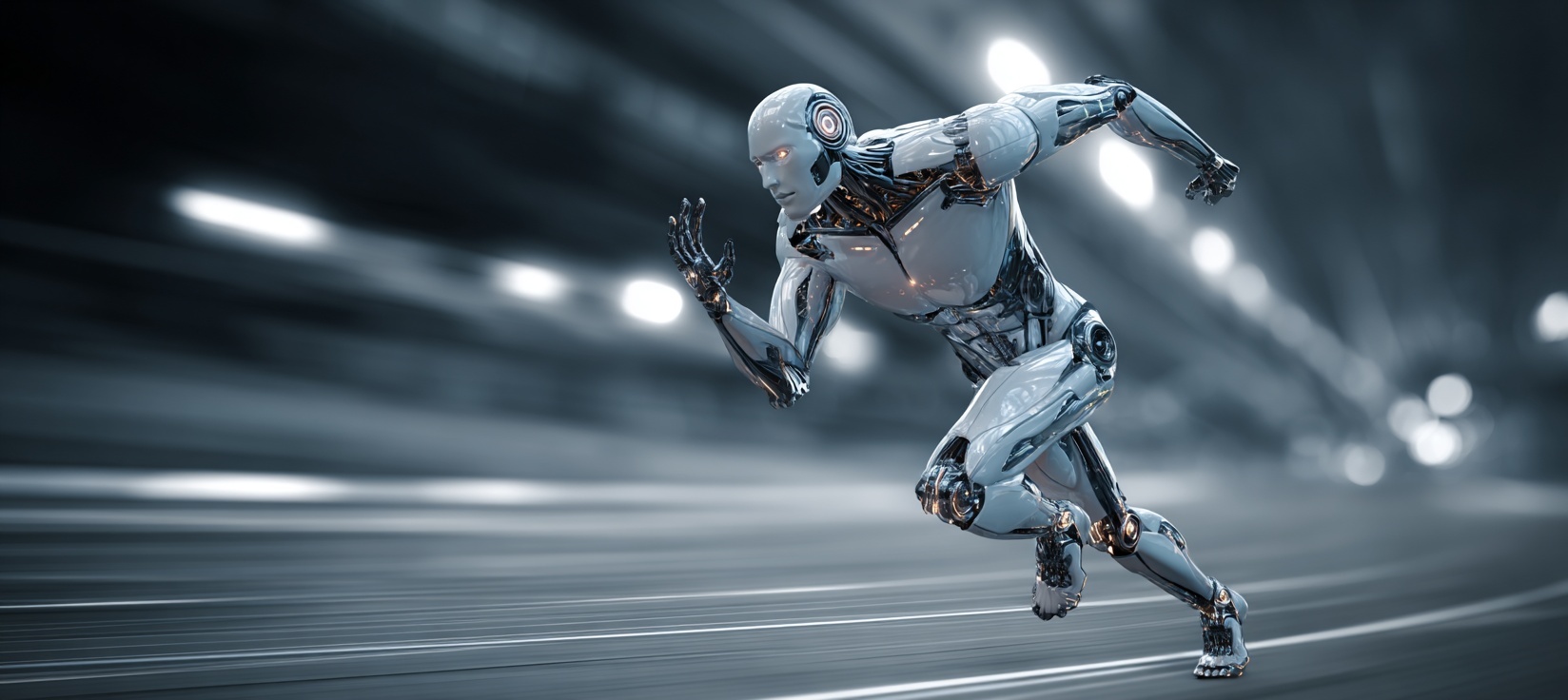
Picture this. It’s August 2025. You’re sitting in the National Speed Skating Oval in Beijing — the “Ice Ribbon,” built for the 2022 Winter Olympics — watching a 1,500-meter race. The competitors line up at the start. The gun fires. They begin to run.
One of them suddenly collapses mid-stride, drawing a collective gasp from 12,000 spectators. Another wobbles, recovers, and keeps going. The crowd erupts in applause — not for speed, but for the simple act of staying upright. The gold medalist crosses the finish line in 6 minutes and 34 seconds. A typical recreational human runner would finish in under seven. The stadium cheers like it’s a world record.
Every athlete in this race is a robot.
The inaugural World Humanoid Robot Games ran for three days in Beijing last August — 280 teams, 16 countries, over 500 bipedal robots competing in 26 events. The second edition returns to Beijing in August 2026, and the organizers have already declared their ambition: to build this into a permanent global institution they’re calling the “third Olympics,” standing alongside the Summer and Winter Games as one of the defining spectacles of civilizational progress.
Most Western media covered it as a curiosity — robots falling down, China showing off, slightly clunky machines doing things humans do better. That framing missed almost everything that matters about what actually happened and what it means for where we’re heading.
What the Competitions Actually Test
The event was divided into three categories, and each was more strategically designed than it appeared on a livestream.
The athletic competitions — track and field events including the 100 meters, 400 meters, 1,500 meters, hurdles, high jump, long jump, and a 4×100 relay — look like entertainment. They’re not. These events test the most fundamental unsolved problem in robotics: dynamic bipedal locomotion under real-world conditions. Any robot can walk in a lab. Walking fast on a curved track, over obstacles, without falling, while managing power consumption and thermal load — that’s the edge where hardware and AI software meet real-world physics. The 100-meter sprint was won by the Tiangong Ultra robot in 21.50 seconds. The fastest human alive runs it in under 10. But the gap between 21 seconds and falling flat on your face is where the science lives, and every team that crossed the finish line contributed data that no controlled lab environment can generate at scale.
The performance showcases — solo dance, group choreography, martial arts including tai chi and kickboxing — test something different: multi-joint coordination, real-time adaptation, and the ability to synchronize with other robots and with music. The dance competition winner from the Beijing Academy of General AI scored 95 points for a three-minute routine that mixed martial arts, ballroom, and street dance, finishing a tenth of a percentage point ahead of a robot that performed a backflip. The margin tells you something important: the performance gap between the best and second-best is already small enough to create genuine competition. One team’s robot even recreated the victory dance of Olympic runner Mo Farah. Not perfectly. But recognizably. The crowd went wild.
The scenario-based challenges are the most revealing category of all — and the least telegenic. Robots competed in industrial material handling, hospital drug sorting and packaging, and hotel hospitality and room cleaning. A team from Shanghai-based UniXAI won the room cleaning gold, finishing in 8 minutes and 21 seconds. Their Wanda 2.0 robot, starting price approximately $12,000, navigated an unfamiliar environment, identified what needed cleaning, and completed the task without human intervention. This is not a party trick. This is a capability demonstration for every hospital administrator, factory manager, and hotel chain executive watching from the audience. When a robot can reliably clean a room it has never seen before, the labor market implications are direct and immediate.
The Stumbles Are the Story
The footage that circulated most widely from the games showed robots falling. During the football matches, four robots crashed into each other and collapsed in a tangled heap. During the 1,500 meters, a robot running at full speed suddenly went down. During the boxing events — which looked like an early draft of the film Real Steel — competitors landed punches that sent opponents to the canvas in ways no boxing trainer planned for.
The reflex of dismissal — look how clunky these things are — misunderstands how technological progress actually works. Every collapse is a data point. Every tangled heap of robots is a collision scenario that gets added to a training dataset. Every drug-sorting mistake is a failure mode that gets engineered out. The games were not, in the organizers’ own words, primarily a competition. They were a public stress test — conducted at a scale and variety that no private lab could replicate — designed to surface failure modes, accelerate iteration, and create a shared body of evidence about where embodied AI actually stands.
Li Yechuan of the Beijing Municipal Bureau of Economy and Information Technology put it directly: “If this had been held a year ago, most humanoid robots would not have been ready.” The progress in a single year — in motor control, battery management, AI decision-making, and multi-robot coordination — was visible and measurable. The same people who are running the 2026 edition are watching those clips of stumbles and falls with the same attention a Formula One engineer gives to a tire blowout. The failure is the information.
Robot bodies are ready—but their minds aren’t. The real breakthrough begins when machines can think, decide, and act without human scripts.
The Honest Gap Between Hardware and Brain
The most important observation from the 2025 Games came not from the competitors but from Unitree CEO Wang Xingxing, whose company won four gold medals — the dominant performance of the event. Standing at the podium, he delivered a candid assessment: the hardware has improved dramatically. The brains haven’t kept up.
Motors, control systems, and battery management are genuinely impressive. The robots’ bodies can do things they couldn’t do eighteen months ago. But the AI models that govern their decisions — what Wang and others in the field call “embodied intelligence” — are still inadequate for most real-world deployment scenarios. The robots competing in Beijing were largely executing pre-programmed sequences or following constrained decision trees. The “real AI age,” as one Chinese roboticist put it, begins only when robots can think and act independently after training — perceiving a novel situation, making a judgment, and executing a response without a human scripting each step in advance.
That gap — between impressive hardware and genuine autonomous decision-making — is the central problem the robot games are designed to accelerate solving. Not by celebrating what robots can already do, but by forcing them into situations they can’t handle yet, over and over, in front of thousands of witnesses. The 5v5 football final, won by Tsinghua University over Germany’s HTWK Robotics 1-0, required real-time coordination, spatial awareness, and strategy adaptation. The German team had been doing this for sixteen years and published their code publicly after every tournament so competitors could build on it. That spirit of open competition accelerating collective progress is the same mechanism that drove the space race, the internet, and now AI. It works.
What We Learned — and What the 2026 Games Will Tell Us
The first edition of the games produced a clear picture of where embodied AI stands. The results were humbling and exciting in equal measure. Robots can run — slowly, but reliably enough to finish a 1,500-meter race. They can dance with precision and even grace. They can sort medicines, clean hotel rooms, and handle factory materials without constant human supervision. They cannot yet see the world the way humans do, reason fluidly about unexpected situations, or maintain performance across a full working day without significant degradation. The hardware is ahead of the software. The legs have outpaced the brain.
The 2026 edition, returning to Beijing this August, will answer several questions that the first games only partially addressed. How much has the AI software caught up to the hardware in twelve months? Have the robots that collapsed in the 1,500 meters learned to fall better — or not to fall at all? Has the gap in the scenario-based challenges — where real-world autonomy matters most — narrowed enough to demonstrate genuine deployment readiness? And critically: how many teams from countries outside China have built robots capable of competing at the top level, rather than entering on Chinese-manufactured hardware?
That last question matters geopolitically. In 2025, virtually every foreign football team competed on Chinese-made robots — specifically the Booster T1, supplied by a Chinese company to ensure competitive parity across all participants. China accounted for 90 percent of the roughly 13,000 humanoid robots shipped globally last year, far ahead of any other country. The Robot Olympics may be framed as an international celebration of robotics. But it is also, as analysts at the Diplomat and elsewhere have noted, a calculated display of China’s intent to dominate the embodied intelligence industry the way it came to dominate EVs — through aggressive government investment, supply chain control, cost advantage, and public narrative. U.S. robot prices now average roughly 30 percent higher than comparable Chinese models. That gap is not accidental.
The Larger Role These Games Are Playing
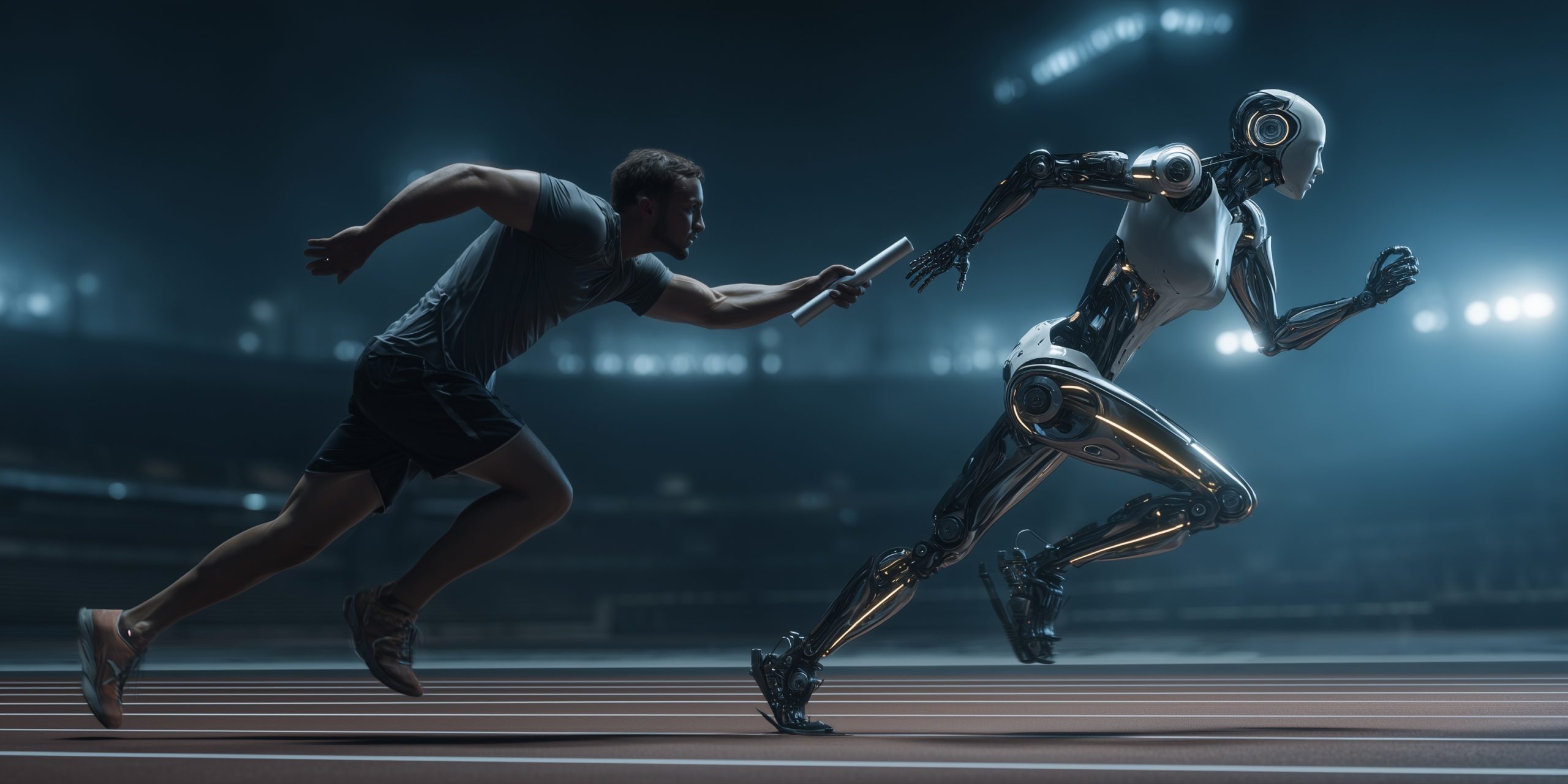
The Olympics, at their best, do something that laboratory benchmarks and corporate press releases cannot: they create a shared, observable, emotionally resonant measure of progress. When Roger Bannister broke the four-minute mile in 1954, it didn’t just set a record — it changed what runners believed was possible. The psychological barrier fell before the physical one did. The Robot Games are playing the same role for the robotics industry and the public it needs to accept these machines into daily life.
The 12,000 people who paid $18 to $80 to sit in the Ice Ribbon and cheer for falling robots were not watching a technology demonstration. They were participating in a new kind of cultural relationship with machines. They gasped when robots collapsed. They applauded when robots recovered independently. They laughed at the tangled football heap and then leaned forward when the goalkeeper extended a leg to block a shot. That emotional investment — that progression from novelty to identification — is how any technology transitions from the lab to the living room. The television didn’t become essential until families gathered around it. The smartphone didn’t become indispensable until it became personal. The robot Olympics won’t make humanoids household companions immediately, but they are building the cultural scaffolding that makes that future legible.
Looking further ahead, the organizers’ ambition to build this into the “third Olympics” is not as grandiose as it sounds. The Summer and Winter Games were themselves invented to serve a purpose — to create peaceful competition, to celebrate human capability, to give nations a stage for pride that didn’t require armies. The Robot Games serve an analogous purpose at the dawn of the machine era: they provide a civilized arena for the geopolitical competition over who controls the technology that will run the next century, while simultaneously accelerating that technology toward the applications that will matter most — elder care, manufacturing, medical support, disaster response, and ultimately the labor that human populations are no longer large enough or young enough to perform alone.
The robot that fell in the 1,500 meters last August got back up. Not because someone helped it — but because it had learned, in training, that falling is a state to recover from. That small moment, largely ignored in the post-event coverage, is the one I keep returning to. The willingness to compete before you’re ready, to fail in public, to get back up and keep going — these are not just athletic virtues. They’re the engine of progress itself. The Robot Olympics have begun. They’re worth paying very close attention to.
Robots Race, Play Football, Crash and Collapse at China’s Robot Olympics
CNN — On-the-ground coverage of the inaugural 2025 World Humanoid Robot Games in Beijing
From Spectacle to Substance: What China’s Humanoid Robot Games Really Mean
The Diplomat — The geopolitical strategy behind the games and China’s push for embodied AI dominance
Beijing World Humanoid Robot Games: Full Takeaways
Mike Kalil — Detailed event-by-event breakdown with results, robot specs, and strategic analysis
