
By Futurist Thomas Frey
A Record That Deserves More Attention Than It’s Getting
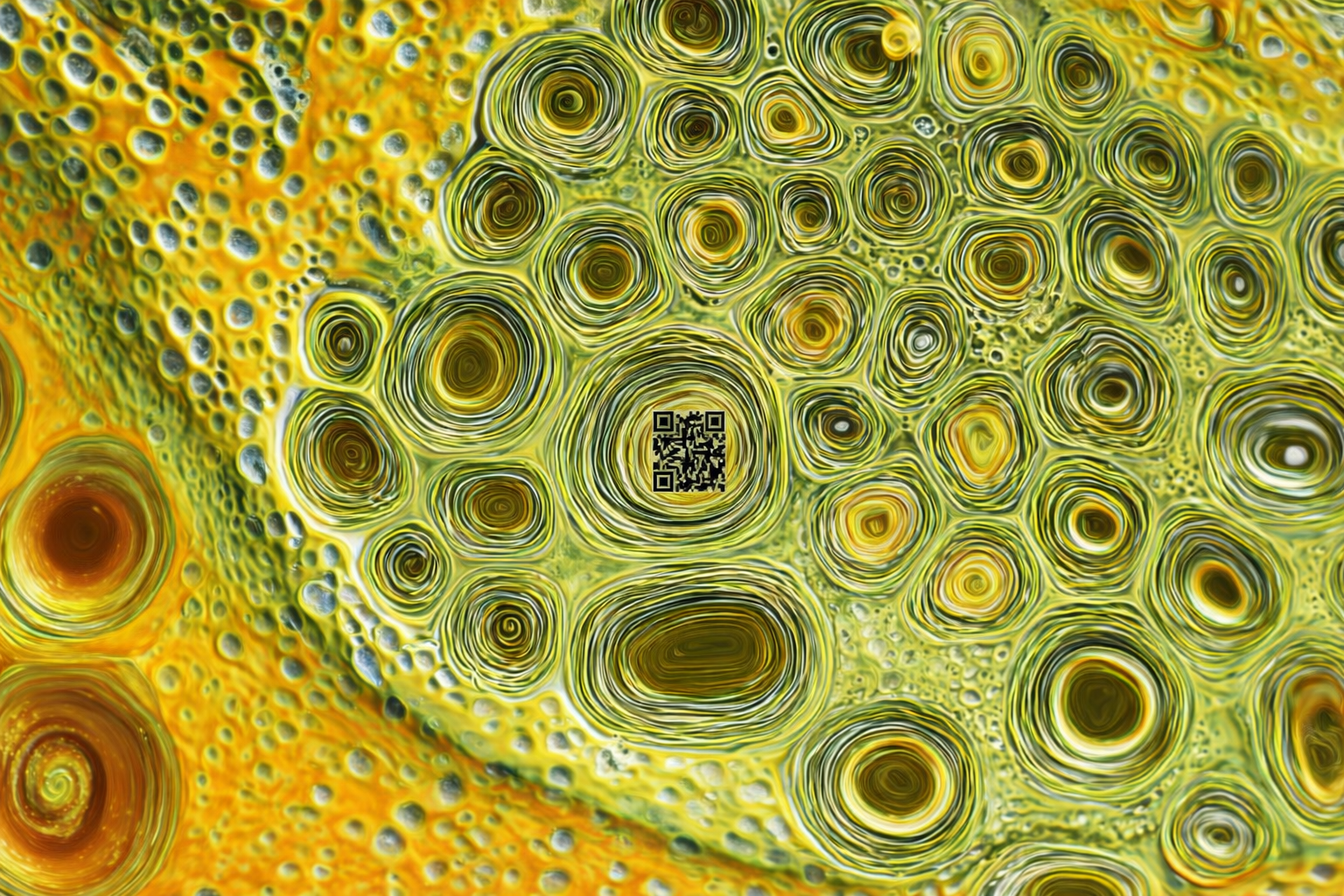
Last week, researchers at the Vienna University of Technology, working with data storage company Cerabyte, officially broke the Guinness World Record for the world’s smallest QR code. The new record-holder measures just 1.98 square micrometers — smaller than most bacteria. Each pixel in the code is 49 nanometers across, roughly ten times smaller than the wavelength of visible light. You cannot see it with an optical microscope. You cannot see it with the naked eye. You cannot see it at all without an electron microscope.
The code was engraved into a thin ceramic film using a focused ion beam — the same class of ultra-stable materials used to coat high-performance industrial cutting tools. The result is not just tiny. It is extraordinarily durable. Unlike magnetic drives that degrade within a decade, or flash memory that loses data without periodic power, or optical discs that scratch and fade, this ceramic-encoded QR code can survive for centuries — possibly millennia — without any energy input whatsoever. At the scale of an A4 sheet of paper, this approach could store more than two terabytes of data. Permanently. With no electricity required to maintain it.
This is a genuinely significant breakthrough. And like most genuinely significant breakthroughs, its importance has almost nothing to do with the headline and almost everything to do with the implications that follow from it. The record itself is a demonstration. What matters is what the demonstration opens up.
The Ancient Insight Behind the Modern Achievement
Alexander Kirnbauer, one of the researchers on the project, made an observation that cuts to the heart of what’s actually going on here: “We live in the information age, yet we store our knowledge in media that are astonishingly short-lived.” He then pointed to ancient civilizations — the Sumerians, the Egyptians, the Romans — who carved their most important information into stone. Those inscriptions are still readable thousands of years later, not because of sophisticated technology but because of material choice. They picked something that lasts.
This observation is more profound than it might initially appear. We are living through what may be the most information-intensive period in human history, and the vast majority of that information is stored in formats that are among the most fragile ever devised. A hard drive fails. A server farm burns. A company goes bankrupt and its cloud storage goes dark. A power grid goes offline and entire data centers go with it. We have created a civilization whose memory depends on continuous electricity — and we have done this so completely and so quickly that most people haven’t stopped to ask whether it’s wise.
The Vienna researchers are asking exactly that question. And their answer is to go back to the oldest insight in the history of information preservation — stable material — and apply it at a scale that no ancient civilization could have imagined. The Rosetta Stone is roughly 760 kilograms and stores a few hundred words. A ceramic film the size of a fingernail, encoded with this technique, could store a library. The marriage of ancient durability with modern information density is a genuinely new thing in the world.
Authentication at the Nanoscale
The first and most immediately practical implication of this technology has nothing to do with archival storage. It’s about authentication — and it is going to change the economics of counterfeiting, forgery, and fraud in ways that are difficult to overstate.
Consider what a sub-microscopic QR code means for anti-counterfeiting. Today, luxury goods, pharmaceuticals, currency, legal documents, and industrial components all use various forms of authentication marks — holograms, watermarks, microprinting, RFID chips. All of these can be replicated with varying degrees of difficulty and expense. A ceramic-encoded QR code invisible to any optical system and readable only by an electron microscope is an entirely different class of authentication. You cannot photograph it with a camera. You cannot scan it with a smartphone. You cannot replicate it without access to focused ion beam technology, which is not something a counterfeiting operation picks up cheaply or quietly. The code becomes an unforgeable certificate baked into the object itself at the nanoscale.
The pharmaceutical industry alone loses hundreds of billions of dollars annually to counterfeit drugs — a problem that kills people. A ceramic QR code engraved directly into the surface of a pill coating, or into the glass of a vial, containing an encrypted certificate of authenticity linked to the specific batch, the manufacturing date, the supply chain transit record, and the expiration data, is not something a counterfeiter can fake. It is materially embedded. It is permanent. And by the time it reaches a hospital or pharmacy, it has been carrying its own verification credentials since the moment it left the factory. The same logic applies to aircraft components, semiconductor chips, legal documents, fine art, weapons, and any other high-stakes physical object where provenance and authenticity carry serious consequences.
The Supply Chain Revolution Nobody Saw Coming
Global supply chains are, at their most fundamental level, information problems. Where did this component come from? Who touched it? What conditions was it exposed to? Is it what the label says it is? The answers to these questions currently depend on paperwork, barcodes, RFID tags, and human record-keeping — all of which can be falsified, lost, corrupted, or simply absent when a part has changed hands dozens of times across multiple countries over several years.
Nano-scale ceramic encoding changes this entirely. Every individual component in a supply chain — a turbine blade, a semiconductor wafer, a surgical instrument, a structural bolt — can carry its complete provenance record permanently engraved into its own surface. Not in a tag that can be removed or a chip that can fail, but in the material of the object itself. The component becomes its own permanent record. Its full history travels with it through every hand it passes through, survives every environment it’s exposed to, and remains readable decades later when questions arise about where a part came from and whether it meets specification.
In aerospace, where a single counterfeit or misrepresented component can bring down an aircraft, this isn’t a marginal improvement — it’s a categorical one. In semiconductor manufacturing, where the origin and integrity of components carries national security implications, the ability to permanently encode verifiable identity into every chip at the nanoscale is exactly what supply chain security has been trying to achieve for years. The technology to do this now appears to exist.
Medicine, Biology, and the Body as a Data Environment
The medical implications of nanoscale data encoding are some of the most far-reaching, and also some of the most ethically complex. Ceramic materials are biocompatible — they are already used extensively inside the human body in orthopedic implants, dental restorations, and bone repair. An implant that carries its own permanent encoded record — the patient’s identity, the implant’s specifications, the surgical details, the manufacturing provenance — eliminates an entire class of medical errors that currently occur when the history of an implant is lost, misrecorded, or inaccessible.
Consider what this means for hip replacements recalled ten years after surgery, for cardiac stents whose manufacturing batch is found to be defective, for patients who cannot communicate their own medical history. A ceramic-encoded record embedded in the implant itself, readable by any facility with the appropriate equipment, carries the information reliably across the entire lifespan of the device — and potentially well beyond.
Beyond implants, the biology implications are significant in ways the current research doesn’t directly address but clearly points toward. If you can encode stable, readable data into ceramic at the nanoscale, the natural next question is what other stable, nanoscale surfaces can carry the same encoding. Biological tissue, bone, tooth enamel — these are domains where the intersection of materials science and information encoding is still largely unexplored. The research from Vienna is a data point in a direction that runs considerably further than long-term storage.
Civilizational Memory and the Long Archive
One of the most underappreciated problems in long-range civilizational planning is the degradation of institutional memory. We know, in the abstract, that civilizations rise and fall. We know that the Library of Alexandria burned, that the records of countless cultures were destroyed by war or disaster or the simple passage of time, that entire languages and knowledge systems have vanished leaving only fragments. We know that modern digital storage is orders of magnitude more fragile than stone carving, and we have done very little about it.
Ceramic encoding at the nanoscale is the first genuinely promising answer to this problem that materials science has produced. Two terabytes per A4 sheet, requiring no power to maintain, surviving extreme temperatures, radiation, humidity, and physical stress — this is a storage medium that could carry human knowledge across the kind of timescales that test every other medium we have. The researchers explicitly frame their work in these terms: a ceramic archive that could remain readable to future generations the way Roman inscriptions remain readable to us, but carrying not a few hundred words but the sum of human knowledge encoded at a density that stone could never approach.
The question this raises — which no laboratory can answer — is what we would choose to preserve if we were building an archive intended to outlast our civilization. Every generation that has thought seriously about legacy has faced a version of this question. We are the first generation to face it with the technological capacity to actually do something about it at scale, and with ceramic storage, potentially the means to make our answer last.

The Invisible World and Its Privacy Implications
There is a shadow side to this technology that needs to be named clearly, because it will become urgent well before most people have thought about it. A code invisible to any optical system, readable only by specialized equipment, permanently embedded in an object — is a surveillance tool as much as it is an authentication tool. The same properties that make it ideal for anti-counterfeiting and supply chain verification make it equally suitable for covert marking of objects, people, and places without their knowledge or consent.
If nanoscale ceramic codes can be applied to physical surfaces during manufacturing — and the research trajectory suggests they can — then any object could carry a permanent, invisible identifier. The implications for tracking, surveillance, and covert marking are significant and require governance frameworks that do not yet exist. The conversation about who has the right to encode data into objects, what that data can contain, who has the right to read it, and what legal protections govern nanoscale marking of physical goods — including goods that people carry, wear, or have implanted — needs to start now, not after the capability becomes widespread.
This is not a reason to oppose the technology. The legitimate applications are too valuable. It is a reason to think carefully, now, about the governance architecture that should accompany deployment — the same conversation the internet needed in 1995 and largely didn’t have until the problems were already embedded in billions of lives.
What Comes Next
The team at TU Wien is clear that the Guinness record is a beginning, not a destination. They are now working on three things: using different ceramic materials to expand the range of surfaces that can carry encoded data, increasing writing speeds to make industrial-scale production viable, and developing the manufacturing processes needed to move from laboratory demonstration to real-world deployment. Cerabyte, the commercial partner, is focused on the data storage market — but the authentication, supply chain, and medical applications represent opportunities that are arguably larger and more immediately monetizable.
The path from world record to widespread commercial application typically takes a decade or more. But the materials science here is not speculative — focused ion beam etching and ceramic thin films are established industrial technologies. What’s new is the combination: using them to create stable, nanoscale information carriers at a density that was not previously achievable. The engineering pathway from here to industrial deployment exists. It is a matter of speed and investment, not of whether it’s possible.
I’ve been watching technology transitions for a long time, and one of the patterns I’ve noticed is that the most consequential breakthroughs are often announced quietly. No product launch. No stock price movement. Just a paper, a record, and a modest statement from researchers who know what they’ve done and are already thinking about what comes next. The world’s smallest QR code, confirmed by Guinness last week in Vienna, is one of those breakthroughs. The headline is the record. The story is everything the record makes possible — authentication that cannot be forged, archives that cannot be erased, supply chains that cannot lie, and a civilizational memory that might, for the first time in human history, actually outlast us.
World’s Smallest QR Code, Smaller Than Bacteria, Could Store Data for Centuries
ScienceDaily / Vienna University of Technology — The original research behind the Guinness World Record, published March 29, 2026
Twisted 2D Magnet Creates Skyrmions for Ultra-Dense Data Storage
ScienceDaily — The broader race to pack more information into smaller and smaller physical spaces
World Record: The Smallest QR Code in the World
TU Wien — Direct from the research institution: the full technical account of the record-setting achievement
