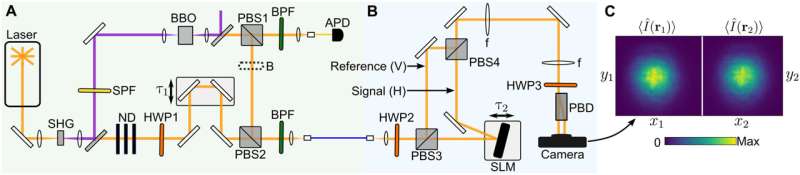
Researchers from the University of Ottawa, the National Research Council of Canada (NRC), and Imperial College London have made a groundbreaking discovery in holography, enabling the recording and reconstruction of faint light beams containing a single particle of light, or photon. This quantum-inspired technique opens new possibilities for holographic imaging of remote objects, akin to what is seen in sci-fi classics like Star Trek and Star Wars.
Led by Dr. Benjamin Sussman, adjunct professor of physics in the Faculty of Science at uOttawa, the team developed this pioneering technique at the uOttawa-NRC Joint Centre for Extreme Photonics. Their goal was to accurately record and reconstruct three-dimensional scenes using extremely faint light beams consisting of single photons.
This quantum-inspired holography offers two significant advantages over traditional methods. Firstly, it exhibits remarkable resilience to mechanical instabilities, such as vibrations during hologram recording. Unlike conventional holography, which requires short exposure times due to susceptibility to vibrations, this new technique enables extended hologram recording, ensuring superior precision. Secondly, it allows researchers to record holograms of self-luminous or remote objects, opening up possibilities for 3D imaging of distant objects and characterizing the spatial shape of single photon emission from quantum dots and single atoms.
Advanced cameras that provide precise timing and location stamps upon detecting a single photon were instrumental in achieving these breakthroughs. This synergy between quantum research and technological advancements played a crucial role in developing this novel holographic technique.
Traditional photography captures scene intensity, while holography incorporates information about phase, the relative delay between light collected from different parts of the scene. The newly developed technique utilizes correlations between the intensities of two light sources, revealing quantum interference effects even in single photons.
The implications of this research are profound, with potential applications in fields like astronomy, nanotechnology, and quantum computing. This quantum-inspired holography promises to enhance existing holography technologies and open up new frontiers in 3D scene reconstruction, making the future of holography undeniably bright.
By Impact Lab