Welders used to rule the shop floor.
Their sparks were the signature of a skilled trade—equal parts craftsmanship, grit, and danger. But what happens when the torch passes to a machine that doesn’t sweat, doesn’t miss, and doesn’t complain?
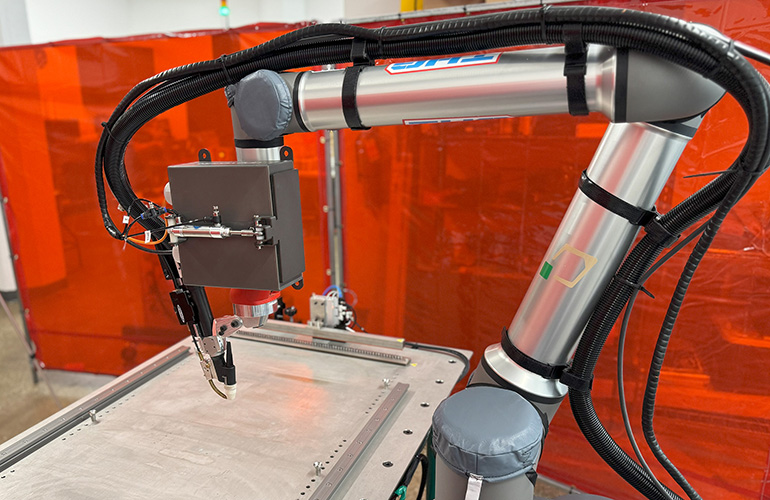
This week, Cohesive Robotics answered that question loud and clear with the launch of its Smart Welding Robotic Workcell, a fully autonomous welding system that doesn’t just automate tasks—it replaces the art of welding with code, cameras, and algorithms.
Welcome to the new frontier of fabrication, where the welder’s helmet is traded for a machine-learning model, and experience is measured in training data—not decades on the job.
No Human Programming Required
At the heart of this system is Argus OS, an AI-powered brain that turns chaotic shop environments into orchestrated robotic precision. Feed it a messy pile of parts, and it identifies, maps, and plans every weld autonomously. MIG? TIG? Laser? Doesn’t matter. The machine does it all—no teach pendant, no hand-guided motion, no human guesswork.
The old way: walk a cobot through the moves, test, adjust, and pray.
The new way: press go.
Fixturing? Automated. Collision checking? Built-in. Weld sequencing? Optimized. Your job? Redundant—unless you’re managing the dashboard.
From Dirty Work to Digital Supervision
The Smart Welding Workcell isn’t just a tool—it’s a blue-collar exoskeleton for the post-labor age. It doesn’t get tired. It doesn’t inhale fumes. It doesn’t clock out. And it boosts production by up to 50%, all while achieving 90% consistency—numbers that would make even the best union welder sweat.
And here’s the real twist: it’s mobile, modular, and designed for high-mix, low-volume environments. In other words, this isn’t a factory-line robot—it’s a freelancer’s assassin. Aerospace. Construction. Fabrication shops. Wherever welds are needed, this workcell doesn’t just show up—it outperforms.
Welders, Meet Your Algorithmic Replacement
While trade schools continue to churn out humans trained in torch angles and puddle control, Cohesive Robotics is quietly building machines that need none of that. A submillimeter-accurate 3D camera replaces your eyes. Vision-based joint detection replaces your instincts.
And it’s not just welding.
Cohesive already sells autonomous systems for sanding, grinding, finishing—the entire manual skills portfolio is being digitized, one task at a time.
This isn’t a tool for welders. It’s a tool that learns to weld better than welders.
The Cybernetic Jobsite Is Coming
The smart welding workcell may seem like another shiny automation product, but it’s part of a larger shift: human dexterity is being reverse-engineered into code. Labor shortages, skill gaps, and rising costs aren’t just problems to solve—they’re excuses to automate everything.
And for those still welding by hand? You’re not just competing with other tradespeople. You’re competing with software.
So the question isn’t whether robots will take over skilled trades.
It’s this: Will they ask us to help—or just show up with better numbers?
The ImpactLab prediction? Welders won’t vanish—but they’ll supervise systems that weld faster, safer, and smarter than any human could. And the companies adopting those systems today?
They won’t just be more efficient.
They’ll be untouchable.