
AI agents are absorbing sales, coding, accounting, and management. What happens when someone builds a giant corporation with no humans on the payroll?
By Futurist Thomas Frey
Every major company in history has needed one thing above all else: people. Thousands of them, organized into departments, reporting up a chain of command, collectively turning an idea into a functioning business. Even the leanest tech giants of the last decade still measured their scale partly by headcount — Google, Amazon, and Meta all employ well over 100,000 people. Size and staff have always moved together.
That link is starting to break, and the people building the technology responsible for breaking it are the ones saying so out loud. At Anthropic’s own developer conference, CEO Dario Amodei was asked when we’d see the first billion-dollar company with a single human employee. His answer: sometime in 2026, with 70 to 80 percent confidence. He pointed to businesses like proprietary trading, developer tools, and automated customer service as the likeliest candidates — fields where AI can already carry enormous operational weight without a human bottleneck. OpenAI’s Sam Altman has said something similar, describing an informal betting pool among tech CEOs over which year the first one-person billion-dollar company actually arrives.
Billion-dollar businesses with a single employee is one milestone. But the more interesting question — the one worth building an entire column around — is what happens several steps further down this same road: a company worth not a billion, but a trillion dollars, with no human employees at all.

The Departments Already Being Absorbed
This isn’t a single breakthrough waiting to happen. It’s the sum of several already underway, each in a different corner of the org chart.
Sales is being restructured by AI agents that research prospects, build contact lists, write personalized outreach, and sequence follow-ups autonomously — compressing what used to require a five-person sales development team into a single automated workflow, with the return on investment direct and measurable enough that adoption has moved fast.
Coding has its own breakout stars. Cognition AI’s autonomous software engineer, Devin, crossed a $2 billion valuation shortly after launch, while Cursor’s parent company reached nearly $10 billion in under two years — both built around AI systems that write, test, and ship software with a fraction of the human oversight a traditional engineering team requires.
Customer service is following the same trajectory. Sierra, a company building conversational AI agents specifically for enterprise support, reportedly reached a valuation near $10 billion, a bet that an entire category of support jobs can be handled by systems fluent enough to replace, not just assist, human agents.
Legal research and accounting are moving just as fast. Harvey, an AI legal research and drafting platform, crossed a $3 billion valuation, with global legal tech AI spending projected to reach $50 billion by 2027 — and the share of corporate legal teams actively using AI tools has more than doubled in a single year.
Add research, operations, and management to that list — all areas where enterprise pilots are already running — and you start to see the shape of something larger than a handful of point solutions. You start to see an entire org chart, department by department, being rebuilt around software instead of people.
The Economics Already Point This Direction
Skeptics are right to ask whether any of this actually scales to something as large as a trillion-dollar enterprise. The early economic signals suggest it’s not as far-fetched as it sounds.
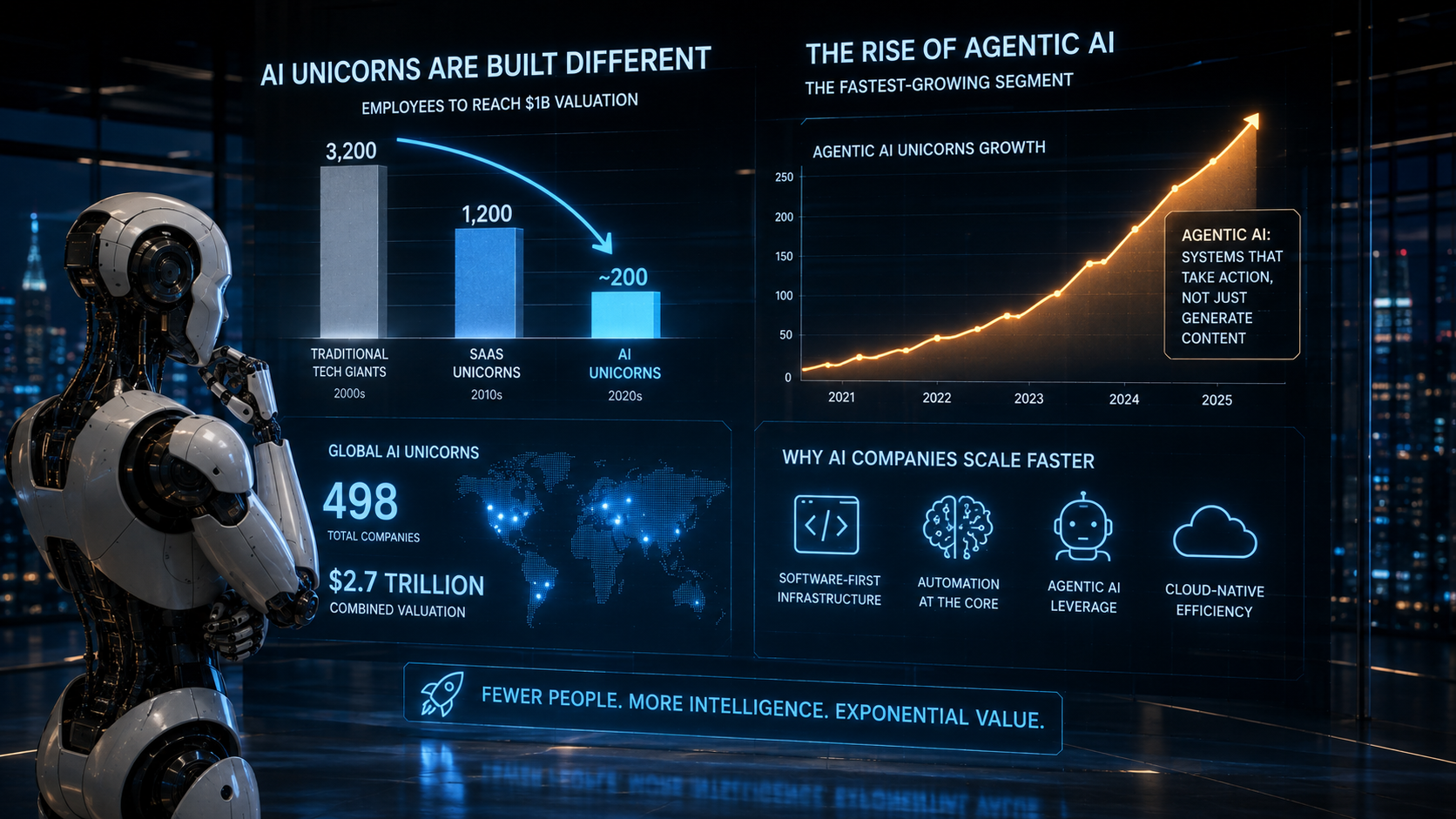
AI unicorns already look structurally different from the companies that came before them. The average AI unicorn now reaches a billion-dollar valuation with roughly 200 employees, a fraction of what earlier tech giants needed to hit the same milestone — and that number has been falling sharply. There are now 498 AI unicorns globally, with a combined valuation of $2.7 trillion, and the fastest-growing segment within that group is specifically agentic AI: systems that take action rather than simply generate text or answer questions.
Zoom out to the macro level and the numbers get even bigger. Analysts estimate AI agents could add $2.6 to $4.4 trillion in value annually across business use cases, and more than half of companies surveyed already report having agents running in production, not just in pilot testing. That’s not speculative venture capital enthusiasm. That’s operational deployment, already generating measurable returns industry trackers estimate at roughly double the cost of running them.
What “No Employees” Actually Means
It’s worth being precise here, because “no employees” doesn’t mean no humans anywhere near the business. It means something more specific: a company where AI agents fill the roles employees would normally occupy — operations, marketing, sales, support — running continuously toward a goal the way a traditional workforce would, with no human in the day-to-day operating loop. A founder or a small ownership team still sets the mission, funds the budget, and holds ultimate accountability. What’s absent isn’t human judgment at the top. It’s the layer of thousands of employees historically needed to execute that judgment at scale.
That distinction matters, because it reframes the milestone. The first trillion-dollar company with no employees won’t be leaderless. It’ll be a company where a handful of people — maybe a dozen, maybe fewer — direct an enormous, continuously operating workforce made entirely of software, coordinating sales, code, support, and finance functions that would have once required tens of thousands of people spread across dozens of office buildings.
The Uncomfortable Questions This Raises
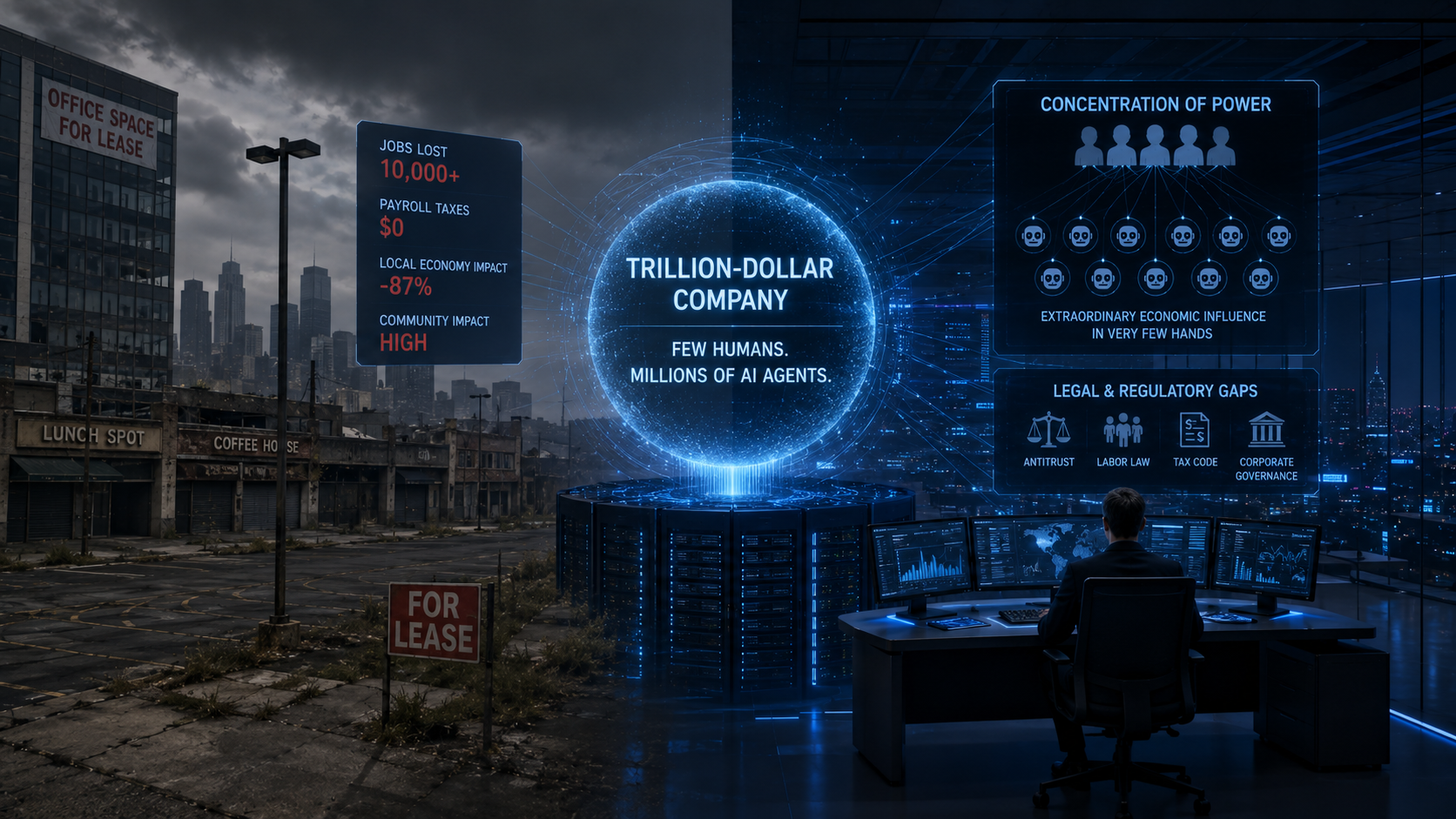
A company this size, built this way, raises problems no regulator, tax code, or labor law was designed to handle. If a trillion-dollar company employs almost no one, what happens to the tax base that currently depends on payroll taxes and large-scale employment? What happens to a regional economy that once depended on that company’s office park, its parking lots, its downtown lunch spots — the entire ecosystem of jobs that used to form around a headquarters, none of which exists when the headquarters is a server rack?
There’s also a harder question about concentration of power. A trillion-dollar company run by a handful of humans directing an army of software agents represents an extraordinary amount of economic influence resting in very few hands — a genuinely new category of corporate structure that existing antitrust and labor frameworks were never built to evaluate.
None of that is a reason to assume this future won’t arrive. If anything, the honest response is the opposite: precisely because the economics point this direction so clearly, the policy conversation about how to handle it needs to start now, not after the first trillion-dollar, zero-employee company is already operating.
The Org Chart of the Future Is Already Being Drawn
We’ve spent the last two years watching individual departments get quietly absorbed into AI workflows, one at a time, each treated as its own isolated story — a legal tech unicorn here, a coding assistant there. But stack those stories together and a different picture emerges: not a series of unrelated disruptions, but the piece-by-piece construction of a company that, eventually, won’t need a workforce at all.
The first trillion-dollar company with no employees won’t announce itself with a dramatic press release. It’ll arrive quietly, built out of exactly the departments already being absorbed today — sales, coding, support, accounting — stitched together by a handful of people who realized, sooner than everyone else, that the org chart of the future doesn’t need to be nearly as large as the one we grew up with.
Related Articles
- Orbilon Tech — How AI Creates $1B One-Person Company
- NanoCorp — What Is an Autonomous AI Company? A 2026 Definition
- Capital Signal — Top AI Agent Startups Investors Are Watching in 2026