When Repair Becomes More Prestigious Than Replacement
The Coming Status Reversal Between Fixing and Buying New
Advanced diagnostics, robotics, additive manufacturing, and AI could make repairing complex products radically easier. A future economy may emerge in which maintaining something for 50 years becomes more technologically impressive than manufacturing another disposable version.
For most of my lifetime, throwing something away and buying a new one has been the sophisticated choice. The old toaster was clunky; the new one was sleek. The old phone was slow; the new one was fast. Replacement wore the halo of progress, while repair got stuck wearing the halo of poverty — something you did because you couldn’t afford better, not because you knew better.
I believe that halo is about to switch heads. And when it does, it will rewrite entire industries, from how products get designed to what we consider genuinely impressive engineering.
The Old Status Hierarchy Is Already Cracking
Look closely and you’ll see the crack forming right now, driven not by nostalgia but by hard economics and even harder regulation. The European Union’s Right to Repair Directive became enforceable law on July 31, 2026, and it doesn’t ease in gently — manufacturers must repair covered products even for customers who bought them years earlier, with no phase-in and no grace period. For appliances like washing machines and dishwashers, manufacturers now have to guarantee spare parts availability for up to ten years after the last unit ever leaves the factory. That’s not a marketing pledge. That’s a legal obligation with real financial penalties attached for getting it wrong.
Here’s what makes this moment different from every well-meaning “repair movement” that came before it: the technology to actually make good on that promise is arriving at the exact same time as the law demanding it. For decades, the obstacle to repair wasn’t willingness — it was economics. Stocking a warehouse full of rarely needed spare parts for a decade was a money-losing proposition for manufacturers, which is a big part of why so many products were quietly engineered to be replaced instead of fixed. That math is now changing fast.

The Warehouse That No Longer Needs to Exist
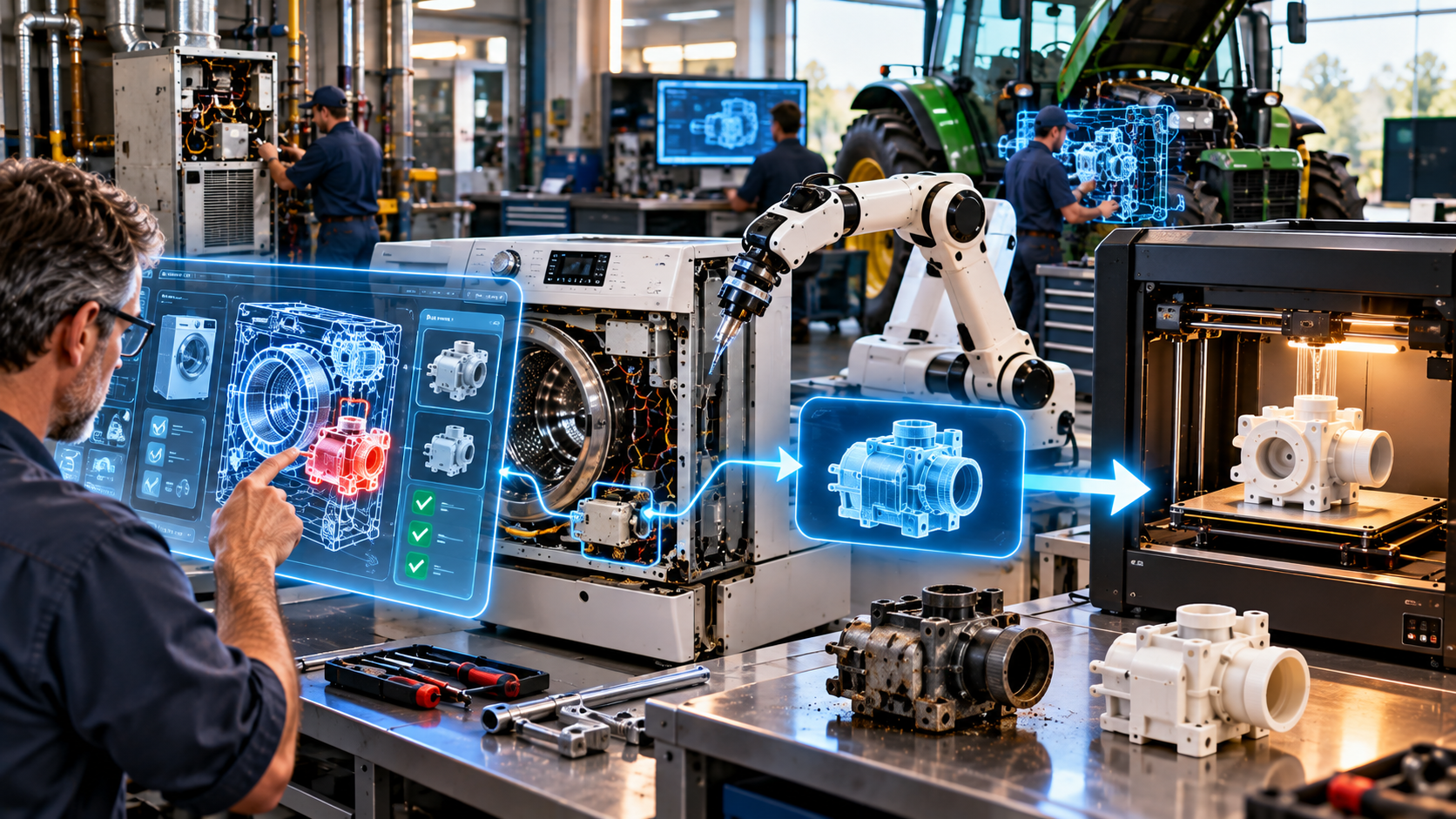
Consider a concrete example. A ten-year-old refrigerator develops a cracked door hinge bracket. The manufacturer retired the original injection-molding tool for that specific part years ago, and building a brand-new tool just to serve the handful of units still out in the field would never pencil out financially under the old model. Under the emerging model, the manufacturer instead keeps a validated digital design file on record. When the repair request comes in, a production partner 3D-prints the bracket on demand, checks it against the original specification, and ships it out — no mold to rebuild, no minimum batch size to justify, no warehouse shelf gathering dust for a decade.
This is precisely the shift now happening across the EU appliance industry, where manufacturers are converting physical spare-parts inventories into digital ones, using additive manufacturing to produce parts only the moment someone genuinely needs them. It flips the entire cost structure of long-term repair from a liability into something closer to a neutral, on-demand service. And once repair stops being a costly burden for manufacturers, it stops being something they quietly discourage — it becomes something they can compete on.
AI as the Repair Technician’s New Superpower
The second half of this transformation is diagnostic, not manufacturing. Repairing something complicated has always required a rare kind of expertise: the ability to look at symptoms — a strange noise, a leak, an error code — and correctly identify which of dozens of possible internal components actually failed. That expertise used to live almost entirely in human heads, which made it scarce, expensive, and slow to scale.
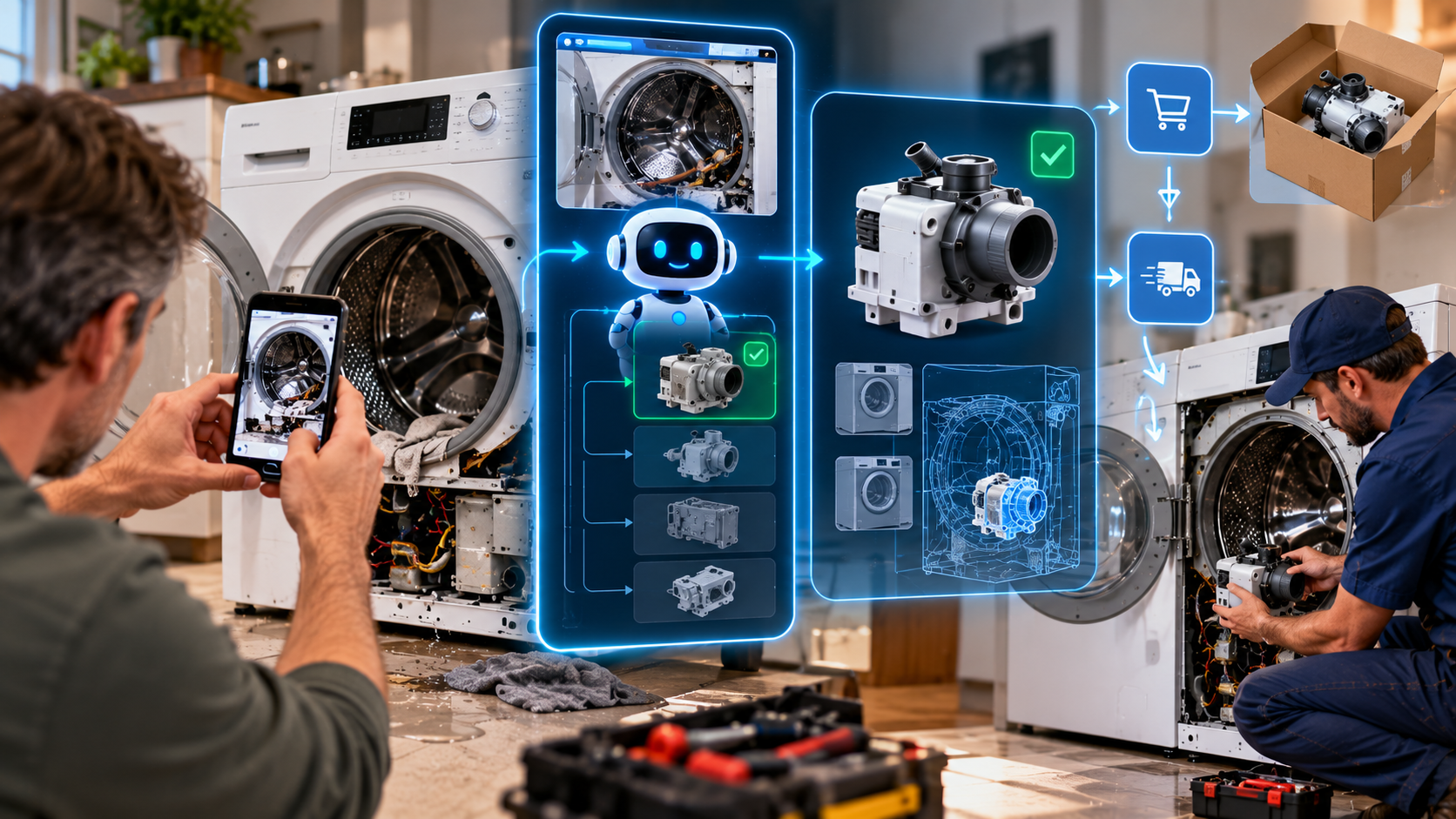
AI is dissolving that bottleneck. Systems now analyze photos of a malfunctioning appliance, cross-reference the specific product model against known failure patterns, check warranty status, and recommend a precise repair path — component identification included — in a matter of seconds rather than requiring a technician visit just to diagnose the problem. Multiply that capability across millions of products and you get something genuinely new: expert-level diagnostic judgment, instantly available, at a cost that keeps shrinking toward zero.
Picture what this actually looks like for an everyday repair decision. A washing machine pump fails. The full economics used to be murky and intimidating enough that most people would just call it quits and buy a new machine. Now, an AI system can instantly lay out the real math: a sixty-dollar pump plus an eighty-dollar technician visit against an eight-hundred-dollar replacement unit plus delivery and disposal fees. When the choice is presented that plainly, repair usually wins on pure economics — and someone who successfully fixes their own machine at that price point isn’t settling for a compromise. They’re the one who came out ahead.

Where the New Prestige Actually Comes From
Status has always attached itself to scarcity and skill, and repair is quietly accumulating both. Building a brand-new appliance mostly requires capital and a supply chain — impressive in its own way, but increasingly automated, commoditized, and unremarkable. Diagnosing a decade-old machine with a subtle intermittent fault, sourcing or printing the exact right component, and bringing a complex piece of engineering back to full function requires something closer to genuine expertise, patience, and craft.
Consider how this dynamic has already played out in other categories. A hand-repaired vintage watch that’s been kept running for sixty years through multiple generations of a family commands more respect, and often more money, than a disposable quartz watch fresh off an assembly line. A well-maintained classic car, lovingly kept original through decades of careful mechanical work, draws crowds at car shows in a way no showroom of identical new sedans ever could. What’s changing now is that this same appreciation — for the human ingenuity of keeping something running rather than the raw fact of making something new — is expanding out of the niche hobbyist world and into ordinary household appliances, electronics, and machinery.
The Coming Redesign of How Things Get Made
Once repairability becomes both legally mandated and technologically cheap, it stops being a compliance checkbox and starts becoming a genuine competitive weapon. France already requires a repairability index score printed on certain products like smartphones, laptops, and washing machines, and the EU is actively considering extending that scoring system across the entire bloc. A visible, comparable repairability score does for appliances roughly what a fuel-economy sticker did for cars: it turns an invisible engineering property into a purchasing decision consumers can actually see and compare.
That kind of visibility changes what engineers optimize for. When a product’s repairability score sits right next to its price tag, “designed to last fifty years and easy to fix” becomes a headline feature rather than a footnote — genuinely more impressive, in the eyes of an informed buyer, than “designed to be replaced in three.” I expect the coming decade of industrial design to look less like a race toward disposability and more like a race toward serviceability, because that’s where the real engineering bragging rights are migrating.
My Prediction: The Fifty-Year Product Becomes the New Luxury Good
Here’s where I think this all lands. Disposability was never actually a sign of progress — it was a workaround for the fact that repair used to be expensive, slow, and dependent on scarce human expertise. Once AI diagnostics and on-demand digital manufacturing solve that problem simultaneously, the underlying economic logic that made “build it cheap, replace it often” the smart default simply stops holding.
I believe we’re heading toward a world where a genuinely well-engineered product — the refrigerator still humming after thirty years, the tractor still running after fifty, the appliance you can trace back through three owners and a dozen documented repairs — becomes a status symbol precisely because it proves something a brand-new purchase never could: that the thing was actually built to be worth keeping. The manufacturers who figure this out first won’t just be complying with a new regulation. They’ll be selling the single most persuasive story a product can tell: this one was made to last, and we’re proud enough of that to prove it.
Related Articles
- “The EU Right to Repair Deadline Is Here: What It Means for Spare Parts and How 3D Printing Supports” — Replique — replique.io/en/eu-right-to-repair-deadline-up-to-10-years-supply-of-spare-parts
- “AI Right to Repair: Laws Driving User Empowerment” — AI Competence — aicompetence.org/ai-right-to-repair-laws-driving-user-empowerment
- “Right to Repair for Home Appliances (2026)” — Claimlane — claimlane.com/resources/blog/right-to-repair-home-appliances