Germany’s AI Drone in a Green Orb Could Revolutionize Wildfire Prevention

Tucked away in the German countryside, a futuristic green orb—resembling a giant, solar-panel-covered golf ball—is housing what may become a game-changing solution to one of the world’s most destructive consequences of climate change: wildfires. Developed by German tech company Dryad, the installation serves as a hangar for an AI-powered drone designed to detect and extinguish wildfires within minutes.

With rising global temperatures, wildfires are becoming more frequent, aggressive, and harder to control. “Fires are spreading much faster and more aggressively than in the past. That also means we have to react more quickly,” explained Dryad CEO Carsten Brinkschulte during a demonstration near Berlin. Once rare in Germany, wildfires are now a growing threat—even in urban-adjacent areas like the forests around Berlin, where severe blazes erupted during the 2022 heatwave.

Continue reading… “Germany’s AI Drone in a Green Orb Could Revolutionize Wildfire Prevention”

Revolutionizing Weather Forecasting: Aardvark AI Offers Faster, More Accessible Predictions

A groundbreaking AI weather prediction system, Aardvark Weather, has emerged as a game-changer in meteorology, providing forecasts tens of times faster and using a fraction of the computing power required by current AI and physics-based systems. According to a recent study published in Nature, Aardvark promises to significantly transform the way weather predictions are made, potentially revolutionizing practices in both developed and developing countries.

Aardvark was developed by researchers from the University of Cambridge, in collaboration with the Alan Turing InstituteMicrosoft Research, and the European Centre for Medium-Range Weather Forecasting (ECMWF). This new approach offers a fresh blueprint for weather forecasting, moving away from complex, resource-intensive systems towards a streamlined, AI-driven model that could reshape global forecasting methods.

Continue reading… “Revolutionizing Weather Forecasting: Aardvark AI Offers Faster, More Accessible Predictions”

Columbia Engineering Breakthrough: 3D Photonic-Electronic Platform to Revolutionize AI and Computing

Artificial intelligence (AI) is poised to drive groundbreaking technological advancements, but its progress has long been hindered by issues like energy inefficiencies and bottlenecks in data transfer. Now, researchers at Columbia Engineering have unveiled a game-changing solution: a 3D photonic-electronic platform that dramatically improves both energy efficiency and bandwidth density. This innovation represents a critical step toward creating faster, more capable AI hardware.

Published in Nature Photonics, the study, led by Keren Bergman, Charles Batchelor Professor of Electrical Engineering, introduces a novel approach that integrates photonics with advanced complementary metal-oxide-semiconductor (CMOS) electronics. By combining these two technologies, the researchers have developed a high-speed, energy-efficient data communication system that directly addresses one of the biggest hardware challenges in AI—moving large amounts of data quickly without consuming excessive power.

Continue reading… “Columbia Engineering Breakthrough: 3D Photonic-Electronic Platform to Revolutionize AI and Computing”

Nathan Myhrvold Reflects on AI’s Potential and the Need for More “Miracles” to Unlock Its Full Power

Nathan Myhrvold, a key figure in the rise of modern computing as Microsoft’s first CTO, has witnessed the technological revolution firsthand. His role in shaping Microsoft’s strategy from 1986 to 2000, where he worked alongside Bill Gates, positioned him as a pioneer during a formative period for the tech industry. Decades after leaving the company, Myhrvold continues to reflect on his experiences and offers insights into the current state of artificial intelligence (AI)—and while he’s impressed with the progress, he believes that AI is still far from reaching its true potential.

At GeekWire’s Microsoft@50 event on Thursday, Myhrvold discussed Microsoft’s profound impact on the modern tech landscape. He noted, “We live in a technological world. We all interact with technology constantly, and Microsoft was an absolutely fundamental, foundational part of that.” He recalled how Microsoft’s early vision of “a computer on every desk and in every home,” once ridiculed, has now become a global reality, transforming the world for the better.

Continue reading… “Nathan Myhrvold Reflects on AI’s Potential and the Need for More “Miracles” to Unlock Its Full Power”

MIT and NVIDIA Create Hybrid AI Model to Speed Up Image Generation by 9x with Unmatched Detail

The ability to generate high-quality images quickly is a game-changer for applications like training self-driving cars to navigate complex environments and predict hazards on the road. However, current generative AI techniques used for producing such images come with their own set of limitations. Diffusion models, while producing incredibly realistic images, are slow and resource-intensive. On the other hand, autoregressive models—like the ones behind LLMs such as ChatGPT—are fast but often result in images with errors and poor detail. Now, researchers from MIT and NVIDIA have developed a solution that combines the strengths of both approaches.

Their groundbreaking hybrid image-generation tool, known as HART (Hybrid Autoregressive Transformer), integrates an autoregressive model for fast, high-level image generation and a smaller diffusion model to refine and enhance image details. Published on the arXiv preprint server, HART produces images that match or even surpass the quality of current state-of-the-art diffusion models, all while running up to nine times faster.

Continue reading… “MIT and NVIDIA Create Hybrid AI Model to Speed Up Image Generation by 9x with Unmatched Detail”

NVIDIA Unveils Groundbreaking AI Technologies to Transform Robotics and Healthcare

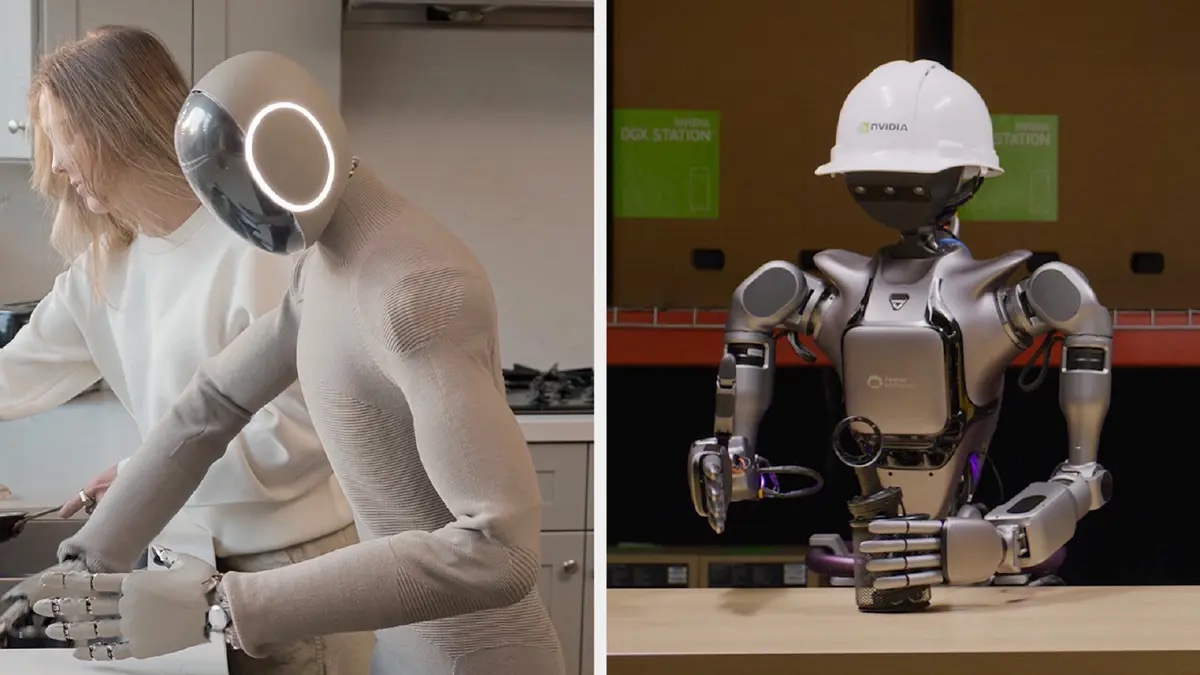
At its GTC conference, NVIDIA made a series of groundbreaking announcements, unveiling a suite of AI-driven technologies designed to revolutionize industries from robotics to healthcare. Among the key innovations revealed was Isaac GR00T N1, the world’s first fully customizable foundation model for humanoid reasoning and skills. Alongside this, NVIDIA introduced Isaac GR00T Blueprint for synthetic data generation, and Newton, a physics engine developed in collaboration with Google DeepMind and Disney Research.

These advancements mark a significant leap in NVIDIA’s mission to bridge the gap between AI and the physical world, offering new possibilities for developers and industries alike. One of the most highly anticipated innovations, Isaac GR00T N1, is the first of a series of pre-trained, customizable models designed for robotics developers. This revolutionary model aims to address the growing global labor shortage, which exceeds 50 million workers, by enhancing robotic capabilities in industries worldwide.

Continue reading… “NVIDIA Unveils Groundbreaking AI Technologies to Transform Robotics and Healthcare”

Revolutionizing AI Training: A Breakthrough Method for Faster, More Energy-Efficient Neural Networks

AI technologies, including large language models (LLMs), have rapidly become integral to everyday life. However, the computational power required to support these technologies is driven by data centers, which consume massive amounts of energy. In Germany alone, data centers consumed around 16 billion kilowatt-hours (kWh) of electricity in 2020—approximately 1% of the nation’s total energy consumption. By 2025, this figure is expected to rise to 22 billion kWh, highlighting the growing energy demands of AI systems.

As AI applications become increasingly complex, their energy needs are expected to grow, especially in the realm of training neural networks, which demand significant computational resources. In response to this challenge, researchers have pioneered a revolutionary training method that is 100 times faster than traditional approaches, all while maintaining the same level of accuracy. This innovation has the potential to substantially reduce the energy required for AI training, offering a promising solution to the industry’s sustainability concerns.

Continue reading… “Revolutionizing AI Training: A Breakthrough Method for Faster, More Energy-Efficient Neural Networks”

Scientists Unveil AI-Powered Digital Twin Model That Can Act Autonomously in Real-Time

A team of scientists has unveiled a groundbreaking new AI-assisted digital twin model that can not only replicate real-world machines but also control and adapt to them in real-time. This innovative concept, described in a study published in the journal IEEE Access, has the potential to revolutionize how smart cities and autonomous systems operate in the future.

The new approach, termed Intelligent Acting Digital Twins (IADT), allows digital twins—digital replicas of physical objects or machines—to go beyond mere simulations. Traditionally, digital twins serve as real-time representations of physical entities, constantly updated with data to monitor their state. These models are widely used in industries like manufacturing, healthcare, and defense, where they help engineers visualize, assess, and predict the behavior of physical machines.

Continue reading… “Scientists Unveil AI-Powered Digital Twin Model That Can Act Autonomously in Real-Time”

China’s Revolutionary Fully Autonomous AI Agent

A group of Chinese software engineers has developed what they claim to be the “world’s first” fully autonomous artificial intelligence (AI) agent, named Manus. Unlike existing AI systems such as ChatGPT, Google’s Gemini, or Grok— which all require human input—Manus can perform complex tasks independently, making proactive decisions and taking actions without waiting for human guidance. This marks a significant leap forward in AI technology.

Manus operates in a way that sets it apart from conventional AI systems. While traditional AIs rely on user instructions to perform tasks, Manus can autonomously assess situations and carry out multi-step workflows. For example, if asked to “Find me an apartment,” Manus doesn’t just search through listings. It evaluates factors like crime rates, weather patterns, and market trends to offer tailored recommendations, all without any human intervention.

Continue reading… “China’s Revolutionary Fully Autonomous AI Agent”

Fujitsu Leverages AI-Driven Video Analytics for Enhanced Security and Automation

Fujitsu is collaborating with Nvidia to integrate AI-powered radio access networks into video analytics, offering the ability to detect potential criminal activity or identify vulnerable individuals in distress, such as someone who has fallen. Radio access networks, which connect devices to mobile telecommunications systems via radio connections, are being enhanced with AI to reduce latency and improve real-time responsiveness in critical applications.

At the Mobile World Congress in Barcelona, Fujitsu is showcasing a range of innovative applications powered by this advanced technology. One of the standout uses involves CCTV monitoring, where the system not only interprets what is happening in a video feed but also analyzes body movements to predict criminal intent or detect emotional cues.

Continue reading… “Fujitsu Leverages AI-Driven Video Analytics for Enhanced Security and Automation”

BrainLLM: A Breakthrough in Decoding Thoughts into Text Using Brain Activity

Recent developments in large language models (LLMs), like those powering AI chatbots such as ChatGPT, have revolutionized text generation by predicting word sequences. However, integrating these models with brain recordings has remained a significant challenge. The key question is whether we can directly generate natural language from brain activity, bypassing the limitations of predefined word sets. A groundbreaking study has made strides toward this vision by introducing BrainLLM, a system that merges brain recordings with LLMs to generate coherent natural language.

In this study, researchers developed BrainLLM, a system designed to directly translate brain activity into natural language by integrating brain recordings with an LLM. The study relied on non-invasive functional magnetic resonance imaging (fMRI) data collected from participants while they processed spoken or written language stimuli. To train the model, the researchers used three public datasets containing fMRI recordings of individuals exposed to various linguistic stimuli.

Continue reading… “BrainLLM: A Breakthrough in Decoding Thoughts into Text Using Brain Activity”

Princeton and University of Washington Develop Ultra-Efficient Light-Based Camera for AI Vision

Researchers from Princeton University and the University of Washington have made a remarkable leap in camera technology by developing an ultra-compact camera—about the size of a grain of salt—that captures incredibly detailed, full-color images. Building on this breakthrough, the team has now developed a new type of camera designed for computer vision, a key area of artificial intelligence (AI) that enables computers to recognize and interpret images and videos.

This new prototype camera takes a radically different approach to computer vision. Unlike traditional devices that rely on electricity, this camera uses light to perform object identification and analysis, offering extraordinary speed and energy efficiency. The camera can identify objects at the speed of light, making it far faster and more efficient than conventional computer vision systems.

Continue reading… “Princeton and University of Washington Develop Ultra-Efficient Light-Based Camera for AI Vision”
Discover the Hidden Patterns of Tomorrow with Futurist Thomas Frey
Unlock Your Potential, Ignite Your Success.

By delving into the futuring techniques of Futurist Thomas Frey, you’ll embark on an enlightening journey.

Learn More about this exciting program.