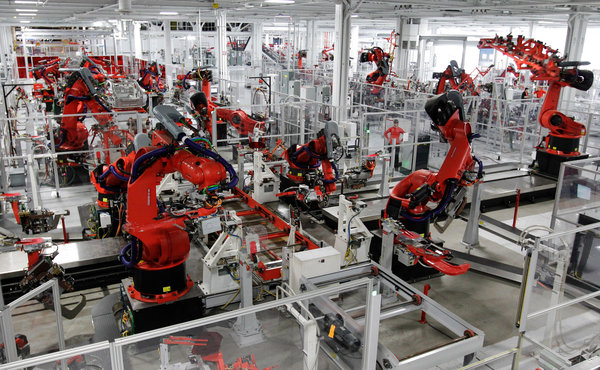
At the new Tesla factory in Fremont, Calif., a robot might do up to four jobs: welding, riveting, bonding and installing a component.
On the coast of China at the Philips Electronics factory hundreds of workers use the old way of working to assemble electric shavers by using their hands and specialized tools.
Chemistry professor Robert Parson instructs his students in a lecture hall classroom during a chemistry class at Colorado University.
An annual meeting of the The American Anthropological Association is held to showcase research from around the world. Thousands of other anthropologists usually pay $650 for airfare, $400 for three nights in a “student” hotel, $70 for membership, and $94 for admission. The latter two fees are student rates. If you are unemployed or underemployed scholar, the rates would double.
Median household income is in the middle of its worst 12-year period since the Great Depression. New York Times and David Leonhardt have launched a feature to investigate the hardest question: Why?
Futurist Thomas Frey: In the late 1980s I was still working at IBM, but had taken on a number of side projects to expand my horizons. One of those projects was working with the City of Denver on the redevelopment of Stapleton Airport.
New rulings mean big changes in the online poker world.
Two weeks ago, online poker site PokerStars.com reached a settlement agreement with the United States Department of Justice in the amount of $731 Million dollars in relations to charges brought against them in April of 2011. In addition, the settlement included terms that saw PokerStars purchase rival online poker site Full Tilt Poker.
For those unfamiliar with the story, the US Department of Justice unsealed an indictment on April 15th, 2011 against PokerStars, Full Tilt, and Absolute Poker that charged them with numerous crimes that included money laundering, bank fraud, and violations of the UIGEA. In addition, their .com domains were seized by the US Government.Since that time, Full Tilt and Absolute Poker have both been forced out of business and PokerStars pulled out of the United States…
With the arrival of the big smartphone platforms, we’ve reverted back to 1999.
Mobile app startups are failing like it’s 1999 with the long cycle times for developing the apps. It’s like we’ve forgotten all the agile and rapid iteration stuff that we learned over the last 10 years.
Twenty-seven year old Natasha Pecor just finished her first year in the MBA program at Duke’s Fuqua School of Business. But after interning this summer at Freestyle Capital, a San Francisco venture capital firm that finances early-stage startups, she may not pursue a second year.
Tobacco companies fear the law will set a global precedent that could slash billions from the values of their brands.
The highest court in Australia upheld the world’s toughest law on cigarette promotion Wednesday. The law prohibits tobacco company logos on cigarette packs that will instead show cancer-riddled mouths, blinded eyeballs and sickly children.
Buying a car often is the second-largest purchase most people will ever make.
They could be called digital test-drivers. According to a new study, more than one in 10 new-car shoppers, armed with online research, now buy vehicles without taking a test drive.
The cloud is starting to become the “mainframe” in the sky.
We are seeing the greatest shakeup in the world of computing that has ever taken place. Three kinds of devices defined what computing was all about over a period of about 50 years. We started out with mainframes, moved on to mini-computers and in the early ’80s entered the era of the personal computer.
According to a plugged-in industry source Google is eyeing a new project: same-day delivery. At first, this seemed like a ridiculous idea. But after some thought the idea kind of makes sense.
A pack of digital authors ganged up on a useful site that connected e-book consumers and shut them down.
The process of lending an e-book is complicated and much of it is a result of conflicting DRM locks and platforms as well as a reluctance on the part of publishers to allow their books to be loaned. But authors can also be a roadblock when it comes to lending, and we’ve just had a classic example of how that can happen with the brouhaha over LendInk, a service that allowed readers to connect with others in order to share e-books. The site has effectively been put out of business by a virtual lynch mob of authors claiming it breached their rights, even though what it was doing was perfectly legal.