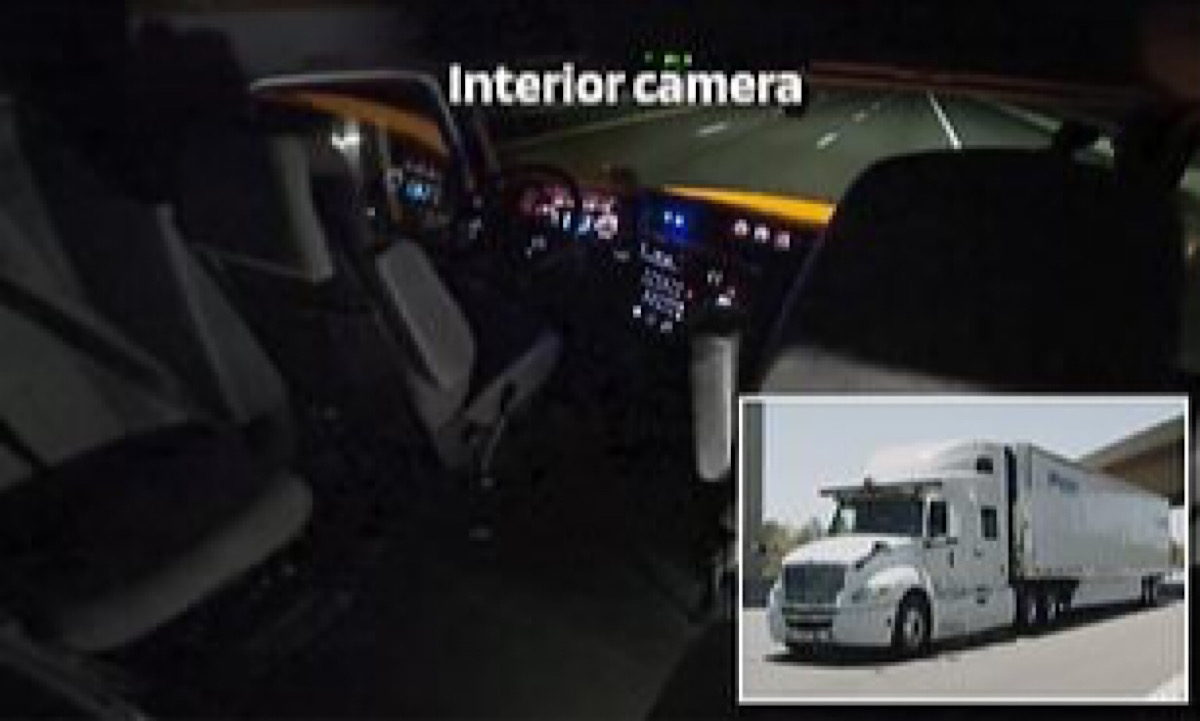
World’s first fully driverless truck trip: TuSimple’s autonomous semi traveled 80 miles on public roads from Tucson to Phoenix with no one at the wheel

By STACY LIBERATORE

  • The truck, developed by TuSimple, cruised along I-10 from Tucson, Arizona to Phoenix for one-hour and 20 minutes
  • This is the world’s first fully driverless trip taken by a semitruck
  • No human was at the wheel or inside truck during its 80-mile journey
  • The truck also operated on public roads, highways and through congested areas 

TuSimple’s autonomous semitruck recently completed the world’s first driverless trip, which saw the vehicle travel 80 miles in Arizona without a safety person at the wheel or any human intervention. 

The nighttime drive on December 22 started at a railyard in Tucson, traveled along 1-10 for one hour and 20 minutes, and ended at a distribution center in Phoenix.

Along the journey, TuSimple’s Autonomous Driving System (ADS) successfully navigated surface streets, traffic signals, on-ramps, off-ramps, emergency lane vehicles, and highway lane changes in open traffic while naturally interacting with other motorists, according to the company.

This trip is also the first time a class 8 autonomous truck has operated on open public roads and TuSimple says this is only the beginning of its technology’s abilities.

Continue reading… “World’s first fully driverless truck trip: TuSimple’s autonomous semi traveled 80 miles on public roads from Tucson to Phoenix with no one at the wheel”

Ford to launch free food delivery program in southwest Detroit using autonomous shuttle

By Jordyn Grzelewski

In a move aimed both at fulfilling a community need and advancing vehicle technologies considered a key part of its future, Ford Motor Co. is launching a fresh food delivery pilot in southwest Detroit using an autonomous vehicle shuttle.

The Dearborn automaker, with its philanthropic arm the Ford Motor Co. Fund, on Tuesday announced a six-month initiative kicking off after the holidays that aims to deliver approximately 10,000 pounds of fresh food to residents of Rio Vista Detroit Co-op Apartments, a senior living center near Ford’s under-construction Michigan Central campus in Corktown. 

The pilot builds on a free food program, called Ford Resource and Engagement Center on the Go, that the Ford Fund and Gleaners Community Food Bank launched earlier this year, doubling the existing food deliveries for more than 20 Rio Vista residents who participate in the service.

“We’re constantly thinking about how to expand our reach in communities for those who don’t have access to the most basic goods, like groceries or warm meals,” Joe Provenzano, mobility director for the Ford Fund, said in a statement. “Bringing Ford’s mobility expertise together with local collaborations allows us to create innovative solutions that make communities stronger and people’s lives better.”

The existing food delivery program operated by the Ford Fund and Gleaners already has distributed roughly 2.4 million pounds of food, according to a news release. Participants receive a mixture of dry and canned goods, plus fresh produce, milk and cheese. The pilot program will bring participants with an additional delivery, containing fresh produce and milk, each month. 

Continue reading… “Ford to launch free food delivery program in southwest Detroit using autonomous shuttle”

China’s Baidu wants to launch its driverless robotaxi service in 100 cities by 2030

An Apollo Robotaxi runs at Shougang Park as Baidu launches China’s first driverless taxi service in the city on May 2, 2021 in Beijing, China.

By Arjun Kharpal

  • Baidu plans to launch its driverless taxi service in 100 cities by 2030 as the Chinese search giant looks to diversify its business beyond advertising. 
  • The company wants to expand Apollo Go to 65 cities by 2025 and then 100 cities by 2030, Baidu CEO Robin Li said in an internal letter that was made public. 
  • Baidu’s driverless car announcement comes after the company reported revenue of 31.92 billion yuan ($4.95 billion) for the third quarter, which was ahead of market expectations. 

GUANGZHOU, China — Baidu plans to launch its driverless taxi service in 100 cities by 2030, as the Chinese search giant looks to diversify its business beyond advertising.

Currently, Baidu operates its Apollo Go robotaxi service in five Chinese cities. Users can hail an autonomous car via an app.

The company wants to expand Apollo Go to 65 cities by 2025 and then 100 cities by 2030, Baidu CEO Robin Li said in an internal letter that was made public.

Continue reading… “China’s Baidu wants to launch its driverless robotaxi service in 100 cities by 2030”

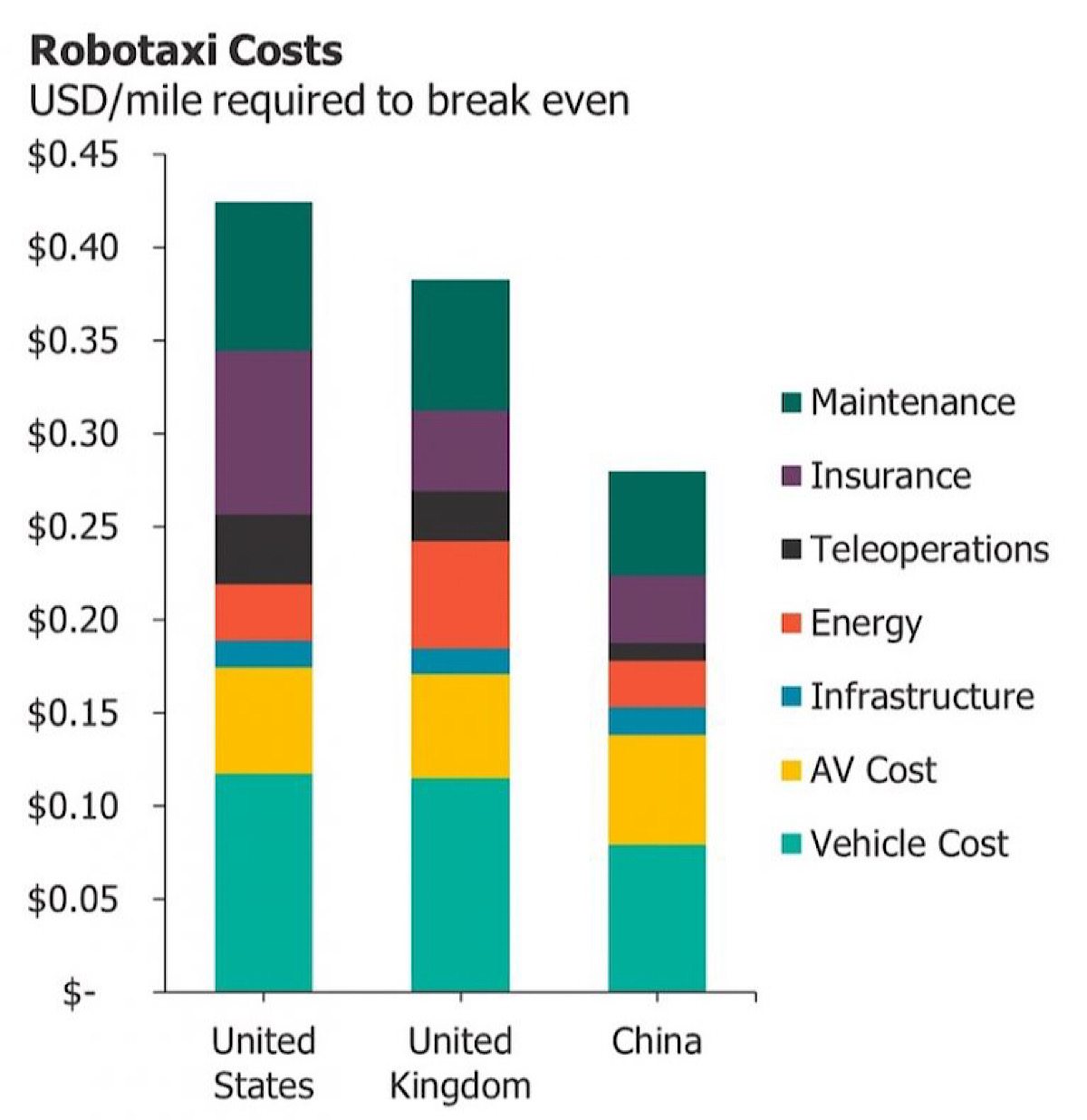
‘Robotaxis will be disruptive to conventional taxis and ride-hailing, but not car ownership’, says new report

BY DAVID EDWARDS

Robotaxis remain one of the most pursued applications for autonomous vehicle technologies today, with many developers envisioning an end to – or at least a significant reduction in – car ownership. 

Developers of autonomous vehicles, specifically those focused on Level-4 self-driving vehicles, often focus on mobility services as the first application.

Not only is there a demonstrated market for taxis and ride-hailing, but it’s a market where the high costs of labor create high prices, making it a ripe opportunity for autonomous vehicle deployment. 

It is also a good technology fit as they can operate in geo-fenced areas, according to new data from Lux Research, a leading provider of tech-enabled research and innovation advisory services.

Continue reading… “‘Robotaxis will be disruptive to conventional taxis and ride-hailing, but not car ownership’, says new report”

GE Appliances and Einride unveil first autonomous and electric truck operating on US soil

Einride will bring its Pods to the US for the first time on GE Appliances’ 750-acre Appliance Park campus in Louisville, Kentucky.

By Jonathan Greig

Transportation is about to get a technology-driven reboot. The details are still taking shape, but future transport systems will certainly be connected, data-driven and highly automated.

GE Appliances and Swedish freight technology company Einride announced the debut of what they say is the first autonomous and electric truck to operate on US soil this week. 

Einride has been operating internationally since 2019 but will bring its autonomous Pods to the US for the first time on GE Appliances’ 750-acre Appliance Park campus in Louisville, Kentucky. 

Einride is also providing GE Appliances with electric vehicles at locations in Tennessee and Georgia. The companies claimed that the partnership would save GE Appliances 970 tons of CO2 emissions within the first year. 

“Sustainability and cost-efficiency is a prerequisite for implementing innovation into our business strategy,” said Bill Good, vice president of manufacturing at GE Appliances.

Continue reading… “GE Appliances and Einride unveil first autonomous and electric truck operating on US soil”

Volvo Unveils First Autonomous EV Made from Fossil-free Steel

By Nolan Beilstein

Volvo Group has built a prototype made with fossil-free steel and New Atlas reports the Swedish manufacturing corporation is claiming the vehicle is the first of its kind. The fully electric and autonomous vehicle is a load carrier and Volvo expects a small-scale series production in 2022 with mass production to follow. 

In August, Swedish steelmaker SSAB completed the first fossil-free steel delivery to Volvo. Volvo then used the steel to make the new load carrier. 

SSAB manufactured the steel by using hydrogen rather than coal and coke as a reductant. Also, instead of a coal-fired blast furnace, SSAB used an electric variant that runs on renewable energy. 

Continue reading… “Volvo Unveils First Autonomous EV Made from Fossil-free Steel”

EINRIDE LAUNCHES AUTONOMOUS PODS AND ELECTRIC FREIGHT OPERATIONS IN US

By Rebecca Bellan

Swedish freight technology company Einride announced the launch of its operations in the United States. On Thursday, the company will officially begin testing its transport solutions — like its autonomous “pods,” electric trucks and “Saga” operating system — with partners like GE Appliances (GEA), Bridgestone and Oatly.

The company also announced that it would introduce a U.S. version of its pod which has been adapted to suit American road conditions and regulations, as well as a flatbed pod, a module vehicle built to accommodate a range of shipping needs, such as transporting containers from shipyards.

Einride operates one of Europe’s largest fleets of electric trucks. Its autonomous pods, which are built without a front cab, and thus, without room for a human safety operator, are also electric. Some of the other major players in the autonomous freight game, like Kodiak Robotics, TuSimple and Waymo, are not necessarily pursuing an electric-only approach.

“Between 7% and 8% of global CO2 emissions come from heavy road freight transport,” Robert Falck, CEO and founder of Einride, told TechCrunch. “One of the drivers for starting Einride is that I’m very worried that by optimizing and making road freight transport autonomous, but based on diesel, it’s likely that we will actually increase emissions because it would become that much cheaper to operate.”

Continue reading… “EINRIDE LAUNCHES AUTONOMOUS PODS AND ELECTRIC FREIGHT OPERATIONS IN US”

FedEx teams up with Neolix for autonomous delivery vehicle test

Neolix-FedEx delivery vehicle

By Gabriella From Gasgoo

Beijing (Gasgoo)- Global express transportation giant FedEx Express announced that it is working with China’s Neolix to test autonomous delivery vehicles in China. This marks the first time that FedEx has partnered with local Chinese tech company for driverless vehicle tests.

The partnership signifies FedEx’s effort to embrace the innovative, sustainable and intelligent logistics in China.

FedEx disclosed that the Neolix collaborative vehicles will be electric-powered with a range of 100km on a full charge and features L4 autonomous functions. The vehicles will be mounted with an interchangeable cargo box that can be converted into a temperature-controlled storage or a parcel locker. The maximum cargo capacity is roughly 500 kg.

Continue reading… “FedEx teams up with Neolix for autonomous delivery vehicle test”

Germany unveils world’s first automated, driverless train

The project, which Siemens and Deutsche Bahn called a “world first”, is part of a 60 million euro ($70 million) modernisation of Hamburg’s rapid urban rail system.

by Shubhangi Gupta

German rail operator Deutsche Bahn and industrial group Siemens on Monday unveiled the world’s first automated, driverless train in the city of Hamburg, billing it as more punctual and energy efficient than traditional trains.

Four such trains will join the northern city’s S-Bahn rapid urban rail network and start carrying passengers from December, using the existing rail infrastructure.

Other cities like Paris have driverless metros while airports often have automated monorail trains plying terminals, but those run on exclusive single tracks while the Hamburg train will be sharing tracks with other regular trains.

Continue reading… “Germany unveils world’s first automated, driverless train”

New York-based Buffalo Automation unveils Greycraft, the world’s first fully autonomous, AI-driven water taxi concept | Tech News | Startups News

By Laurie Foti

We wrote about Buffalo Automation in November of 2019 after the New York-based tech startup was selected as one of the 19 semi-finalists to compete for the $3 million investments by New York accelerator GENIUS NY. A lot of exciting things have happened since them.

Last week, Buffalo Automation unveiled the world’s first fully autonomous, AI-driven, passenger-carrying robotaxi in Knoxville, Tennessee next week, opening the door for cities nationwide to adopt this alternative form of transportation. The official launch of the fully operational Greycraft Water Taxi is targeted for early 2021 and will initially be cost-free for residents pending proper transportation permits.

Greycraft is the only solar-powered, autonomous vessel currently capable of carrying passengers and traversing busy waterways. Using the newly released Mayday app, it can also be hailed much like Lyft or Uber. Buffalo Automation has made the possibility of using autonomous water taxis as a safe, reliable, environmentally friendly means of transport, a reality.

Founded in 2015 Thiru Vikram, Buffalo Automation is an AI startup that provides autonomous systems for commercial ships, recreational boats, ports, and waterways. Buffalo Automation’s flagship product, Automate, is a predictive boat navigation system that guides large commercial ships.

Continue reading… “New York-based Buffalo Automation unveils Greycraft, the world’s first fully autonomous, AI-driven water taxi concept | Tech News | Startups News”

New Citroen Skate is autonomous platform with swappable pods

Urban mobility concept can drive itself around a city, hosting travel compartments designed by different companies

By Felix Page

Skate, a new platform concept, is Citroën’s vision for the future of autonomous shared mobility in cities and forms part of a revolutionary “open-source” model that the firm says could improve traffic fluidity by 35%. 

The platform, equipped with level-five autonomous capabilities to move around urban areas with no human input, can operate “almost continuously” 24/7, charging itself at dedicated hubs. 

t has a maximum speed of 3mph or 16mph, depending on its surroundings, and is equipped with Citroën’s Advanced Comfort hydraulic cushion suspension set-up for optimum ride quality. Bespoke motorised spherical wheels designed by Goodyear allow for 360deg manoeuvrability, “just like a computer mouse”. 

Continue reading… “New Citroen Skate is autonomous platform with swappable pods”

WeRide Launches China’s First Level 4 Self-Driving Cargo Van

WeRide’s Robovan, China’s first L4 self-driving cargo van.

By Charles Choi

Autonomous driving startup WeRide unveiled China’s first self-driving cargo van capable of level 4 autonomy — that is, the ability to act without any human intervention in the vast majority of situations — on September 9.

WeRide is developing the new vehicle, dubbed the Robovan, in partnership with Chinese automaker Jiangling Motors and Chinese delivery company ZTO Express. WeRide and Jiangling Motors will help develop the vehicle for mass production on JMC’s customized assembly lines, which ZTO Express aims to use in urban logistics applications.

“WeRide has always emphasized that autonomous driving technologies should be used effectively in reality to serve the society. With the introduction of Robovan, the very first level 4 self-driving cargo van in China, we have heralded a new era of autonomous driving for urban logistics in the country,” Tony Han, the founder and CEO of WeRide, said in a statement. “We are aiming to deliver both smart mobility and smart logistics for cities in the future.”

Continue reading… “WeRide Launches China’s First Level 4 Self-Driving Cargo Van”
Discover the Hidden Patterns of Tomorrow with Futurist Thomas Frey
Unlock Your Potential, Ignite Your Success.

By delving into the futuring techniques of Futurist Thomas Frey, you’ll embark on an enlightening journey.

Learn More about this exciting program.