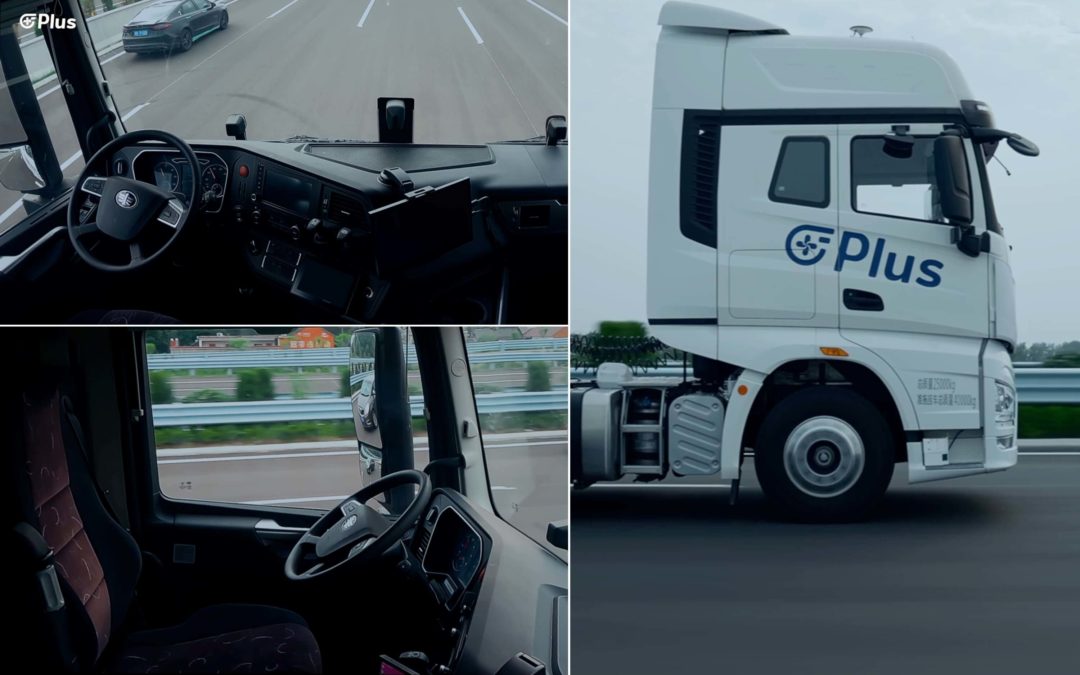
Plus demos level 4 autonomous truck

Plus_driverless_demo_image_for_press_release-3.jpg
DRIVERLESS SEMI TRUCK COMPLETES RUN ON CHINA HIGHWAY, WITHOUT A SAFETY DRIVER OR OTHER HUMAN INTERVENTION.

California-based self-driving truck technology provider Plus reached a milestone this week with the successful completion of a driverless Level 4 truck demonstration on a China highway, the company said Thursday. 

The demo was run completely autonomously, without a safety driver, teleoperator, or any other form of human intervention, according to company leaders.The demonstration took place on the Wufengshan highway in China’s Yangtze Delta region.

It was conducted with a special permit on the newly built highway, company leaders said, adding that Plus was the first company to be granted such a permit in China. During the demonstration, the driverless truck drove safely and smoothly in typical highway traffic, the company also said.“The driverless demo highlights the ability of our Level 4 autonomous driving technology to enable driverless highway operations in a semi truck.

Continue reading… “Plus demos level 4 autonomous truck”

The measure of: Trombia Free autonomous electric street sweeper

The world’s first autonomous electric street sweeper promises efficient and silent operation in all weathers.

Developed by Finnish road maintenance equipment manufacturer Trombia Technologies, Trombia Free is an autonomous electric street-cleaner that uses less than 15 per cent of the power needed by current sweeping technologies and 95 per cent less water, while still being capable of heavy-duty operation, effectively removing both debris and fine PM2.5 dust.

Built to operate in all weather conditions, the Trombia Free has the look of an oversized robotic vacuum cleaner or lawnmower. It makes use of lidar and machine vision technology to trundle around cleaning up city streets and pathways. The company equipped the sweeper with a safety margin zone so it can register obstacles in front and stop if needed.

Continue reading… “The measure of: Trombia Free autonomous electric street sweeper”

World’s Most Advanced Autonomous Research Vehicle Completes Ocean Crossing from San Francisco to Hawaii

The uncrewed, autonomous, Saildrone Surveyor will arrive in Hawaii today after a groundbreaking maiden voyage from San Francisco to Honolulu. 

Over 80% of Earth’s oceans remain unmapped. Saildrone intends to map the world’s oceans in the next 10 years.

While ocean crossings are nothing new for Saildrone’s autonomous surface vehicles, the Saildrone Surveyor is a new, much larger class of vehicle optimized for deep-ocean mapping. During the 28-day voyage, the Saildrone Surveyor sailed 2,250 nautical miles and mapped 6,400 square nautical miles of seafloor.

Using renewable wind and solar energy for its primary power source, the Saildrone Surveyor is the only vehicle in the world capable of long-endurance, uncrewed ocean mapping operations. The valuable data it collects will help address issues impacting our world including climate change, offshore renewable energy, natural resource management, and maritime safety.

Measuring 72 feet long (22 m) and weighing 14 tons, the Saildrone Surveyor carries a sophisticated array of acoustic instruments, normally carried by large, manned survey ships. The Surveyor’s sensors interrogate the water column looking at underwater ecosystems and map the seafloor in high resolution to a depth of 23,000 feet (7,000 m).

Continue reading… “World’s Most Advanced Autonomous Research Vehicle Completes Ocean Crossing from San Francisco to Hawaii”

Infineon creates radar sensors to monitor people in self-driving cars

Infineon’s radar sensors can detect human movement in self-driving cars.

By Dean Takahashi

When self-driving cars hit the market, they will need to monitor the well-being of the “driver” and passengers in the car. Today, Infineon Technologies is announcing some sensors that can do just that using radar technology.

The radar can detect subtle movements from people in a car, including noticing children who may have been inadvertently left behind, drivers who are having a heart attack or some other emergency, and passengers who have simply fallen asleep in the car.

With this data, the intelligent car can send out emergency alerts or make adjustments, such as ensuring seat belts and emergency air bags are in the correct positions.

Continue reading… “Infineon creates radar sensors to monitor people in self-driving cars”

Roboats: Amsterdam tests out electric autonomous boats on its canals

An electric boat steers close to a full-size replica of the 18th century three-mast trading ship Amsterdam at the National Maritime Museum, in Amsterdam,

By The Associated Press

AMSTERDAM (AP) — Electric cars, meet your competition. Electric boats are on the way.

Amsterdam didn’t have to look very far when searching for a way to ease traffic on its congested streets. The Dutch capital’s canals were used for transport long before cars and trucks powered by polluting internal combustion engines began clogging its narrow roads.

Already steeped in maritime history, the city’s more than 100 kilometers (60 miles) of waterways are to start hosting prototypes of futuristic boats — small, fully-autonomous electric vessels — to carry out tasks including transporting passengers and picking up garbage.

The Amsterdam Institute for Advanced Metropolitan Solutions and the Massachusetts Institute of Technology are collaborating on the Roboat project that aims to develop new ways of navigating the world’s waterways without a human hand at the wheel.

Stephan van Dijk, director of innovation at the Amsterdam institute, said the technology is “very relevant in highly complex port operations, where you have a lot of vessels and a lot of ships and a lot of quays and piers. There you can really improve the safety with autonomous systems, but also make it more efficient and into a 24/7 operations approach.”

At a recent demonstration, one 4-meter (13-foot) long electric boat sailed past a full-size replica of the 18th-century three-mast trading ship Amsterdam, providing a snapshot of the city’s nautical past and its future.

Continue reading… “Roboats: Amsterdam tests out electric autonomous boats on its canals”

SberAutoTech launches its first fully autonomous vehicle

SberAutoTech, a Sber ecosystem company, has revealed a prototype of its own autonomous vehicle for future mobility, which it has named “FLIP”.

By David Rafalovsky, CTO, Sberbank Group; executive vice president, head of technology, Sberbank

The brand-new and fully self-driving vehicle has been developed to match the highest level in international driving automation classification. It pursues the new mobility concept providing quick, safe, and comfortable transportation for passengers through cutting-edge IT and automotive technologies.

There is a proprietary electric platform driven by an electric motor powered by a replaceable battery module at the core of FLIP. Key differentiating know-how is that fast-swappable batteries can be replaced in five minutes.  So the vehicle is ready to continue the journey in time comparable to a fueling of a conventional car.

Fast-swappable batteries is a solution that removes the current challenges of EV market, such as extensive charging time and high battery prices resulting from their expected capacity and range.

Moreover, FLIP is designed to be powered from both electricity and other alternative fuels like natural gas and hydrogen.

Continue reading… “SberAutoTech launches its first fully autonomous vehicle”

Experts are convinced that self-flying planes will roam the skies by 2025 — here’s how one startup is working to win over the FAA and the public

A Boeing 787 Dreamliner taking off

By Thomas Pallini 

  • Xwing, founded by Marc Piette, is one of the startups working to make self-flying planes a reality. 
  • Its Cessna 208B Grand Caravan can already fly on its own, as Insider found on a demonstration flight. 
  • Self-flying planes will start by flying cargo and then regional passenger flights as early as 2025. 

Teaching a 27-year-old aircraft how to fly on its own was the easy part for Marc Piette and his team at Xwing. The real challenge is how to get the technology flying on commercial aircraft, and accepted by the public.

Piette had the idea to conquer self-flying aircraft when driving from San Francisco to Eureka, California, a near-300 mile journey that takes five hours by car. As a student pilot taking flight lessons at Palo Alto Airport at the time, he couldn’t accept that driving was the most efficient way to travel regional distances for the average person. 

“The time it takes me to get to places like [Eureka] from San Francisco is about the same time it takes me to get to New York,” Piette, the founder and CEO of Xwing, told Insider. “It’s absurd. Traveling 250 miles shouldn’t take me the same amount of time it takes to travel across the cross country.”

And the idea for Xwing was born. The vision was to use the vast aviation infrastructure that already exists but make it more accessible and bring costs down by using autonomous technology. 

“The only way to travel fast on the ground is through massive infrastructure investment … which isn’t happening anytime soon,” Piette said.

Continue reading… “Experts are convinced that self-flying planes will roam the skies by 2025 — here’s how one startup is working to win over the FAA and the public”

AI, captain! First autonomous ship prepares for maiden voyage

The Mayflower 400 autonomous trimaran during sea trials in Plymouth this week

by Anna Cuenca

The “Mayflower 400″—the world’s first intelligent ship—bobs gently in a light swell as it stops its engines in Plymouth Sound, off England’s southwest coast, before self-activating a hydrophone designed to listen to whales.

The 50-foot (15-metre) trimaran, which weighs nine tonnes and navigates with complete autonomy, is preparing for a transatlantic voyage.

On its journey the vessel, covered in solar panels, will study marine pollution and analyse plastic in the water, as well as track aquatic mammals.

Eighty percent of the underwater world remains unexplored.

Brett Phaneuf, co-founder of the charity ProMare and the mastermind behind the Mayflower project, said the ocean exerts “the most powerful force” on the global climate.

Rosie Lickorish, a specialist in emerging technologies at IBM, one of the partners on the project, said the unmanned craft provided an advantage in the “unforgiving environment”.

“Having a ship without people on board allows scientists to expand the area they can observe,” she told AFP.

A variety of technology and service providers have contributed to the project with hundreds of individuals involved from nations including India, Switzerland and the United States, said Phaneuf.

The project would have cost 10 times the roughly $1 million (820,000 euros) invested by ProMare without the “global effort,” he added.

Continue reading… “AI, captain! First autonomous ship prepares for maiden voyage”

Baidu Apollo to launch fully driverless ride-hailing services in Beijing

Baidu Apollo will launch fully driverless robotaxi services to the public in Beijing starting from May 2, 2021.

This will be China’s first paid autonomous vehicle service where users can hail a robotaxi without a safety driver behind the steering wheel, marking a landmark step on the road to commercialization of autonomous driving.

The fully driverless Apollo Go Robotaxi service will first be launched in Beijing’s Shougang Park – one of the venues for the 2022 Beijing Winter Olympics – and will soon be transporting visitors at the games. 

With the ride-hailing service being launched during the bustling Labor Day holiday period, Baidu will be the first Chinese company offering a fully driverless robotaxi service under commercial operation.

By using the Apollo Go App, users can locate a robotaxi in the vicinity and hail a driverless ride by themselves through a system of unmanned self-service processes.

Continue reading… “Baidu Apollo to launch fully driverless ride-hailing services in Beijing”

Domino’s, Nuro to begin autonomous pizza deliveries in Houston


By Rebecca Bellan

Starting this week, some Domino’s customers in Houston can have a pizza delivered without ever interacting with a human.

The pizza delivery giant said Monday it has partnered with autonomous delivery vehicle startup Nuro to allow select customers to have their pizzas dropped at their door via Nuro’s R2 robot.

“There is still so much for our brand to learn about the autonomous delivery space,” Dennis Maloney, Domino’s senior vice president and chief innovation officer said in a statement. “This program will allow us to better understand how customers respond to the deliveries, how they interact with the robot and how it affects store operations.”

On certain days and times, customers ordering from the Woodland Heights store on the Domino’s website can request R2, which uses radar, 360-degree cameras and thermal imaging to direct its movement. They’ll get texts to let them know where the robot is and what PIN they’ll need to access their pizza via the bot’s touchscreen.

Over the course of the pandemic, the contactless, autonomous food delivery industry has accelerated quickly, and Nuro is currently poised to become a leader in this space.

“Nuro’s mission is to better everyday life through robotics,” Dave Ferguson, Nuro co-founder and president, said in a statement. “We’re excited to introduce our autonomous delivery bots to a select set of Domino’s customers in Houston. We can’t wait to see what they think.”

Continue reading… “Domino’s, Nuro to begin autonomous pizza deliveries in Houston”

Volvo and Aurora team up on fully autonomous trucks for North America

Another day, another partnership

By Andrew J. Hawkins

Volvo is partnering with self-driving startup Aurora on a new lineup of fully autonomous semi trucks, the companies announced. The trucks will be deployed in North America on highly frequented hub-to-hub routes.

The deal between Volvo Autonomous Solutions and Aurora — which was founded by former executives from Google, Tesla, and Uber — is a “long-term partnership spanning several years,” the companies said. 

It’s also the latest partnership between a major OEM (original equipment manufacturer) and an autonomous technology startup, as the industry continues to slowly inch toward a future with more fully driverless passenger vehicles and trucks on the road. 

Aurora has been testing its “Aurora Driver” hardware and software stack in its test fleet of minivans and Class 8 trucks in the Dallas-Fort Worth area since last year. Unlike its rivals, which are largely focused on robotaxi applications, the company has said that its first commercial service will be in trucking “where the market is largest today, the unit economics are best, and the level of service requirements is most accommodating.”

Continue reading… “Volvo and Aurora team up on fully autonomous trucks for North America”

Driverless Air Taxis Could Fly Tourists to Restaurants 100-Feet Above the Ground

A groundbreaking concept proposes driverless air taxis lifting tourists to restaurants situated 100 feet off the ground – giving an unprecedented experience and view of the Italian wilderness around.

By Mark Bustos 

Chinese unmanned aircraft company EHang Holdings are working with architects from the Rome, Italy-based Giancarlo Zema Design Group to turn this lofty vision into a reality. The 100-foot towers – dubbed “Vertiports” by the proponents – are designed to receive the driverless air taxis landing vertically on each roof.

Tourists who will go on the experience will be automatically carried to the raised restaurants. After the dining experience with a panoramic view of the Italian forests, tourists will be ushered by their self-driving vehicles in an equally scenic ride back to their nearby accommodations.

Continue reading… “Driverless Air Taxis Could Fly Tourists to Restaurants 100-Feet Above the Ground”
Discover the Hidden Patterns of Tomorrow with Futurist Thomas Frey
Unlock Your Potential, Ignite Your Success.

By delving into the futuring techniques of Futurist Thomas Frey, you’ll embark on an enlightening journey.

Learn More about this exciting program.