Jordan Weismann of the Atlantic puts together a graph that shows how construction had the worst percentage loss of jobs in the country, over one in four jobs lost in total. He writes…
Dwolla is forever changing the way credit cards are transacted.
Online and mobile payment service Dwolla has announced that all transactions under $10 will have no fee from now on. This is of course great news for small businesses and merchants whose average transaction is below that. Anything above still carries the flat $0.25 fee…
When the term Cyber Monday was coined in 2005, the Monday after Thanksgiving was the 12th biggest online shopping day of the year. That year, Facebook had 5.5 million users and Twitter didn’t exist. In 2010, Cyber Monday was the #1 biggest online shopping day of the year, with sales topping $1 billion. I believe the growth of social media and the importance of Cyber Monday are correlated because peer -to-peer sharing of deals and owned marketing channels like Facebook Pages and Twitter accounts are bringing promotions directly to where users spend their time online.
The red line is where Cyber Monday ranked among the top online shopping days (from comScore press releases) for that year. Aside from 2008, which is an outlier due the recession, there is a trend in Cyber Monday popularity growing along with Facebook users…
More money doesn’t necessarily lead to greater happiness.
Many Americans are finding reasons to be thankful this time of year despite lingering unemployment and a still sluggish economy. For some, unexpected layoffs, financial setbacks, or simply a desire to spend more time with family have served as a reality check, a wake-up call for consumers to rethink their idea of wealth and prosperity.
Mexicans sell their plasma across the U.S. border.
Two times a week, Araceli Duran closes the small store she runs from her home in Ciudad Juarez, Mexico and heads to what she considers “her other job.”
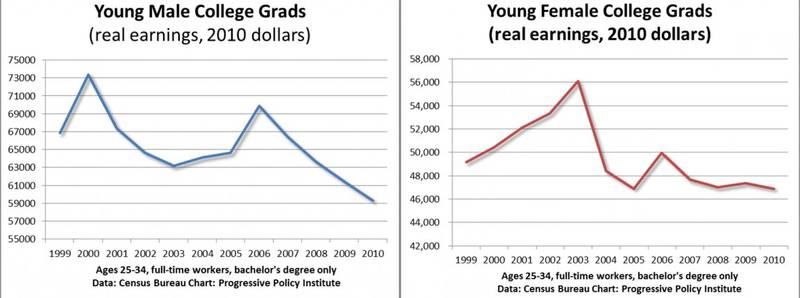
According to analysis from economist Michael Mandel, the average wages of US college grads have experienced sharp declines in the last decade. On the other hand, college keeps getting more expensive, and the collection of student loans has become much more aggressive. Sounds like a recipe for disaster…
With the government’s explicit guarantee of mortgages a bailout appears to be inevitable for the Federal Housing Authority. This should not be surprising news to anyone who follows the mortgage market closely, but a new study by Wharton finance professor Joseph Gyourko makes this conclusion clearer. As a bailout for the FHA looms, Congress will likely become enraged again — on behalf of the taxpayers they represent. What impact would an FHA bailout have on the housing finance policy debate?

 Construction has been hit the hardest.