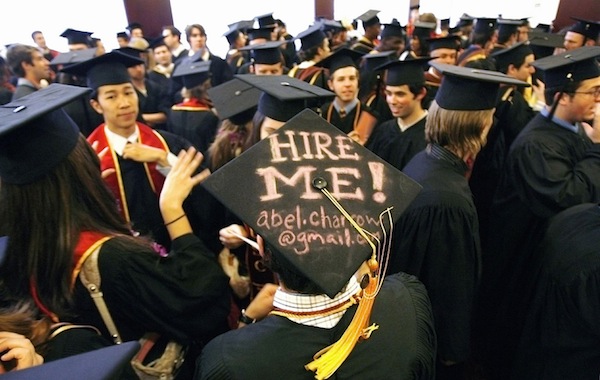
One of the world’s oldest, largest, and best business schools is the Wharton School of the University of Pennsylvania. They have 11 academic departments, 20 research centers, 230 standing faculty, and an endowment nearing $1 billion. With all those resource, it has produced 92,000 living alumni.
If kids are learning math, they should also learn logic.
These days learn-to-code startups abound. There is one in particular that is focusing on the very young and is having some success in elementary schoolsaround the country — even under served schools with no budgets for STEM but a great need for better tools.
The online education movement is transforming physical colleges at a fast pace.
The California State University system is the largest university system in America and they are aggressively expanding its experimental foray into Massive Online Open Learning (MOOCs), based on an unusually promising pilot course. They will offer a special “flipped” version of an electrical engineering course at 11 more universities, where students watch online lectures from Harvard and MIT at home, while class time is devoted to hands-on problem solving. A San Jose State University pilot found that the flipped class increased pass rates a whopping 46%, which university President Mohammad Qayoumi believes is enough to move full-steam ahead.
CodeSpells is an immersive, first-person player video game designed to teach students in elementary to high school how to program in the popular Java language. CodeSpells has been developed by University of California, San Diego computer scientists.
Futurist Thomas Frey: A couple years ago I was on a weekend outing in Vail, Colorado and ended up attending a kayaking tournament taking place on the Gore Creek in the heart of town.
The actual number of professors who discount the quality of MOOCs is probably much higher than 72%.
Seventy-two percent of professors who have taught Massive Open Online Courses (MOOCs) don’t believe that students should get official college credit, even if they did well in the class. More importantly, these are the professors who voluntarily took time to teach online courses, which means the actual number of professors who discount the quality of MOOCs is probably much higher. The survey reveals the Grand Canyon-size gap between the higher-education establishment and the coalition of tech companies and lawmakers that are mandating college credit for online courses.
Entrepreneurs can hop online and hone their expertise for free.
Education for entrepreneurs is slowly but surely becoming more mainstream. Traditional universities are offering entrepreneurs more tools than ever before. But Coursera and Udacity, education startups, have taken this a step further. They are offering in-depth classes on entrepreneurship taught by industry heavy-weights such as Silicon Valley serial entrepreneur Steve Blank for free.
MOOCs: Internet-based teaching programs are designed to handle thousands of students simultaneously.
Engineering, science, and technology have at the forefront of the massive open online course movement. These classes also are providing fodder for scientific research on learning.
The question of whether college is “worth it” continues to be hot.
Last week, the national unemployment rate fell from 7.9 percent to 7.7 percent after a strong Non-Farm Payrolls report. But the unemployment rate differs greatly for people with different levels of education.
The majority of high-achieving kids from low-income backgrounds fail to apply to any selective colleges.
Middle-class American high-school seniors with good grades go through a familiar ritual of the college application process each year. The seniors file a bunch of applications. They submit test scores, grades, essays, and letters of recommendation. They apply to a “reach” school or two and a “safety” school or two along with some in the middle. The idea is to see where you can get in and then decide where you want to go after researching both the quality of the schools on offer and the actual financial cost of attending. This system is a bit stressful and annoying, but basically it works. Students get matched with schools that roughly suit their level of academic preparation and people have a chance to shop around a bit for the myriad forms of financial aid that make college attendance feasible.
Technology will make education even more accessible and more reliable than it has today.
Kevin Kelly told the audience at the 2007 EG Conference for youth and young adults that 10 years ago no one would have believed the Internet was coming, least of all him.